

…“The realisation of generations of Guyanese” – AG
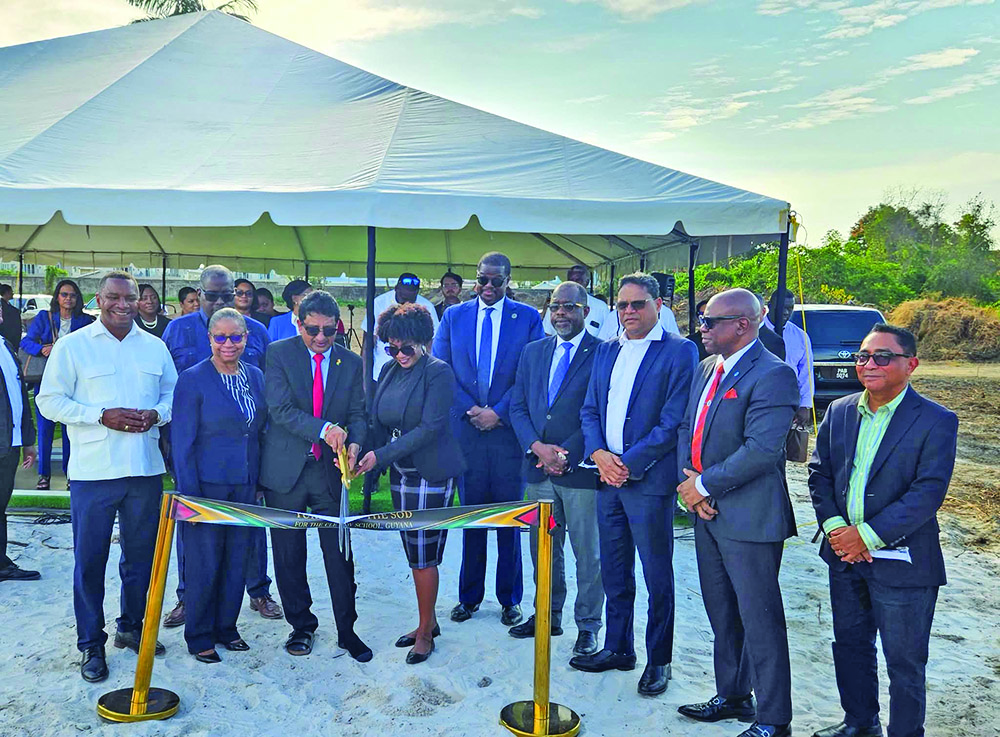
The sod has officially been turned on about eight acres of land at the Turkeyen Campus of the University of Guyana (UG) for the establishment of the fourth law school under the auspices of the Council of Legal Education (CLE) in the Caribbean.
The idea of establishing a law school in Guyana under the CLE dates back to 1996, when it was first proposed at a meeting of the Council by the then Attorney General (AG) of Guyana.
The proposal was born out of difficulties encountered by Guyanese students graduating from UG, who faced challenges securing admission to the Hugh Wooding Law School in Trinidad and Tobago.
At the time, an arrangement that had existed for more than three decades guaranteed 25 students’ automatic entry to the law school.
However, Guyanese students were required to meet the relevant admission criteria, which had historically presented challenges for many, partly because of the economic costs associated with pursuing legal education abroad.
Speaking at the sod-turning ceremony, AG Anil Nandlall pointed out that the institution will serve not only Guyana but also the wider region.
“History will record us here today because this law school will be here for a very, very long time. It is the realisation of the aspirations of generations of Guyanese. Many students, dozens if not hundreds of students, are out there listening to us and waiting for this initiative to become a reality. Significantly, the establishment of this law school is part of the Government’s vision of making Guyana one of the centres of learning in the Caribbean. And right here, if you look, it’s eight acres of land.”
CCJ Academy of Law
Nandlall further disclosed that the Government intends to work with the Caribbean Court of Justice (CCJ) to establish a home for the CCJ Academy of Law on the same grounds.
“It’s quite a big piece of land, and right here, we will work with the Caribbean Court of Justice to establish a home here on these grounds for the CCJ Academy of Law. And we hope that judicial training, legal education, and professional continuing legal education will be done from this facility. Again, not for Guyanese alone, but for the entire region.”
The AG also stressed the need for the CLE to modernise its frameworks, infrastructure and methods of delivering legal education in response to changes in the Caribbean and globally.
“In 2021, we celebrated the 50th anniversary of the Council. No doubt, the Council of Legal Education has served with distinction its conceptual role and purpose of administering and delivering quality legal education to the Caribbean. But 50 years hence, and now we are beyond 50 years hence, the world has dramatically changed. The Caribbean has dramatically changed. Legal education, as we know it, has changed. Technology has revolutionised the world.”
Next 50 years
Nandlall said the Council must therefore prepare for the next 50 years by moving away from its traditional approaches to legal education.
“So, I believe the Council recognised that, going forward for the next 50 years, it cannot continue with the same framework, the same infrastructure, the same method of delivery of education, or the same system of administering legal education in the region. We have to prepare for the next 50 years over the last 50 years.”
Nandlall stressed that the establishment of the law school was not granted without conditions, noting that strict criteria had to be met before the initiative could move forward.
A feasibility study was required to demonstrate that the law school would be economically viable, not only during its first and second years but also as a long-term venture. He said careful consideration was also given during negotiations to ensure that the institution would not be viewed as an insular Guyanese school.
Instead, the institution will be located in Guyana but serve as a regional law school, catering to people across the Caribbean and operating under the regional council responsible for legal education.
Nandlall explained that Guyana therefore had to satisfy the Council of Legal Education that establishing the institution locally would make economic and financial sense, while also taking into consideration the current demand for legal education.
Nandlall said Guyanese law students historically faced financial and admission challenges to regional law schools.
He said it was against this backdrop that the President of Guyana was compelled to raise the issue with CARICOM Heads of Government. A decision was subsequently taken at the Heads of Government level and brought before the CLE.
Over the last three years, the current administration has been working to get permission from the CLE to establish a much-needed law school here. The CLE is a regional organisation which operates the Hugh Wooding Law School in the Republic of Trinidad & Tobago, the Norman Manley Law School in Jamaica, and the Eugene Dupuch Law School in the Bahamas.
Under the A Partnership for National Unity/Alliance for Change (APNU/AFC) Coalition Administration, attempts were made to establish the Joseph Oscar Fitzclarence Haynes Law School. However, the CLE was not approached about the project initially, and when permission was eventually sought after the fact, it was denied in late 2017.
However, the PPP/C Government had previously declared that any law school that is established in Guyana will be done under the ambit of the CLE – something that will also allow the country to capitalise on the overcrowding at the other institutions across the region.
Discover more from Guyana Times
Subscribe to get the latest posts sent to your email.