

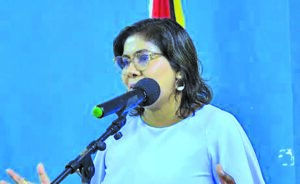
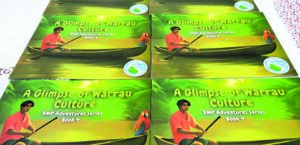
A new cultural doorway has been opened for Guyana’s children as the Guyana Marine Conservation Society (GMCS) in collaboration with its partners, launched the Warrau Booklet “A Glimpse of Warrau Culture”, giving fresh insight into the heritage of the Warrau people while strengthening ties between tradition and modern education in Guyana. This has been made possible following a collaboration between the Education Ministry and the GMCS. This is the fourth booklet in a series produced under the Education and Awareness Project on the Barima-Mora Passage. The booklet, which targets primary and secondary school students, is supported by SBM Offshore Guyana and aims to promote, increase, and encourage the sustainable use and management of the Barima-Mora Passage in Region One. It provides a window through which younger generations and future scholars may look, learn, and come to know, appreciate, and celebrate the heritage of the Warrau people. Speaking at the launching ceremony on Monday, Director of National Centre of Educational Resources Development (NCERD), Omwattie Ramdin, noted that the booklet is designed to showcase the richness of Warrau culture. “Unless we read somewhere, perhaps an old outdated booklet, we would not know of the Warrau people. And so, for me, this is huge, because a lot of our cultural identity gets lost in the daily mundane talks of society. Sometimes, the exciting things are the things that we give life to, and they take precedence over the important things. That is the importance of launching this booklet,” she emphasised.
In the pages of this beautifully written book, readers will find reflections of language, ritual legends, agricultural practices, craftsmanship, and the spiritual world—the warp and weft of Warrau cultural expressions. You will read myths, like the origin of the Sky People, a story that speaks of people, spirits, and the night sky.
“It is a bridge between Warrau communities and the broader Guyanese society, a tool for education, recognition, and respect. May this work be taken into classrooms. May the launch be only the beginning. Very often, we launch something, but it is not sustained. While a launch is important, it is even more important for our children to be using the book, and for it not to become another resource that gets stuck on a shelf acquiring dust.”
She urged that the lessons of the booklet should not remain only on its pages.
In fact, she called for field trips, encouraging children to step outside the classroom, live the stories, and make real the knowledge passed down through the book.
“So, I am happy to say the Ministry of Education is pleased to partner with the organisation to have this book in the hands of our children, to be reading and hearing stories. I challenge us: don’t let this be the end. Don’t just launch the book, print it, and give it to the children—encourage, through the Environmental Club and short field trips, to bring this book to life.” Meanwhile she stressed that it cannot only be a book that is being read for reading’s sake.
“Bring the book to life; make it actionable. That is when we will really see the fruits of this beautiful book. So, I thank you all for the opportunity. I am happy we’re partnering on this. We will be checking for the book and encouraging its use through our literacy programme, which is now being implemented full scale.”
Meanwhile, Martin Cheong, Country Manager of SBM Offshore Guyana, explained that this initiative is more than cultural preservation—it is an investment in the nation’s future leaders. “Through this booklet, children will see themselves reflected in its pages while also learning the importance of caring for the forest, for who they are, and for their country. We are investing in these lessons to guide them in how to care for one another and the environment.”
Discover more from Guyana Times
Subscribe to get the latest posts sent to your email.