

…says Govt investments already contributing to cleaner communities
…school programme to promote proper waste management among youths
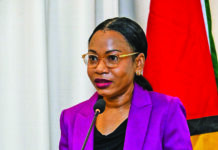
As work continues on the development of a National Solid Waste Management Plan, Local Government and Regional Development Minister Priya Manickchand has pointed to investments made by the Government, noting that these are already contributing to cleaner communities across Guyana.
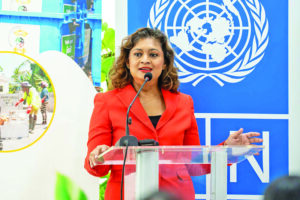
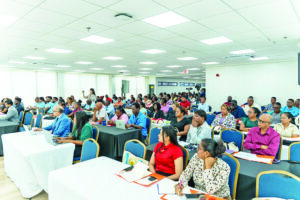
She made the remarks on Wednesday at a workshop hosted by the ministry for the validation of Guyana’s draft National Solid Waste Management Strategy and Action Plan. The workshop brought together key stakeholders to review and validate the draft strategy, which seeks to strengthen the regulatory, institutional and operational frameworks for solid waste management across Guyana.
Manickchand highlighted that even without a national plan in place, the Government has been making investments to contribute to a cleaner country.
These include the distribution of compactor trucks to Neighbourhood Democratic Councils (NDCs) and Municipalities, including putting systems in place for central Government to cover expenses associated with their maintenance and operations, such as paying for fuel and drivers.
She also highlighted plans to develop eight new landfill sites across the country. The Local Government Minister also mentioned the launch of the Georgetown Solid Waste Management Plan, which will better govern how garbage is disposed of in the capital city.
“I invite you to look at your city. Look at your city; it’s a city that is getting cleaner. Is there still garbage in some pile somewhere? Yeah, but we’re fixing it, but it’s a city that is getting cleaner,” the Minister remarked.
“Look at your NDCs, the ones that function, because there are some that don’t – so much infighting, so much everything else than what they’re supposed to do, and we have to fix that – but if you look at the ones that are functioning, this plan is beginning to take shape,” she added.
School Programme
Key to the creating a clean country, the Minister emphasised, is educating the next generation. In this regard, she revealed that with support from the United Nations Development Programme (UNDP), a programme will be rolled out in schools to help educate youths on proper solid waste management.
According to an advertisement published last month, the objective of the initiative is to strengthen awareness, knowledge and practical action on solid waste management among secondary schools and tertiary or technical and vocation education and training (TVET) institutions in Guyana. The goal is to reach at least 2000 students and young people as well as support at least 10 student-led waste-action pilots.
According to Manickchand, in order for the national plan, once finalised, to work, every person residing in the country will have a role to play.
“Here’s the thing about management of solid waste: it cannot be done by one sector, it cannot be done by a department in a sector, it has to be done through the partnership of Government, Private Sector, every individual in a country, or international partners…every neighbourhood democratic council, every municipality, every household, every individual,” she expressed.
National Plan
Meanwhile, in underscoring the importance of developing this national plan, the Minister explained that it must be a data-driven and carefully costed strategy, with clear deliverables.
“It’s not a scatterbrain operation…we have to have data in each NDC, in each village, in each town: how much [solid waste] are we producing, how much do we need to cater for…what kinds of possibilities do we have for recycling, what kinds of possibilities do we have for something like composting? How do we match that with our president’s plan to make this the food capital of the Caribbean? How do we use our solid waste to make sure that we have fertiliser for our agricultural beds and produce…so it has to be a plan that is thought-out, that has deliverables, that has a cost, that tells everybody where we want to go,” she outlined.
“Once we have that plan, we will chase it down to deliver to this country a new Guyana, a different Guyana, as far as our management of solid waste,” the Minister added.
The five-year plan is being developed with strategic and technical support from the UNDP and is financed through the Partnership for Action on Green Economy (PAGE).
UNDP is supporting the Government of Guyana by providing technical expertise and global knowledge to guide the development of an evidence-based and participatory strategic plan. This includes a comprehensive assessment of current waste management systems, a review of regulatory and institutional frameworks, and structured stakeholder consultations to inform priorities, investments and practical solutions. The process is designed to improve coordination across institutions, enhance planning, and guide action on waste prevention, separation, collection, recycling, treatment and safe disposal.
Through financing from PAGE, the initiative also connects solid waste management to a broader green economy agenda. This creates opportunities for Guyana to move beyond traditional approaches and advance more circular systems that prioritise resource efficiency, recycling, recovery and sustainable consumption. In doing so, the Strategic Plan is expected to contribute to environmental sustainability while opening pathways for innovation, investment and green economic opportunities.
Once developed, the National Solid Waste Management Strategic Plan will guide Guyana’s efforts to modernise waste management systems, reduce environmental and public health risks, and improve service delivery across communities. It will also provide a clearer framework for investment, institutional roles and long-term planning, supporting a transition toward more integrated and sustainable waste management nationwide.
Legislation
Alongside this plan, the ministry is also developing an Integrated Solid Waste Management Bill, which will soon be presented to the National Assembly.
The proposed legislation introduces a modern legal and regulatory framework aimed at improving how waste is collected, transported, treated, recycled, and disposed of across Guyana. Key provisions include a graduated enforcement regime, which prioritises compliance through notices and corrective orders, while allowing for significant penalties, including fines and imprisonment, in cases of persistent or serious violations.
It will also promote waste reduction, segregation, recycling, and resource recovery, in keeping with international best practices and circular economy principles, while prioritising public health and environmental sustainability.
Discover more from Guyana Times
Subscribe to get the latest posts sent to your email.