
Half of the Guyana Defence Force’s (GDF) aviation fleet was mobilised during the response to the distress alert involving the MV Barima, with six aircraft deployed between July 19 and 31, 2026, the Commission of Inquiry (CoI) heard on Friday.
Testifying before the Commission, GDF Air Corps Flight Operations Officer Captain Simon Gordon revealed that the Bell 407 was the only helicopter available for deployment on July 19.

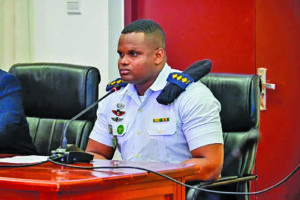
He said the aircraft was used to transport drone operators to Hampton Court before carrying out coastal reconnaissance.
Gordon explained that aircraft deployment depended on confirming the distress alert, determining the reported location and assessing the available resources and crew.
“So once we get a distress, first we need to confirm as much as possible, essentially, that it’s not a spoof, an inaccurate reading or a signal triggered before we deploy the resources. Once that is established, then, based on where it is, we need to determine which aircraft can go there and, based on the time of day or night, which crew can go there,” he testified.
He outlined the composition of the Air Corps fleet, which included two SC7 Skyvan transport aircraft, two Hindustan 228 aircraft, one Tecnam light utility transport aircraft, one BN Islander light utility transport aircraft, one Beechcraft King Air 350, one Cessna 208 Grand Caravan and three helicopters: the Bell 412, Bell 407, and Bell 429.
Of the nine aircraft, six were deployed in the search-and-rescue mission.
Gordon detailed the chronological sequence of events for the mission on July 19, 2026, beginning with a WhatsApp briefing at 00:40h.
At 01:00h, the crew reported to the Eugene F Correia International Airport, and by 01:30h, the Bell 407 had been fuelled and was ready for deployment. At 01:45h, a drone team was dispatched to Hampton Court, followed by the deployment of specialised equipment by the Intelligence Corps at 01:55h. Between 02:00h and 03:00h, the aircraft departed for Hampton Court, while the BN Islander departed on a reconnaissance operation at 02:59h.
He explained that aircraft selection depended on the reported location of the distress, the time of the operation and the resources required.
His responsibilities included coordinating flight times, passengers and cargo, while aircraft preparation was handled by the Flight Operations Department.
Gordon further stated that it took approximately one hour to prepare for departure and outlined the information that had to be confirmed before undertaking the operation.
“I would say it would have taken me approximately an hour, an hour and a half. This is the confirming information, as well as the mobilisation and centralisation of the crew,” he testified.
When asked what information he needed to confirm the actual location of the distress, Gordon said it was necessary to establish the precise location, identify the closest landing point for fixed-wing aircraft, determine what services were available there and verify whether the landing point was secure and usable at the time.
French military personnel
Gordon also testified that the GDF Air Corps transported French military personnel and specialised equipment as part of the response. He noted that the Bell 429 was deployed on July 27, while a discrepancy between two recorded landing times was raised during the proceedings. He undertook to verify the conflicting times.
Meanwhile, Lieutenant Colonel Kevin Langevine told the Commission that he conducted three coastal reconnaissance missions aboard a Bell 407 on July 22, 24 and 25 to search for survivors and bodies.
He said the helicopter flew approximately 20 to 40 feet above the shoreline, but no survivors or bodies were spotted during the missions.
Langevine also explained that he initially documented flight timings in a personal notebook before transferring the information to the official records.
Arrival of survivors & recovered bodies
During the afternoon session, Midshipman Rahul Ramsarup, who was the officer commanding the Coast Guard Floating Base at Pomeroon at the time, testified about the initial response and the arrival of survivors and recovered bodies at the base.
The Commission heard that between July 19 and 22, 2026, a total of 69 survivors and 71 bodies were recovered following the MV Barima tragedy.
The testimonies are part of the Commission’s examination of aviation resource deployment, aerial search operations and the coordination of the response to the MV Barima tragedy.
The Commission’s final report is expected to be released within six months.
On July 18, the MV Barima departed the Georgetown stinging at about 15:00h on its scheduled voyage to Port Kaituma, North West District, carrying 179 persons, including 18 crew members, as well as cargo.
Following the rescue mission, 76 persons survived, 73 bodies were recovered, and at least 30 others are still missing.
According to officials, the vessel encountered rough sea conditions off the Essequibo Coast, near the mouth of the Pomeroon River, late that night and capsized.
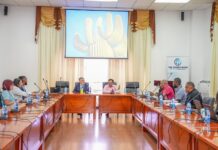
The CoI into the MV Barima tragedy continues at the Arthur Chung Conference Centre (ACCC), Greater Georgetown.
Justice Godfrey Phillip Smith is chairing the inquiry alongside Commissioners Alfonso, Pritchard, Captain Hamada Fouda, and Dr Andrzej Jasionowski. They are supported by counsel and attorneys Teni Housty and Arudhanath Gossai.
Discover more from Guyana Times
Subscribe to get the latest posts sent to your email.