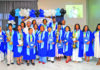


– as GPA President urges use of AI to strengthen democracy & protect people’s rights
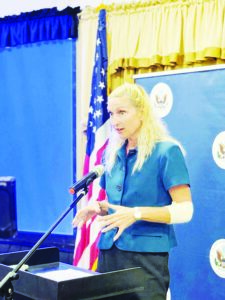
US Ambassador to Guyana, Nicole Theriot, on Saturday urged local Journalists and media representatives to embrace ethical artificial intelligence (AI) practices and leverage technology responsibly to strengthen democracy during the opening ceremony of a two-day hybrid workshop hosted by the United States Embassy in collaboration with the Guyana Press Association (GPA).
The workshop, titled “AI and Democracy: Promoting Ethical Technology Governance and Media Literacy in Guyana”, was held at the Herdmanston Lodge and brought together media practitioners from across the country.
During the opening ceremony, Theriot called on Journalists to be responsible. “Think about how you can apply what you’ve learned and consider how to become a champion for ethical AI use. The future of AI in Guyana is bright, and the United States is proud to support you in that journey,” Theriot said.
In addition, GPA President Iva Wharton highlighted the dual opportunities and challenges that AI presents. “More than 20 years ago, as an Information Technology teacher, we would discuss AI as something of the future; today we are living that future. AI comes with both opportunities and challenges. This workshop offers a unique space to learn how AI intersects with democracy, governance, and ethical technology use. I ask participants to ask questions and ensure we understand how we can use AI to strengthen democracy and protect the rights of our people,” Wharton said.
She emphasised that media professionals must use AI responsibly not only for personal productivity but also to train others and empower citizens through accurate information.
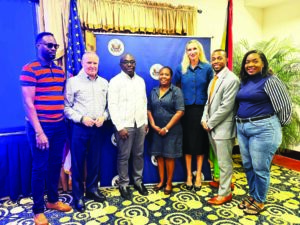
Further, Minister within the Office of the Prime Minister, Kwame McKoy, stressed the need for fact-checking and careful adoption of AI.
“It is important for Journalists to always keep in mind the importance of fact-checking and the importance of utilising the technology while ensuring that you have a system, a mechanism that would prevent us from going in the direction of creating harm and danger for our society. I therefore commend the US Embassy for yet another genuinely committed effort to provide training opportunities to our Journalists here in Guyana,” McKoy said.
The workshop was facilitated by former CNN Managing Editor and Senior Global Media Consultant with Frank N Magid and Associates, James LeMay, who guided participants through practical applications, ethical considerations, and newsroom policies related to AI.
The workshop covered a wide range of AI-related topics, including disinformation, generative AI, natural language processing, data mining, and pattern recognition.
LeMay provided practical guidance for newsroom use, highlighting AI’s potential to assist with research, transcription, drafting, multimedia production, translation, and cross-referencing sources. He cautioned, however, that AI is a tool, not a replacement for Journalists.
“Reporters remain one of the most valuable roles in journalism. AI can assist with speed, scale, and analysis, but humans must decide the story, confirm facts, and ensure ethical reporting,” LeMay said.
He outlined the “Three Pillars” of responsible AI use: transparency, human supervision, and human verification. As such, he encouraged newsrooms to develop clear AI policies detailing approved tasks, red lines, and standard disclosure practices for transparency. Practical demonstrations included using AI to turn interviews into accurate transcriptions, analyse large data sets, and identify trends in public records, budgets, and contracts.
The Caribbean approach to AI ethics was also emphasised, advocating for skill-building, fairness, and regional collaboration.
LeMay underscored the importance of disclosing AI use responsibly to maintain trust with audiences. “Transparency works best when it explains what AI did, confirms human oversight, and reaffirms accuracy standards.”
Journalists were also trained to detect disinformation and AI-generated content, including deepfakes and softfakes, using tools such as Deepware Scanner, InVID, and Google Fact Check Explorer.
LeMay stressed that human verification remains essential. Participants were urged to adopt a “Detect, Verify, Educate – Together” approach, combining technology with collaboration to strengthen media integrity.
The training reinforced the message that AI, when used ethically and transparently, can amplify journalism’s reach and empower citizens with accurate, timely information.
Discover more from Guyana Times
Subscribe to get the latest posts sent to your email.