

…says Venezuela must refrain from trespassing, threatening Guyana’s sovereignty
Attorney General Anil Nandlall, SC on Monday emphasized Guyana’s position that it will abide by the International Court of Justice’s ruling in the Guyana Venezuela border controversy and said he hopes that Venezuela stops further actions of aggression and follow suit.
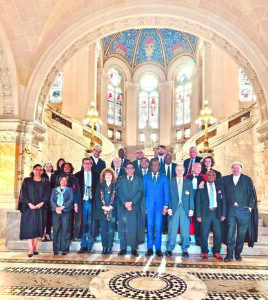
“We hope, that after the passions recede, and responsible government officials reflect, they will conclude, as we have done, that both States are best served by an end to this longstanding conflict, and that the only way to secure a just and lasting peace, and an enduring friendship, is by respect for and compliance with, the Court’s final Judgment, whatever it may be,” Nandlall read from a statement as he was flacked by Guyana’s delegation at the Hague, Netherlands, following the end of the oral arguments.
Guyana has consistently pledged to abide by the Court’s ruling and this was repeated by Nandlall. “Guyana has pledged repeatedly, including at these oral hearings that it will abide by the Court’s Judgment whatever it may be,” he affirmed.
He said that the case reaching the International Court of Justice, along with the completion of both the written and oral phases of the proceedings, marks a triumph for the rule of law and the rules-based international order.
“Must never be resolved by threat”
The attorney general emphasised that disputes between states “must not be allowed to fester indefinitely” and “must never be resolved by threat or use of military force.”
He added that after the hearings, Guyana is “more confident than ever” that the Court will uphold the validity of the 1899 Arbitral Award, which established the boundary between then British Guiana and Venezuela.
Expressing commendation to this country’s legal team which included renowned advocates such as Paul Reichler of the United States, Professor Philippe Sands of the United Kingdom, and Professor Alain Pellet of France, the Attorney General said that “Guyana is very proud of the presentations it made in these hearings… It believes that its arguments were compelling and convincing, and that they showed the lack of merit in Venezuela’s arguments both on the facts and on the law.”
Guyana’s delegation was led by Foreign Affairs Minister, Hugh Todd and his predecessor Carl Greenidge, serving as Agent. Venezuela’s delegation was headed by acting President Delcy Rodríguez Gómez and Ambassador Samuel Reinaldo Moncada Acosta, Permanent Representative to the United Nations.
The controversy dates back to 1962, when Venezuela challenged the lawfulness of the 1899 Arbitral Award after having accepted it for more than six decades. “The oral hearings established that Venezuela made this very belated protest precisely at the time Guyana was nearing its independence, British troops would be departing, and Venezuela would have a significant military advantage with which to press its antiquated claim to nearly three‑quarters of Guyana’s territory,” Nandlall explained.
In 1966, before Guyana’s independence, Britain negotiated the Geneva Agreement with Venezuela that agreement provided for four years of bilateral discussions, which proved unsuccessful.
It empowered the UN Secretary‑General to choose the means of settlement. After decades without resolution, Secretary‑General António Guterres decided in January 2018 that the ICJ should adjudicate the matter. His decision was binding on both parties.
Following the unsuccessful four-decade-long Good Officers process, Guyana initiated legal proceedings in March 2018.
Venezuela challenged the Court’s jurisdiction, but in December 2020, the ICJ ruled that it had jurisdiction to determine the validity of the 1899 Award and the boundary. The case then moved to the merits phase, culminating in the hearings that concluded on Monday.
Venezuela reiterated rejection
During the hearings, Venezuela reiterated its rejection of the ICJ’s jurisdiction for which Nandlall noted, “We have heard the statements of Venezuela’s representatives at these hearings, including today [Monday], that they do not accept the ICJ’s jurisdiction and will not abide by its rulings. This would be a breach of its most solemn obligations under the United Nations Charter, the Charter of the Organization of American States, and general international law.”
He warned that the international community would not allow Venezuela “to defy the most fundamental rules of international law, which demand a world order based on the rule of law.”
The ICJ on Monday confirmed that the Court will now deliberate and announce its decision at a public sitting, with the date to be announced later.
Nandlall stressed that Guyana will await the judgment “with patience, decorum, dignity and optimism.” He added: “We will continue to address Venezuela in a spirit of peace, cooperation and friendship, and as sovereign equals. We will respect Venezuela’s sovereignty, as we have always done, and insist that Venezuela refrain from trespassing on, or threatening, Guyana’s sovereignty.”
The ICJ’s forthcoming judgment will be historic as it will determine whether the 1899 Arbitral Award remains valid and binding, and whether the boundary it established is final.
For this country the stakes, as the Minister of Foreign Affairs said last week, are “existential”, given that Venezuela’s claim covers nearly three‑quarters of this territory, including resource‑rich regions.
On the Western Spanish speaking neighbour’s side, the case represents a decades‑long effort to contest a boundary it once accepted and sought to deflect on only when this country’s independence was nearing.
The outcome, according to Nandlall, will not only settle a bilateral dispute but also reaffirm the authority of international law in resolving conflicts. “No doubt, that rules‑based order is being tested now. Therefore, it is more important than ever, that it be preserved and strengthened.”
Discover more from Guyana Times
Subscribe to get the latest posts sent to your email.