


– highlights Guyana’s approach to tackling hunger
Finance Minister Dr Ashni Singh reinforced the need for integrated and coordinated action across agrifood systems and sustained investment to build and strengthen resilience, as these are required to make healthy diets more affordable and accessible to all.
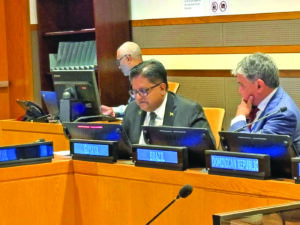
He was at the time delivering remarks on Tuesday during a High-Level Ministerial Dialogue at the United Nations Headquarters in New York under the theme “From Leaving the Hunger Map to Sustaining Progress in Latin America and the Caribbean”.
Dr Singh, during his address, highlighted the measures that have been implemented by the Government of Guyana, which has allowed the country to be recognised as one of the countries from Latin America and the Caribbean that has successfully reduced the prevalence of hunger and undernourishment to below 2.5 per cent, with Guyana noted for being “capable of self-sufficiently feeding its entire population across all seven essential food groups without foreign imports.”
He noted, however, that despite this, Guyana has still not escaped the impacts of severe weather and geopolitical disruptions.
“Guyana is proud to be one of those countries, and we congratulate all of the other countries in Latin America and the Caribbean – Brazil, Chile, and the Dominican Republic – who have achieved this major milestone,” he said, but noted that “as we heard earlier, despite some reduction in food insecurity across the globe, progress remains uneven and vulnerable to multiple shocks. An estimated 520 million people could still face hunger in 2030, rendering us off track in achieving the SDG 2 target of zero hunger,” Dr Singh explained.
He added,”Stark as they might appear, these projections may in fact understate the magnitude of the problem, given the potential impact of the currently ongoing El Niño conditions and disruptions to agrifood systems resulting from geopolitical tensions. Wheat prices, for example, have surged in recent weeks to levels not seen in years, growing 2.6 per cent in August and now 15 per cent above a year ago, while fertiliser has also seen record growth, with average urea prices over the first eight months running 31.3 per cent above the same period last year.”
The Minister also pointed to the price of diesel, which he noted “is a critical input to agricultural production” and which “is also currently trading at historically high prices, more than 60 per cent higher than a year ago. These and other similar developments do not augur well for the global food security outlook in the near term.” It was here that the Minister urged the need for integrated and coordinated action across agrifood systems and sustained investment to build and strengthen resilience.
Further, he zeroed in on the measures taken by Guyana thus far as a comprehensive approach to address the structural factors affecting access to healthy diets through the increase of supply via domestic production and trade and prioritising food affordability and nutrition, particularly for children.
“Some of our measures include significant investments in growing and diversifying agriculture, expanding both production and exports, reducing production costs, and promoting economies of scale, including through investments in transport infrastructure to open more arable land and improve farm-to-market connectivity, as well as a regional food hub with cold storage capability to facilitate trade.”
Dr Singh added that the Government has also been promoting the use of more data-driven, scientific, climate-resilient methods in agriculture, including hydroponic and shade house technology; incentivising private investment in agriculture and crowding in private capital to agribusiness, including by removing corporate taxes on income earned by companies from agricultural activity; rolling out farmers’ markets nationwide as part of a broader effort to reduce inefficiency and improve competitiveness in the market for food items and ease food price pressures; continuing Guyana’s National School Feeding Programme that supplies fortified daily hot meals to combat short-term hunger and reduce stunting and wasting; and implementing a Comprehensive Child and Youth Health Programme and School Screening that is proactive and preventative, providing health screenings for nursery, primary, and secondary school children.
He also highlighted the creation of new jobs in the country, as he referenced the 156,000 new jobs created in the past five years, as broadly, the Government has been ensuring broad-based, job-intensive economic growth in order to improve livelihoods, increase disposable incomes, and raise household ability to meet basic nutritional necessities.
“These and other measures have helped to keep the incidence of hunger, undernourishment, and child malnutrition low over the last five years,” Dr Singh posited.
Meanwhile, he stated that looking ahead, even as Guyana navigates volatile commodity prices, supply chain disruptions, imported inflation, and El Niño conditions, the country remains resolute with President Irfaan Ali’s leadership in continuing to spearhead the CARICOM “25 x 2025 + 5” Initiative and in the pursuit of strengthening regional food security through increasing agricultural output and by ensuring more efficient intra-regional trade in agricultural output and food products, thereby reducing the region’s food import bill and improving the region’s food security outcomes in a lasting manner.
Discover more from Guyana Times
Subscribe to get the latest posts sent to your email.