

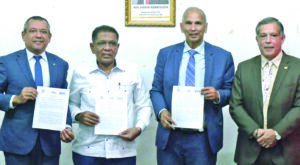
Brazil’s Deputy Minister of Agriculture and Livestock, Cleber Soares, joined Guyana’s Agriculture Minister, Zulfikar Mustapha; IICA Director General Muhammad Ibrahim; and Inter-American Institute for Cooperation on Agriculture (IICA) Guyana Representative Wilmott Garnett on Monday to sign a Letter of Intent launching the Brazilian Agricultural Research Corporation (EMBRAPA)’s Science, Technology and Innovation Hub in Guyana and establishing the Regional Hub for Innovation and Sustainable Agriculture in Georgetown.
The hub is envisioned as a centre of excellence for innovation, technology transfer, and agricultural training, aimed at making tangible contributions to increasing the productivity and resilience of regional agrifood systems.
It will provide researchers and farmers with easier access to climate-smart planting materials, improved seed varieties, and innovative agricultural technologies.
The initiative makes agriculture smarter and more innovative, placing farmers at the centre of knowledge and technology transfer by providing access to information and practices that have been tested and proven in other settings.
Speaking at the launch, Director General of the IICA, Muhammad Ibrahim, championed the establishment of the hub.
“We are in a tropical region, a tropicalised region in which climate change is a threat, with rising temperatures, increased stress, heat, and changes in water distribution. EMBRAPA has laboratories and tools that are very advanced, and it has developed methodologies that are very applicable. EMBRAPA can make the poorest soil produce large quantities of soybeans as well as corn in a low-input mixed-system approach.
He also noted that while there has been significant advancement in innovation and technology, discussions with other officials have focused on facilitating opportunities for young scientists from Guyana and the Caribbean region to receive training at EMBRAPA. He added that the initiative also aims to support the adoption of these technologies within the region, enabling complementary practices to be scaled up effectively. He further emphasised the need to explore blended finance mechanisms to assist farmers in overcoming existing challenges.
Guyana continues to champion the agricultural agenda within the Caribbean region, driving efforts toward sustainable food security targets. Ibrahim highlighted consistent dedication to the nations’ and region’s farmers, with responsibility for overseeing the country’s rapid agricultural expansion programme and spearheading CARICOM’s 25 by 2025 Plus Five food security agenda.
Transcend borders
Meanwhile, Agriculture Minister Zulfikar Mustapha noted that the hub allows Guyana’s agriculture sector to transcend borders and strengthen key areas, including regional research networks and collaborative partnerships.
“Hosting this hub is a natural extension of that leadership. Our institutions, such as the National Agricultural Research and Extension Institute (NAREI) and the Caribbean Agricultural Research and Development Institute (CARDI), are ready to collaborate as we seek to validate technologies for tropical crops and livestock, strengthen climate-smart agriculture, improve natural resources management, enhance regional research networks, and build a pipeline of innovations ready for scaling across CARICOM.”
Whilst speaking, he underlined that the Private Sector will also be a key beneficiary and partner in this initiative, stating that the technologies validated through the Hub will enable agribusiness expansion, improve productivity, and unlock new investment opportunities across the region.”
Looking ahead, he outlined plans for Brazilian and Guyanese technical teams to begin preparatory arrangements during the second half of this year. He also underscored the importance of the hub to Guyana and its partners, particularly in advancing climate resilience and sustainable agricultural development.
“In the coming months, technical teams from the Ministry of Agriculture of Guyana and Brazil, EMBRAPA, and IICA will finalise the institutional, operational, and financial arrangements required to commence operations in the second half of this year. [this hub] It will ensure that our farmers have access to the technologies, knowledge, and innovations they need to thrive in a changing climate. Many of you are being affected by climate change; not only as farmers, but even people living in the city are experiencing its impacts. This system will enable us to build regional scientific capacity so that Caribbean countries can generate, adapt, and scale solutions suited to our own tropical realities.”
He added that the initiative traces its roots to agreements reached during Brazilian President Luiz Inácio Lula da Silva’s visit to Guyana, when both countries signed an MoU aimed at expanding cooperation in science, innovation, and technology. He noted that the hub represents the fulfilment of that commitment and is expected to serve Guyana and the wider Caribbean.
Discover more from Guyana Times
Subscribe to get the latest posts sent to your email.