– Mustapha reiterates calls for stronger regional collaboration, removal of trade barriers across C’bean
The Guyanese Government has offered scholarships to Belizean agriculture students to pursue certification at the Guyana School of Agriculture (GSA).
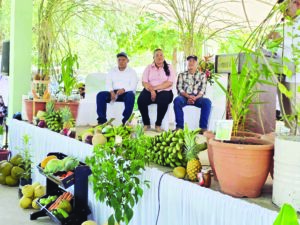
The offer was made by Agriculture Minister Zulfikar Mustapha during the opening of the National Agriculture Trade Show 2026 in Belize on Thursday, which is being held under the theme “Advancing Smart Agriculture, Building a Climate Resilient and Sustainable Belizean Food System”.

“Thousands of young people would have graduated from that school with various certificates and diplomas, and today they are out in the field working not only in Guyana but across the Caribbean. We are working with our many countries in the Caribbean to give them scholarships to also help their country technically, and here I want to offer to you, my brother from Belize, 10 full-time scholarships to the Guyana School of Agriculture so that we can help your young people,” Mustapha stated.
The GSA, which has been at the forefront of agricultural education for decades, offers training in crop cultivation, livestock management, agribusiness, and sustainable farming methods. Already, Guyana is working on establishing a Centre of Excellence at the GSA, where more practical subjects on agriculture will be taught.
The goal is to foster innovation, boost productivity, and support sustainable agricultural development across the country. Mustapha had previously challenged the GSA to lead regional efforts in agricultural production and food security.
“As the next generation of agriculturists, the GSA must play a direct role in achieving every target set by CARICOM, which includes ‘Vision 25 by 2025 + 5’ through enhanced training, meaningful research, and community engagement as the future of agriculture depends on our ability to produce skilled technicians, agro-entrepreneurs, and researchers,” Mustapha had said in October 2025.
Regional Collaboration
Addressing the gathering, the Guyanese Minister underscored the importance of better regional collaboration to strengthen food security. He recognised Belize as a powerhouse in agriculture, noting that it has played a major role in helping to reduce the region’s food import bill.
“It’s fertile land, strong farming traditions, and commitment to innovation have positioned it as a key contributor to regional food and nutrition security. The progress made here is not only commendable; it is essential to the collective advancement of the Caribbean,” Mustapha said.
Nevertheless, he noted that the Caribbean continues to face challenges such as climate variability, rising input costs, global supply chain disruption, and increased competition in international markets. He explained that structural constraints such as limited arable land in some territories, gaps in financing, and inadequate transportation linkages continue to impact the region’s growth.

“With the exception of Belize, Guyana, Suriname, and to a lesser extent Jamaica, there are a number of Caribbean countries that face challenges with arable land and freshwater supply. My friends from the Bahamas only this morning informed us that they have 75 per cent rocks in the Bahamas. Imagine that – the challenges they face. Their food import bill is US$1 billion annually, and they have to ensure that they find that to import food into the Bahamas.”
Amidst these challenges lie tremendous opportunities that can be realised when countries in the region work together, he emphasised. “We have to change our mindset if we want to be successful, and through the CARICOM food security agenda, we have committed ourselves to a bold and transformative vision to reduce the region’s food import bill by 25 per cent and to build a more reliant, resilient, and sustainable food system,” he noted.
Mustapha said the vision is ambitious but achievable, adding that significant progress has already been made in recent years. For instance, he explained that Guyana is expanding production, modernising infrastructure, and investing in climate resilience technology, including improved drainage and irrigation systems, shade houses, hydroponics farming, and research into climate-smart crop varieties.
“However, our approach is not one of competition; it is one of complementarity because if countries in CARICOM want to compete with one another, then we will never realise the initiative of reducing the food import bill,” the Agriculture Minister noted.
“We must complement one another, work alongside one another, build capacity, share experience… and then we can be successful,” he added.
Trade Barriers
In this regard, Mustapha addressed a major bugbear within CARICOM – barriers to trade.
“We are working diligently in CARICOM to strengthen inter-regional trade and to develop systems that position the region as a cohesive and capable food network,” he noted.
“We are saying that we are the same families; we are a family of CARICOM members, but if we have different criteria for trade in various member states, we will never be successful. We must remove all the barriers to inter-regional trade. If we are serious about feeding ourselves, then Caribbean food must move more freely, efficiently, and affordably across our borders,” he added.
Political Will
Nonetheless, the Minister boldly remarked that for the first time since the formation of CARICOM, there is now political will to transform the agricultural food system. He referenced the recent Memorandum of Understanding between Guyana and Belize to advance cooperation in areas such as technology transfer, climate-smart agriculture, agro-processing, livestock development, and fisheries.
Notwithstanding, the Minister said the region needs to act decisively in other key areas.
“First, we must expand; we must expand and modernise production through climate-smart practices, improve infrastructure, and provide greater access to financing inputs and agriculture. Here again, with the problems farmers are faced with, we have to work diligently to establish crop insurance in the Caribbean,” he said.
For the first time in Guyana’s history, the Government was able to do this. In July 2025, the Government launched a crop insurance programme for rice farmers across the country. Under the initiative, for the next three years, more than 6000 rice farmers will have access to insurance for their crops without having to pay a cent on premiums. It is a first-of-its-kind initiative in the Caribbean, covering losses from extreme weather like floods and droughts.
The crop insurance programme is a result of a unique partnership between the Government of Guyana, UPL Costa Rica, and Philip Morris International (PMI).
Value-Added
Mustapha also emphasised the need for better value-added products within the region. He lamented that “too often we export raw commodities and import finished goods at higher costs, importing inflation into our country.”
He used The Bahamas as a typical example, noting that they are importing almost all their food items. In this regard, Mustapha assured “my friends in The Bahamas that they will have products; they will have commodities coming out from CARICOM countries: Belize, Guyana, Suriname, and Jamaica.”
Innovation
The Minister further reiterated the need to embrace innovation and digital transformation in the agriculture sector, especially to attract young people.
“We must; it’s an obligation on us to ensure that we make agriculture more interesting for young people. Today, young people in the Caribbean see agriculture as a menial job. They see agriculture as an activity for old people who never went to university and school. We must change that perception. We must modernise the system. We must move away from labour intensity and embrace modernisation, embrace digital transformation, and make agriculture more transformative and more attractive for young people.”
Additionally, he explained that from drought to flooding, regional farmers are on the front lines, and as such, building resilience to climate change requires sustained investment in adaptation strategies.
Private Sector
The Guyanese Agriculture Minister also spoke about the importance of the private sector in these undertakings, noting that “Governments cannot do it alone”.
“We need active engagement from the private sector. We must create an enabling environment that encourages investment, fosters innovation, and rewards productivity. Belize, through this national agriculture and trade show, is demonstrating the power of collaboration, bringing together stakeholders, ideas, and opportunities in one space to drive progress. As we move forward, let us remember that regional integration is not optional. It is essential. Our success depends on our ability to work together, to share knowledge, and to act collectively in pursuit of a common goal,” he noted.
“The vision before us is clear: A Caribbean that feeds itself competes globally and secures a prosperous and sustainable future for its people. This vision is within our reach, but it requires commitment, urgency, and action. We will continue to work closely with member states, including Belize, to implement policies, mobilise resources, and deliver tangible results for farmers and citizens. Let us work together. Let us build a food system that generations to come will be proud of. As long as we act with unity and urgency, the Caribbean will not only feed itself; we will help to feed the world,” Mustapha expressed.
Discover more from Guyana Times
Subscribe to get the latest posts sent to your email.