

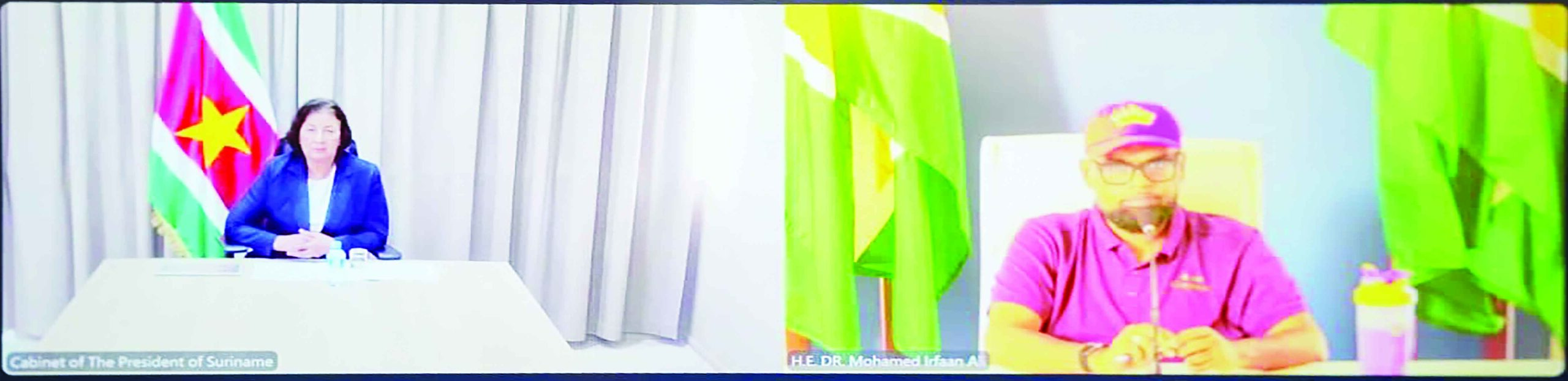
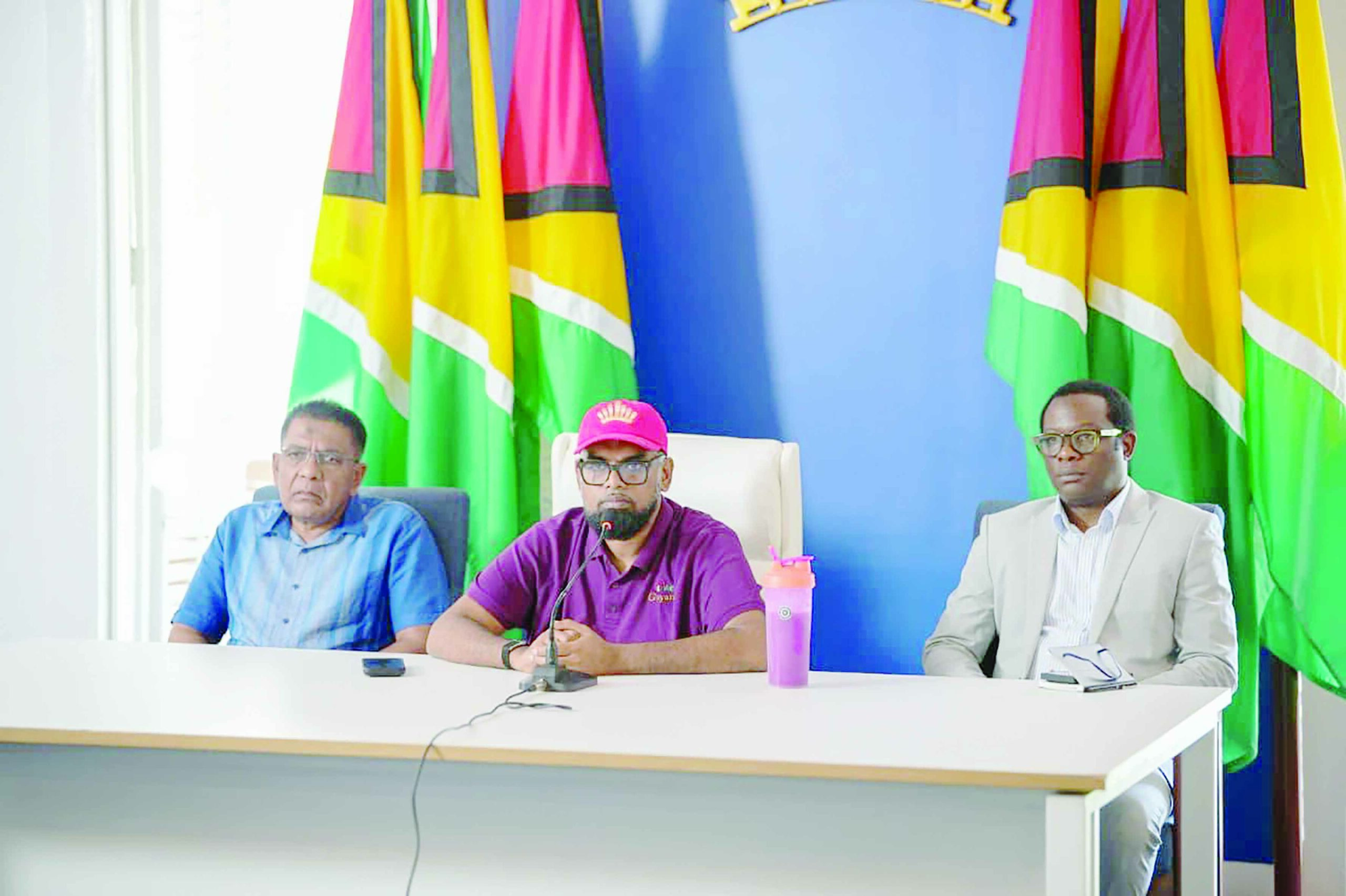
The Presidents of Guyana and Suriname met virtually on Friday to deal with a number of issues, including movement along the Corentyne River and challenges facing the fishing sector as well as opportunities in the area of oil and gas.
Corentyne River passage
Last month, President Dr Irfaan Ali had revealed that Guyana will be intensifying diplomatic efforts with the aim of addressing the fees imposed by Suriname for the use of the Corentyne River, which serves as a border between the two countries.
Surinamese authorities had imposed new fees on Guyanese vessels traversing the Corentyne River – a move that is affecting local timber and quarry operators.
While the statement from Guyana’s Office of the President did not mention any dialogue on this issue between the two Heads of State, Suriname’s President Jennifer Simons, via a Facebook post, indicated that the matter was discussed.
In March, President Ali had issued a diplomatic note to the Government of Suriname, protesting the imposition of the maritime fee, indicating that Guyana expects its South American neighbour will reconsider and ultimately desist from such actions that may be perceived as arbitrary or detrimental to the shared objective of deepening cooperation between the two countries.
Fisheries
Presidents Ali and Simons also discussed challenges within the fishing industry, according to statements from both Guyana and Suriname, though no further details were provided.
Under Suriname’s existing legal framework, licences to fish in the Corentyne River are generally issued only to Surinamese nationals or companies, leaving Guyanese fishermen unable to obtain licences directly.
This has forced many to rely on costly arrangements with intermediaries, significantly increasing operational expenses and cutting into already thin profit margins. Although previous bilateral engagements had resulted in assurances that a special allocation of licences would be granted to Guyanese fishermen, those licences were never delivered.
The Government of Guyana has maintained that the matter has to be handled through diplomacy and cooperation, given the importance of preserving strong relations with Suriname while protecting the interests of Guyanese citizens.
Flooding
Additionally, the two South American leaders discussed the impact of climate change and current challenges posed by heavy rainfall, including flooding.
Both Guyana and Suriname are dealing with flooding, following intense rainfall earlier this week.
In Guyana, approximately 217 pumps were operational to facilitate the rapid drainage of floodwaters, and as a result, there were no major flooding incidents, and most floodwaters have already receded.
On the other hand, reports indicate that multiple villages in Suriname were flooded.
Corentyne River Bridge
Presidents Ali and Simons also furthered discussions on the establishment of a bridge across the Corentyne River, linking the two countries.
The high-span Corentyne River bridge will run approximately 3.1 kilometres (km), connecting Moleson Creek in Guyana to South Drain in Suriname with a landing on Long Island in the Corentyne River, where a commercial hub and tourist destination will be established.
That free zone will see major infrastructural development such as hotels, recreational parks, entertainment spots, tourist attractions, malls and farmers’ markets. This bridge project is one of the first agreements that was signed between President Ali and the late former Surinamese President Chandrikapersad Santokhi in their August 2020 cooperation pact. At the time, both leaders had underscored the critical role the bridge across the Corentyne River would play in advancing cooperation, creating more opportunities for development for the two nations.
Meanwhile, both Guyana and Suriname have since settled on Chinese construction company China Road and Bridge Corporation (CRBC) as the preferred contractor to build the new bridge.
However, it is unclear whether the contract has been signed.
Back in October 2024, Public Works Minister Juan Edghill had told Guyana Times that the contract between the contractor and the two countries would be signed as soon as the financing mechanism for the bridge was sorted out.
Both Guyana and Suriname had written to the Government of China for financing of the bridge project. Guyana Times was previously told by a senior Guyana Government official that the Chinese Government is willing to fund the project given its close bilateral relations with both Caribbean Community (CARICOM) member states. However, the issue lies in Suriname’s economic situation. As part of its economic recovery programme, the Surinamese Government signed a structural adjustment programme with the International Monetary Fund (IMF) to restore its macroeconomic stability. But this programme makes it difficult for the Dutch-speaking country to take out loans, hence the snag in the process of securing financing for the bridge project.
Both Guyana and Suriname are meant to share the cost of the bridge construction in a 50-50 arrangement.
Oil and gas opportunities
According to the statement from President Simons, Guyana and Suriname also talked about opportunities in the oil and gas sector.
Earlier this year, President Ali told the Energy Conference and Supply Chain Expo in Georgetown that the two countries could jointly develop their natural gas resources.
President Ali has always been touting a regional energy corridor as Guyana moves to monetise its gas resources, which will be an independent project from the model Gas-to-Energy (GtE) initiative that is currently under construction at Wales, West Bank Demerara. The GtE project comprises a Natural Gas Liquids (NGL) facility and a 300-megawatt power plant utilising the rich natural gas from the Liza Fields in the Stabroek Block, offshore Guyana.
United States energy firm Fulcrum LNG Inc, has been selected to work in a tripartite arrangement with the Guyana Government and ExxonMobil to develop a potential gas project.
The Guyanese leader had previously touted several projects that are being considered for this gas monetisation plan, including the export of energy to northern Brazil, a shore base facility, an additional power plant and a potential joint aluminium plant facility using bauxite from both Guyana and Suriname.
Similar sentiments were expressed last year by Annand Jagesar, Managing Director of Staatsolie, Suriname’s state-owned oil company.
According to the Surinamese official, there are already piles of paperwork done by the Inter-American Development Bank (IDB) on connecting the eastern part of Brazil with the western part through the Guianas – French Guiana, Suriname and Guyana. While those studies were based on hydropower projects, Jagesar believes that the data can be adapted for this new opportunity with natural gas.
According to Jagesar, the two countries have to work out key issues, including the economics of such a collaboration, and also work along with their respective oil companies on a favourable model that would ensure profitability.
In the Stabroek Block, which United States oil major ExxonMobil and its co-venturers are operating, some 17 trillion cubic feet of gas has already been found, with the Pluma and Haimara wells being proven gas fields. The People’s Progressive Party/Civic (PPP/C) Government is seeking to develop this gas.
3-month framework
According to the statement from the Office of the President in Guyana, the two countries committed to working within a three-month framework to finalise many of the matters discussed.
“The two leaders discussed current challenges posed by heavy rainfall and its consequential effects. They also addressed ongoing bilateral issues, including the Corentyne River Bridge, the fisheries sector, ease of trade, energy, and agriculture. Both Presidents committed to working within a threemonth framework to finalise many of these matters, with the aim of deepening economic cooperation, expanding trade, and further integrating the two countries’ economies,” Guyana’s statement outlined.
Moreover, it added that President Ali is pleased with the countries’ “shared commitment in deepening our partnership and friendship to ensure further economic cooperation, expansion of trade and integration of our economies”.
President Simons’ statement noted that “I had a constructive and friendly online discussion with President Irfaan Ali of Guyana.” During the conversation, we talked about the effects of climate change and the increasing flooding that our countries are facing. We emphasised the importance of intensive cooperation to tackle these challenges together.”
Her statement further detailed that “it has been agreed that the Ministers of Public Works of both countries will cooperate on the water problem and infrastructural measures at the technical level. In addition, we have discussed further strengthening of socio-economic cooperation between Suriname and Guyana, including cooperation in the field of oil and gas, the fisheries issue and the passage on the Corantijn river [Corentyne River].”
She also noted that the two sides agreed to meet again within the Suriname-Guyana Strategic Dialogue and Cooperation Platform “on short notice”.
“In addition, we will actively involve the private sector in the further cooperation journeys,” President Simons said.
Discover more from Guyana Times
Subscribe to get the latest posts sent to your email.