

…asks ICJ to order Venezuela to revoke laws, maps claiming Essequibo
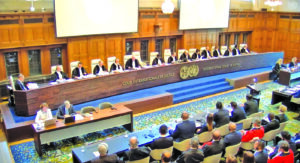
Guyana on Monday advanced detailed legal and historical arguments before the International Court of Justice (ICJ), maintaining that the 1899 Arbitral Award establishing its boundary with Venezuela remains valid and legally binding and urged the top United Nations court to order Caracas to destroy all maps and repeal all laws that includes Essequibo as part of that territory.
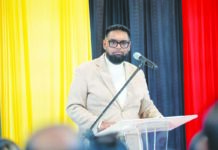
“For six decades, Venezuela fully respected and complied with that Award and that Agreement. Throughout that period, it never protested or challenged the Award,” Foreign Affairs Minister, Hugh Todd said as he opened oral arguments before the ICJ, with a plea that underscored the existential stakes of this country’s border controversy with Venezuela.
The Foreign Affairs Minister reminded the Court that the 1899 Arbitral Award, which established the boundary between then-British Guiana and Venezuela, was the product of exhaustive proceedings and accepted by Venezuela for decades. “It is Guyana’s submission that the 1899 Award is, without question, legally valid and binding on the parties,” he declared.
Guyana’s legal team aimed to present the matter not just as a dispute over historical records, but as an issue with real implications for people and territory. Guyana’s Agent and Director of Frontiers, Ambassador Donnette Streete, told the Court that Venezuela’s claim spans approximately 159,500 square kilometres, encompassing six of Guyana’s ten administrative regions and affecting more than one-third of the country’s population.
She described the Essequibo River and its tributaries – the Potaro, Cuyuni, Mazaruni and Rupununi, as “arteries” of national life, connecting communities and sustaining ecosystems.
This country’s Agent also pointed to the region’s natural and economic importance in Iwokrama rainforest, Mount Roraima, gold, bauxite, manganese, agriculture, cattle ranching and the waters off the coast where oil and gas potential has become central to Guyana’s development. She told the Court that the Essequibo is not empty land or a distant frontier; it is home to Indigenous communities and Guyanese families of many backgrounds and a place where inhabitants pay their taxes to Guyana.
She said that the Essequibo is not merely territory, but also of the people who live there, who govern it, and who identify with it, including her own family, noting that the 2022 Census placed the population at 313,175.
She noted that the population includes members of nine Indigenous groups, described as the earliest inhabitants of the territory. She further explained that the rest of the population reflects Guyana’s ethnic and racial diversity, including descendants of Dutch settlers, identified as the first Europeans to occupy the area,as well as descendants of Africans and Asians who were brought to the territory as enslaved and indentured labourers under Dutch and later British colonial rule between the 17th and 19th centuries.
She also stated that the British followed the Dutch into the Essequibo region in the first half of the 19th century, formed alliances with Indigenous communities, carried out exploration and mapping of the area, and expanded settlement and administration from the coast into the interior. She maintained that there was no Spanish or Venezuelan administration established in that territory.
The Frontiers Director highlighted that British administration deepened in the second half of the 19th century and continued until Guyana’s Independence in 1966.
Honing in on the county that is an integral and essential part of Guyana, Streete emphasized its geography, its economic activity, its culture, and the continuous governance of its land and peoples, first by the Dutch and then by the British and since 1966 by Guyana itself, nothing that it is not “not matters of abstract historical interests.”
“…Guyana has no desires in anyone else’s territory, but we insist on our rights to our own territory, which, by virtue of the arbitral award of 3 October 1899, includes Essequibo,” she said.
No Spanish or Venezuelan administration
Former Foreign Minister Carl Greenidge then took the judges through a concise history of the territory as he made reference to maps posted and other historical documents.
Guyana’s position is that the Dutch were the first Europeans to establish themselves in what is now Guyana, founding the colony of Essequibo in the early 1600s, before the British later inherited and administered the colony.
Greenidge detailed there was no Spanish or Venezuelan administration in the territory now claimed by Venezuela. He also argued that Venezuela itself pushed for arbitration in the 19th century after failed negotiations with Britain, eventually leading to the 1897 Treaty of Washington and the 1899 Award.
He said Venezuela, in its exasperation with the British, sought support from the United States and asked it to use its influence to push Britain toward arbitration over all the land lying between Essequibo and the Orinoco rivers. He added that, according to the historical record before the Court, it was Venezuela that insisted on arbitration and brought the United States into the process to help secure Britain’s agreement after failing to obtain it on its own.
He further noted that, with US support, Venezuela achieved the arbitration arrangement through the 1897 Treaty of Washington and at the time “celebrated” it as a major diplomatic success, expressing strong appreciation for the United States’ role. He said Venezuela maintained this position for decades without challenging or questioning the treaty, but now argues the opposite before the Court, claiming it was unlawful and invalid.
And when Paul Reichler, one of Guyana’s international lawyers presented, he echoed Greenidge while focusing on Venezuela’s attack on the 1897 Treaty of Washington, the agreement that sent the 1899 boundary dispute to arbitration that Caracas now says was invalid.
Reichler argued that Venezuela’s present claims of fraud, error and coercion do not stand up to the historical record.
“The arbitration agreement was largely negotiated directly by the British Ambassador to the United States, Lord Pontfort, and the US Secretary of State, Richard Olney, on behalf of Venezuela. At the time, there was no objection by Venezuela. There is no evidence of any kind of such an objection. To the contrary, the evidence shows that Venezuela trusted Mr Olney, as well as his boss, President Cleveland, to protect its interests, and it believed Secretary Olney would have more influence with the British than its own representatives. This is confirmed by what Venezuela Ministry of Foreign Affairs reported contemporaneously in August 1896, upon reviewing the correspondence between the US and Great Britain in the negotiation process,” he said referencing documents.
Calling Venezuela’s action seemingly contemporaneous, he said that the country’s “assessment of the role played by the US demonstrates that Venezuela was manifestly content with the way Secretary of State Olney handled the treaty negotiations to that point.”
Entirely fallacious
“Venezuela thus focuses on a later stage of the negotiations, between September and November 1896, during which the subjects about which it expresses most concern, the acquisition of title by prescription and preservation of the 1850 agreement, were directly addressed by Secretary of State Olney and Lord Pomsfit. Venezuela’s principal contention now, as opposed to what it said contemporaneously, is that during this stage of the negotiations, the two representatives of Venezuela, Messrs. Andrade and Storo, were kept in the dark by Secretary of State Olney and denied the opportunity to defend or even explain Venezuela’s interests. This is entirely fallacious. It is completely refuted by the documentary evidence, as you will now see. Faced with this contemporaneous documentary evidence, how can Venezuela in the present case possibly argue that it was coerced to accept the treaty?” he questioned.
In fact, he said that it “it fails to identify any acts of coercion against it or any persons or entities who might have perpetrated such acts. Instead, it complains of what it calls, quote, structural coercion. In Venezuela’s telling, it found itself in a situation in which it had no choice but to accept arbitration of its territorial dispute with Great Britain because the alternative would have been to subject itself to further British expansion, which it was powerless to stop.”
Conveniently forgets or deliberately ignores
But in making this argument, he said that Venezuela conveniently forgets or deliberately ignores the fact that it had been pleading for precisely this outcome, an arbitration agreement with Great Britain for the better part of two decades, and that it repeatedly beseeched the United States to come to its assistance and to press the British to accept arbitration of the territorial dispute.
“That under US pressure, the British finally agreed, and that the treaty negotiated by the US in close consultation with Venezuela’s representatives was deemed by Venezuela to be acceptable and worthy of signature. Venezuela’s very belated contention, 66 years after the fact that it was coerced into signing the treaty, physically or structurally, has no factual support. It is completely contradicted by the evidence before you,” he stressed.
“The bottom line, Mr President, is that Venezuela cannot come up with any basis, any legitimate basis whatsoever, for invalidating the 1897 treaty, or for invalidating the 1899 arbitral award on the basis of an allegedly invalid compromise. This afternoon, my colleagues will demonstrate convincingly that there is no other basis, no other basis for invalidating the 1899 award or the international boundary that resulted from it, and that the award was and remains valid and binding on both Venezuela and Guyana,” he added.
Venezuela accepted award for decades
One of Guyana’s strongest arguments of the day – Venezuela’s conduct after 1899 – was brought to the World Court by International Law Professor Nilufer Oral who showed that for more than 60 years Venezuela accepted and complied with the 1899 Award and the 1905 Boundary Agreement.
Through Professor Oral, Guyana pointed to official Venezuelan Acts, laws, international dealings and maps, saying at least 16 official Venezuelan maps between 1911 and 1962 showed the boundary in keeping with the 1899 Award and 1905 demarcation. She noted that Venezuela had insisted on the precise replacement of a boundary marker displaced by natural forces, reflecting its commitment to implementing the award exactly as determined.
Reference was made to the 1929 Protocol between Brazil and Venezuela, ratified in Rio de Janeiro, which defined the frontier from the island of São José to Mount Roraima, where the borders of Brazil, Venezuela, and British Guiana meet.
The professor also cited Venezuela’s 1948 Organic Federal Territorial Law, which described the Delta Amacuro Federal Territory as bounded by British Guiana “as defined by the Border Treaty between Venezuela and Great Britain.”
She questioned Venezuela’s current position, noting that during the boundary demarcation process carried out jointly with Britain between 1900 and 1905, Venezuela raised no objections.
She emphasized that Venezuelan members of the Joint Boundary Commission, reporting directly to their Ministry of Foreign Affairs, worked diligently and with precision to implement the award until the Commission’s conclusion.
“A giant red herring”
International Law Professor Philippe Sands addressed to the court for Guyana, the Mallet-Prevost memorandum, a document Venezuela has relied on to suggest wrongdoing in the 1899 arbitration. Sands attacked its reliability, saying the original has never been produced, its contents were published only after Mallet-Prevost’s death, and its allegations were uncorroborated. Guyana’s case is that the memorandum is not evidence capable of undoing a binding award.
He described Venezuela’s central evidence memorandum as “a giant red herring,” riddled with inaccuracies and “it is long on fantasy and short on facts. This is the stuff of a novel. It is not the stuff of a pleading before this Court.”
Professor Sands noted that the memorandum, allegedly written decades after the arbitration, contains demonstrably false claims, including a supposed dinner conversation with Lord Russell before he was even appointed to the tribunal.
“Not a shred, nothing at all. Mr Mallet-Prevost’s claim of a secret Anglo-Russian deal is a concocted fantasy,” Sands argued.
“In the years since 1962 Venezuela has used it repeatedly to generate heat and smoke, but no light and no illumination…While the allegation of a secret Anglo Russian deal is outlandish, it is also instructive for it starkly demonstrates the unreliability of the claims made in the memorandum, which by way of speculation and nothing by way of substance. It’s long on fantasy and short on facts; it lay dormant for 13 years after its publication,” he said.
Guyana rounded up its arguments with Attorney Edward Craven, asking the ICJ to take firm action against Venezuela’s repeated violations of the Court’s authority and provisional measures.
Openly rejected the Court’s jurisdiction
Turning to more recent events, Craven told the judges that Venezuela has openly rejected the Court’s jurisdiction, citing its December 2023 referendum and subsequent government declarations.
“Venezuela makes no secret of the fact that it rejects the Court’s judgment on jurisdiction,” he said.
He emphasized that Caracas has gone further, breaching provisional measures designed to protect Guyana’s sovereignty. These include plans to incorporate the Essequibo region into Venezuelan territory and grant citizenship to Guyanese residents.
“Venezuela has willfully and flagrantly breached both orders,” Craven declared.
He asked the Court to impose remedies for these violations, stressing that Venezuela’s conduct undermines the authority of the ICJ and threatens the stability of international law. Craven urged the judges to reaffirm the validity of the 1899 arbitral award and ensure that Guyana’s territorial integrity is protected. He reasoned the law demands finality as to unravel awards from the 19th century would destabilize international arbitration itself.
Craven asked the Court to declare that Venezuela breached those orders and to require Venezuela to revoke laws, decrees and maps that purport to incorporate Guyana’s territory into Venezuela.
“Judgment in the terms sought by Guyana will provide the key which finally unlocks the resolution of this decade’s long dispute. The Court can, with its judgment in this case, provide the foundation for enduring peace and security in the region on the basis of the rule of international law and it can definitively and finally settle a long-standing source of tension and conflict between the parties. Above all else, the Court’s judgment can and should affirm Guyana’s territorial integrity in the clearest possible terms and place its sovereignty over the Essequibo beyond any possible question,” he said.
“The declarations which Guyana seeks will allow a line to finally be drawn under a dispute which will benefit all relationship which it is sincerely to be hoped will be characterised by amity, stability, respect for the rule of international law and respect for the inviolability of Guyana’s sovereign territory,” he added.
The ICJ has scheduled oral hearings from Monday to Monday, May 11, 2026, with Venezuela due to present its first oral round on Wednesday.
Discover more from Guyana Times
Subscribe to get the latest posts sent to your email.