

…warns against new mineral dependence, urges balanced, responsible resource management
Noting that Guyana is maximising the value of its hydrocarbon resources while simultaneously advancing a renewable, low-carbon energy system, President Dr Irfaan Ali on Monday assured stakeholders that investments in the country’s energy sector are investments in a sustainable future.
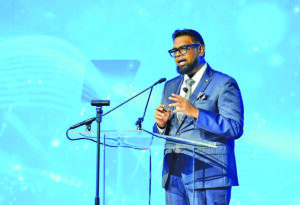
The Head of State made these remarks while delivering the keynote address at the Offshore Technology Conference (OTC) in Houston, Texas.
He spoke about the need to create an energy balance, to guarantee a win-win scenario for investors, the planet, and humanity.
The president highlighted that Guyana has rejected the false choice between economic development and environmental stewardship and adopted a deliberate and integrated dual track approach.
“We are extracting full value from our hydrocarbon resources while simultaneously building the renewable and low-carbon systems that will define our future. These objectives do not conflict. Managed properly, they reinforce each other,” he explained.
According to him, Guyana’s role in the global energy and climate landscape is distinctive.

“We are one of the fastest-growing oil producers in the world. At the same time, we are one of the most significant net carbon sinks. Our forests cover approximately 85 percent of our landmass. They sequester more than 150 million tonnes of carbon annually. They’re among the most intact tropical forests on earth. This is not accidental,” he said, adding that, “it is the result of sustained policy, national commitment, and community stewardship. Guyana has maintained one of the lowest deforestation rates in the world, a fact of which we are very proud. We care about the world, and we’re demonstrating it. I’m not lecturing to you. I’m sharing real examples of how we are following our own advice.”
He referred to the Low Carbon Development Strategy (LCDS) as well as the Global Biodiversity Alliance (GBA) – key initiatives launched by Guyana to promote environment stewardship.
Through the LCDS, Guyana demonstrated that forest conservation can be monetised, President Ali noted.
Similarly, he said the GBA provides a platform for countries to advocate for fair value for the global service their ecosystem provides.
“This is a critical issue. Countries that preserve forests and biodiversity are delivering a service to the world. That service must be recognised, supported, and monetised,” President Ali emphasised.
Mutually reinforcing
Against this backdrop, the President expressed that Guyana demonstrates that energy production, climate leadership, and biodiversity protection are not mutually exclusive.
“They are mutually reinforcing. We are showing that a country can, at the same time, produce oil, maintain a net carbon sink, expand renewable energy, and protect its natural environment. We take pride in that. It is the responsible thing to do. We urge others to join us in this endeavor for all mankind and for our own homeland and this planet Earth,” he posited.
“The world requires reliable and affordable energy that is produced with the least impact on the environment and the greatest return on a dollar. And I say most humbly that Guyana fits the bill in all of these criteria. Any investment in energy in Guyana is an investment in a sustainable future and a balanced framework that the world needs,” the President added.
Balanced approach
The Guyanese leader also recognised challenges facing the global energy sector, noting that a balanced approach is needed.
For instance, he noted that the global energy transition is not only a question of capital, but also of minerals.
“We are moving from a system that is fuel-intensive to one that is mineral-intensive. The implications of that shift are profound,” he highlighted.
He explained that the transition to renewable energy, electrification, and storage technologies depends on a set of critical minerals, including lithium, cobalt, nickel, copper, graphite, and rare earth elements.
“According to the International Energy Agency, a single electric vehicle requires approximately six times the mineral inputs of a conventional vehicle. An offshore wind plant requires up to nine times more mineral resources than a gas-powered plant of the same capacity requires.
These multipliers are not marginal.
They represent a structural shift in the composition of global resource demand,” he further explained.
The President said research shows by 2040, demand for lithium is expected to increase to more than four times its 2024 level, demand for graphite will be doubled, demand for copper is expected to increase by approximately 27.7 per cent, demand for nickel is projected to rise by approximately 68.5 percent, cobalt 49.5 by per cent, and rare earth elements 60 per cent.
“These projections underscore the magnitude of the transition. What they also expose is fragility, finite resources, and depletion risk,” he outlined.
In fact, he disclosed that estimates suggest that by 2050, up to 80 per cent of known global copper reserves will be depleted, 81 per cent of nickel reserves will be exhausted, and nearly 70 per cent of cobalt reserves could be gone.
He noted too that unlike oil, which is found in multiple regions across the globe, critical minerals resources are highly concentrated. For example, he informed that as of 2024, Australia and Chile held approximately 58 per cent of global lithium reserves.
Moreover, he highlighted that the extraction and processing of critical minerals are highly water-intensive. “Producing a single tonne of lithium requires between 1.9 million and 2.2 million litres of water. In 2024 alone, lithium production consumed an estimated 656 billion litres of water, enough to meet the annual domestic needs of approximately 62 million people in sub-saharan Africa,” he explained.
As such, President Ali cautioned that “the world is at risk of moving from one form of dependence to another.”
“We are not eliminating dependence, we are relocating it from fuels beneath the ground to minerals within it,” he added.
In this regard, the President said more research and development is required in both fossil fuel and renewables.
“That is the only sustainable pathway, finding this balance through technology and research and development,” he stressed.
The President emphasised that if the world is to pursue a sustainable future, leaders and policymakers must be honest about these realities.
He said, “oil and gas remain essential in the present and does not face an existential threat. Renewables are essential for the future. Critical minerals will determine the pace of change. The challenge is not to choose between them. The challenge is to manage them wisely, responsibly, and in a balanced manner.”
“Guyana has chosen this balanced approach. The future of energy will not be defined by what we abandon. It will be defined by how wisely we manage what the world still requires, how responsibly we build what the future demands, and how fairly we ensure that no country and no community is left behind,” the president added.
In this regard, he used the OTC platform to call for collective action.
“I urge all governments, financial and development institutions, and the private sector to seize this opportunity with us in our shared and collective interests,” he expressed.
Energy mix
Meanwhile, the President spoke about Guyana’s own energy mix, outlining major investments made over the last five years, including the building out the transformative gas-to-energy project and investments in renewable energy across the country.
He also highlighted works in enhancing the energy grid and investing in technology, to build stronger and modern systems that keep up with the country’s growth.
“With that growth comes rising energy demand. We are addressing this proactively. By 2030, we are hoping to have an energy mix and energy balance that celebrates technology around renewables and hydrocarbons,” the president noted.
Discover more from Guyana Times
Subscribe to get the latest posts sent to your email.