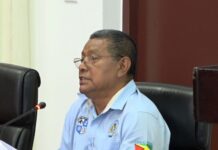


– Prosecution accuses defence of employing tactics to further delay proceedings
Further delay stalled the extradition proceedings against businessmen Nazar Mohamed and his son Azruddin Mohamed on Wednesday at the Georgetown Magistrates’ Courts, with issues ranging from illness, Muslim holidays, and conflicting court commitments.
Despite the setbacks, Principal Magistrate Judy Latchman allowed the case to proceed in part with the cross-examination of the Permanent Secretary (PS) in the Ministry of Foreign Affairs and International Cooperation, Sharon Roopchand-Edwards, who has been on the stand for more than two months.
The Mohameds’ attorneys, Siand Dhurjon and Damien DaSilva, were absent from the proceedings. Dhurjon reported sick while DaSilva was dealing with family matters which may see him off the defence team.
Nazar Mohamed, who will more than likely be left without one of his attorneys, told the court he was uncertain how to proceed. However, Magistrate Latchman noted that his direct participation at this stage was minimal, as another attorney, Roysdale Forde, continued to lead the cross-examination.
Latchman, however, added that Dhurjon’s presence would be necessary when rulings are to be delivered.
The proceedings were further complicated by a mix-up over scheduling. The court had previously agreed not to sit on Friday due to Forde’s prior engagements at the Court of Appeal.
However, it later emerged that those commitments were actually for Thursday. At the same time, the defence had indicated that Thursday would be observed as a Muslim holiday, a position disputed in court before it was clarified that the observance would instead fall on Friday.
Amid these disruptions, cross-examination of Roopchand-Edwards continued, focusing heavily on diplomatic correspondence between Guyana and the United States following the October 2025 extradition request.
During the afternoon session, the court was presented with a key diplomatic response, Note 458, from the United States, which was tendered into evidence. Under questioning by Forde, Roopchand-Edwards confirmed that the US had provided assurances that the Mohameds would not be extradited to any third country without the consent of the Government of Guyana.
“Yes,” she told the court when asked to verify the contents of the document.
The exchange formed part of a broader examination into Note Verbale 1680 of 2025, through which Guyana had formally requested assurances under Article Seven of the extradition treaty, invoking the principle of speciality.
Roopchand-Edwards maintained that the US response directly addressed Guyana’s concerns. “458 is the assurance for 1680 of 2025”, she stated.
However, the defence pressed the issue further, arguing that there is a distinction between “assurances” and “undertakings”. The PS disagreed, stating, “In my mind, undertakings and assurances are the same.”
The court also heard that Roopchand-Edwards did not conduct any independent assessment of how the treaty provisions are applied by the United States, nor was she aware of any such evaluation within the Ministry. “I didn’t do any assessments,” she admitted.
She further confirmed that upon receiving the extradition documents in October 2025, she did not refer them to a legal officer for review but instead forwarded them to the Minister of Home Affairs. The request for assurances, she explained, was sent to the US Embassy both electronically and by hand, based on advice from the Ministry’s legal department.
Earlier in the day, outside the courtroom, prosecutor Glen Hanoman sharply criticised the repeated disruptions and accused the defence of employing tactics designed to delay the proceedings.
“The content of two diplomatic notes. One of the diplomatic notes was a request from the Government of Guyana to the United States Government for assurances as a precaution against re-extradition… and of course there was a diplomatic note from the United States embassy… they were given an assurance for the Mohameds that they were not going to be extradited to a third country or for any other offence,” Hanoman told reporters.
He added that the diplomatic exchange was intended to benefit the accused. “These diplomatic notes were clearly an attempt by the Government of Guyana to protect the Mohameds from re-extradition.”
Hanoman argued that it was therefore difficult to understand any objection to the documents. “So, it’s hard to imagine that this is a document that the defence can have any complaints about, or the Mohameds.”
Turning to the pace of the proceedings, the prosecutor accused the defence of deliberately stalling the matter.
“I think it’s clear for everyone to see that this is their strategy. Every single manoeuvre that they make is to affect this purpose,” he said.
He pointed out that multiple applications to stay the proceedings had already been dismissed by both the High Court and the Court of Appeal, as well as by the Magistrate.
“They continue to try to obtain delays in this case,” Hanoman asserted.
Addressing the day’s developments, he described the sequence of events as unusual, particularly the absence of attorneys and the inability of Senior Counsel Forde to hold the matter on behalf of his colleagues.
“So, it’s highly unusual for a senior counsel… to now say that he’s not in a position to hold the matter,” he said.
Hanoman went further, suggesting that additional delays may occur. “All sorts of shenanigans are going to go on to try to achieve delays, and I expect that various persons will fall ill on the defence side, whether lawyer or fugitive offender.”
He also criticised the nature of the cross-examination, describing many of the questions as irrelevant to the limited scope of the Magistrates’ court under the Fugitive Offenders Act.
“He continues to ask what in our view are a series of irrelevant questions that have no bearing on any issue before the court,” Hanoman said, warning that the proceedings were at risk of losing focus.
“At some point… we’re now bartering on the verge of this thing becoming a circus.”
Hanoman has since called for a “reset” of the case, stressing that the court’s role is confined to determining whether the offences are extraditable, whether sufficient evidence exists, and whether the request is politically motivated.
Further cross-examination of Roopchand-Edwards was adjourned and is expected to resume on Tuesday, March 24, 2026.
Discover more from Guyana Times
Subscribe to get the latest posts sent to your email.