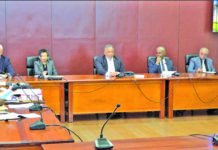


Attorney General (AG) and Legal Affairs Minister Anil Nandlall has emphasised that, while the judiciary enjoys independence, judicial officers are not immune from accountability for their actions.
He made the remarks during his programme Issues in the News on Tuesday evening, where he highlighted that in Guyana, the judiciary enjoys independence and is adequately resourced.

He also underscored the importance of an independent judiciary to a country’s economy and business climate.
“It is so crucial that we ensure that the judiciary remains independent and remains competent because it is an indispensable factor in the development equation of this country because of the peculiar and fundamental role that it has to play in the adjudication and resolution of disputes,” he said, adding that “it’s against that backdrop that the government invests billions and billions of dollars every year in ensuring our judiciary is adequately resourced, and I have said on innumerable occasions on this programme that the judiciary of Guyana has never been the beneficiary of the magnitude of resources that it now benefits from at any time in its history.”
Unaccountability?
However, he stressed that judicial independence does not mean judicial officers are exempt from accountability for their actions.
“Now, this is the question. Does judicial independence translate into judicial unaccountability? I say ‘no’. Though the judiciary is different and is institutionalised differently and is the most independent organ of state, it remains an accountable institution,” the AG asserted.
“If only for the fact that it is funded by public monies. If only for that fact, there is no agency in a democratic society funded from public funds that is allowed or will ever be allowed to be unaccountable to the public who is funding the functioning. That can’t happen, and I respectfully submit that that does not obtain in Guyana,” he added.
To further demonstrate his point, Nandlall referenced the foreword done by the then Chancellor of the Judiciary, Justice Yonette Cummings-Edwards, in a Code of Ethics for judicial officers, which was promulgated in 2021.
He said, “And I quote, ‘An independent judiciary is indispensable to the administration of justice and the rule of law. Similarly, the integrity of judicial officers and their accountability to the public are indispensable for the administration of justice in a fair and transparent manner. “I continue, “We must be accountable to the public. Exemplary conduct on the part of judicial officers helps to inspire public confidence in the judicial system. “I continue, ‘Let justice be done with proprietary independence, integrity, impartiality, equality, competence and diligence; let us be accountable to the people we serve.’ “ So here it is from the mouth of the head of the judiciary embracing the concept that the independence of the judiciary does not render it unaccountable.”
“Her Honour rightfully asserts that judicial officers are accountable to the public and that accountability is indispensable to the administration of justice in a fair and transparent manner,” Nandlall emphasised.
For instance, he explained that financially, the judiciary is accountable to the Auditor General’s Office and, by extension, the Public Accounts Committee. The AG also pointed to legislation that outlines time limits for judicial decisions.
Not immune to criticisms
From another perspective, Nandlall emphasised that the judiciary is not immune from criticisms that are in good faith. He referred to a Privy Council case from 1936 and an observation made by Lord Atkin: “Whether the authority and position of an individual judge or the due administration of justice is concerned, no wrong is committed by any member of the public who exercises the ordinary right of criticising in good faith…”
Against this backdrop, Nandlall said members of the public “are entitled to criticise the judiciary, but you must do so without casting aspersions on the integrity of the officer, you must not be motivated by malice, you must be acting in good faith, your criticisms must be genuine, you must have a fair and reasonable concern, and not motivated by an ulterior motive.”
“Judges and other judicial officers are accountable; they are accountable, and the public and society must hold them accountable for the discharge of their functions but must do so with dignity and respect,” he added.
Nandlal further contended that “when a case is before a judicial officer, that case has to be dealt with conscientiously, dealt with in accordance with law, where superior courts have given directions, those directions must be followed, when the particular judicial officer has fixed dates, one month before, for example, and lawyers are coming from all over the world to attend court, those dates must not be vacated at the whims and fancy of one side or for flimsy reasons.”
The AG’s remarks come on the heels of Chief Magistrate Judy Latchman saying that “rushed justice is crushed justice” in the United States extradition case involving US-sanctioned Azruddin Mohamed and his father, Nazar Mohamed.
The matter has been ongoing in the court since the proceedings against the father and son duo were initiated on October 31, 2025, following a request by United States authorities for their extradition.
At the last hearing in the Georgetown Magistrates’ Courts on September 10, the Chief Magistrate further adjourned the matter to September 21, 22, 28, and 29.
In response to concerns raised by the prosecution, the chief magistrate had noted that the court will control its own pace and that she needed no reminder of timelines.
Discover more from Guyana Times
Subscribe to get the latest posts sent to your email.