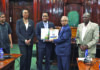


President Dr Irfaan Ali’s response to protesters during his public meetings in Region One (Barima-Waini) on Wednesday provided a clear example of a leadership style rooted in dialogue and a non-confrontational approach, rather than division.
At a time when emotions remain high following the tragic loss of lives in the MV Barima disaster, the President demonstrated that public concerns must be met with understanding and engagement. Instead of treating protest as confrontation, the Head of State created an opportunity for conversation, inviting those gathered outside his meeting to join the discussions and directly raise their concerns.
That decision reflected confidence in the Government’s willingness to face difficult issues and hear from citizens, regardless of their position. It was an important reminder that democratic governance is about engaging those who are critical.
The MV Barima tragedy has understandably left deep concerns among affected families and communities. The July 18 incident, which occurred while the vessel was travelling to Port Kaituma, Region One, resulted in significant loss of life and has prompted widespread calls for accountability, improved maritime safety, and greater protection for citizens who depend on river transportation.
The Government has since taken several steps in response, including establishing a Commission of Inquiry with international experts, launching a technical audit of the maritime sector, and providing support measures for survivors and families of victims. These actions demonstrate that addressing the tragedy requires both immediate assistance and long-term reforms.
President Ali’s decision to meet protesters face-to-face reinforced that concerns raised by citizens deserve attention and a respectful response.
The President’s invitation for protesters to participate in the Santa Rosa Secondary School meeting was a significant moment. It transformed what could have become a tense encounter into an opportunity for discussion. By encouraging residents to voice concerns respectfully, the President reinforced the principle that disagreements can be addressed through dialogue rather than conflict.
The same approach was evident at Matthews Ridge, where protesters were also encouraged to participate in the public engagement. The President’s willingness to personally greet those gathered and assure them that their concerns would be considered reflected a leadership style focused on accessibility and problem-solving.
The outcome of the Region One engagements showed the value of this approach. A protester later acknowledged that concerns regarding infrastructure improvements in the community were being addressed. This demonstrates that direct communication between Government and citizens can produce progress when both sides are willing to engage constructively.
Political disagreements will always exist in a democratic society. However, the manner in which disagreements are handled determines whether they contribute to progress or create further division. A responsible Government must not fear criticism, and responsible citizens must have opportunities to express concerns in ways that encourage solutions.
President Ali’s response stands as an example of how public frustration can be redirected into meaningful engagement. The choice to listen rather than confront, to invite discussion rather than dismiss criticism, reflects a statesmanlike approach to governance.
The focus of public leadership must ultimately remain on improving lives, resolving problems and ensuring that every community feels included in national development. Turning protest into conversation is not a sign of weakness; it is a demonstration of confidence, maturity and respect for the democratic process.
At a time when the nation continues to mourn and seek answers following the MV Barima tragedy, leadership that promotes unity and constructive engagement is essential. President Ali’s willingness to meet critics and create space for dialogue reinforces an important principle: a Government that listens is better positioned to serve.
Discover more from Guyana Times
Subscribe to get the latest posts sent to your email.