

– as consultations on draft legislation to start soon
As part of efforts to strengthen the local criminal justice system, the Guyana Government is moving to update the country’s archaic Evidence Act and will soon commence consultations on the draft document.
“We are going to launch shortly a public consultation exercise on a new Evidence Act that we have worked on, and the draft is complete. It will transform the evidential architecture and landscape of the country,” Attorney General (AG) Anil Nandlall disclosed on Thursday.
This new Evidence Act will overhaul the outdated 1898 United Kingdom (UK) model that currently exists.
According to the AG, “That can’t…be the law that governs us in the next few decades going forward. It’s wholly outmoded, built of a particular era, [and] the concepts that are now permeating law and the evidential arena are not captured in that framework… We desperately need a new Evidence Act that will take into account new realities of the world.”
While noting that some amendments were made in the past, much more work is needed to be done to modernise the legislation. The draft Evidence Act is an Australian model that is modern and considers all technological advances made over the years.
Nandlall posited that this new Act will transform the country’s evidential architecture and landscape, thus strengthening the delivery of justice. “Evidence is one of the most crucial areas of law and litigation… So, if you have an outmoded Act, it’s going to have a horribly negative impact on the type and quality of justice your justice system produces. So, this is a matter of priority, but it is a very important undertaking because it will change the landscape of not only litigation but arbitration and Commissions of Inquiry and everywhere else that evidence is required to be taken – in a legal or quasi-legal arena,” the Legal Affairs Minister asserted.
Currently, Barbados is the only country within the Caribbean with a modern Evidence Act, and Guyana is hoping to follow suit.
AG Nandlall made these remarks at the opening ceremony of the Partnership of the Caribbean and the European Union on Justice (PACE Justice) training programme for Guyanese prosecutors.
It was organized by the Director of Public Prosecutions (DPP) Chamber and forms part of the European Union (EU)-funded and United Nations Development Programme (UNDP)-executed PACE Justice Project.
The training, titled “Criminal Practice and Procedures”, focused on some of the most crucial areas of law, including rules of evidence and identification of evidence, with special emphasis on technological advancements.
Both AG Nandlall and DPP Shalimar Ali-Hack underscored the importance of such training programmes for prosecutors to refresh their knowledge and further build capacity to work in a modern environment.
“Practitioners always need to be trained, and there are many new pieces of legislation and…there is the whole idea of IT (Information Technology) coming into the law… And we need to adjust and move with the times. So, this training is very important, and it’s very timely,” Ali-Hack stated.
The training was held under the UNDP and EU-funded PACE Justice Project, which is a regional initiative designed to strengthen and enhance the institutional capacities of police forces, prosecutors, and courts across the region, enabling them to manage the backlog of criminal cases effectively and efficiently within the justice system.
Guyana is among eight Caribbean nations where the PACE Justice Programme is being rolled out. In fact, UNDP Resident Representative Katy Thompson disclosed that some US$768,000 was set aside at improving the local criminal justice system here as it continues to work alongside local stakeholders such as the Legal Affairs Ministry, DPP, the Judiciary, and the Ministry of Home Affairs.
Among the targeted support that these agencies are receiving includes hardware to promote digitisation efforts. In fact, local courts are already benefiting from such support, while considerations are being given for additional software assistance to enhance recording, transcribing, and analytical capabilities for law enforcement entities.
But according to Thompson, special importance is given to capacity training in a number of key areas, including restorative justice, children in conflict with the law, case management training for judicial officers, forensic and criminal investigation, and criminal trials and appeals.
“All of these trainings…aim to further enhance the justice sector and all of your agencies in terms of better executing your roles, your responsibilities, and your support to the part of the system that you are representing. So, we’re very aware at UNDP that the work that we do in strengthening the justice system, in particular, the criminal justice system, is also to get all parts of the system to work together efficiently,” Thompson posited.
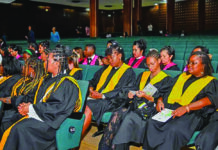
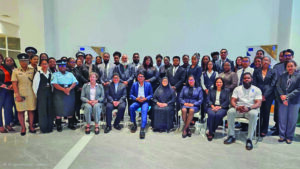
Thursday’s training programme brought together prosecutors from across the state sectors, including the Office of the Director of Public Prosecutions, the Police Legal Advisors, prosecutors attached to the Special Organized Crime Unit (SOCU) and the Customs Anti-Narcotics Unit (CANU), and police prosecutors. Criminal investigators and lawyers from the Attorney General’s Chambers were also present.
Training sessions were conducted by former State Prosecutor and current Justice of Appeal of the Court of Appeal of Trinidad & Tobago, Mme Justice Gillian Lucky.
Discover more from Guyana Times
Subscribe to get the latest posts sent to your email.