

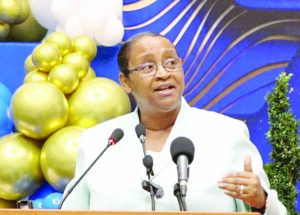
More pupils achieved passes in all four subjects of the 2026 National Grade Six Assessment (NGSA) than previous years, according to the Caribbean Examinations Council’s (CXC) Director of Operations, Dr Nicole Manning, on Friday. Dr Manning made the statement during the official release of the NGSA results at the Arthur Chung Conference Centre (ACCC) in Liliendaal. A total of 15,706 students sat this year’s assessment, with the Minister of Education congratulating every pupil, teacher, parent and guardian who contributed to the outstanding outcome. The CXC was responsible for marking this year’s NGSA examinations. A total of 350 examiners were engaged across the four assessed subjects, enabling the marking process to be completed on schedule. The Council also conducted a comprehensive post-marking quality assurance process to ensure the accuracy and integrity of the results. Providing an overview of the marking process, Dr Manning noted that students performed exceptionally well in most subjects, with this year’s results surpassing those recorded in 2025.
English
“Beginning with English, in terms of the overall performance, the percentage of candidates earning 50 per cent and above moved from 69.25 per cent to 73.08 per cent. I must also note that for English, we had a sharp increase in the number of candidates receiving full marks, and we had no candidate receiving zero,” Manning stated.
She explained that additional work had to be done and that further steps were taken in relation to the areas identified in English. She also highlighted the mean performance, noting that it was valuable to observe positive movement, especially in the face of changes and increased quality assurance.
“That’s extremely good. Notably, we are seeing the young ladies outperforming our young men here at 70.38 per cent compared to the 61.03 per cent we are seeing for the males. But I want to note that if you compare 2025 to 2026, they have moved out of the percentile grouping that they were in, and that’s also noteworthy. For Social Studies, while the increase was not as sharp as English, it is still very important to note that we moved from 64.77 per cent in terms of the percentage of candidates earning 50 per cent and above to 65.28 per cent.”
Meanwhile, she revealed that there was a sharp increase in the number of candidates receiving full scores in science, with the number rising from 227 in the previous year to 417. She also noted that no candidate received a zero in the subject. Additionally, she highlighted that the percentage of candidates achieving 50 per cent and above in science increased from 63.70 per cent to 65.38 per cent.
Mathematics
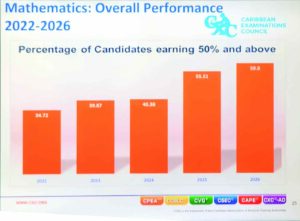
Meanwhile, she noted significant improvements in Mathematics, stating that the results exceeded expectations. “For Mathematics, we saw candidates moving from 55.51 per cent in terms of the percentage of candidates earning 50 per cent and above to 59.8 per cent. This speaks volumes, not only at this stage but also for what we know we will see five years from now,” she stated, as she was greeted by a round of applause from proud parents and teachers. She noted that while assessments are often viewed from a regional perspective, countries continue to implement interventions aimed at improving student outcomes. She highlighted Guyana’s efforts in this area, noting that the results reflected the impact of these initiatives.
She pointed out that the number of candidates achieving full marks increased from 472 to 627, while the number of candidates receiving zero marks saw a reduction, reaching its lowest level in the past five years. She also highlighted improvements among both male and female candidates and provided further details on performance across the four quartile groupings, noting that the greatest movement was observed within these categories.
Impact of COVID-19 pandemic
Chief Education Officer (CEO) Saddam Hussein highlighted the impact of the COVID-19 pandemic on students’ learning experiences, particularly those affected by school closures. “We were in the middle of COVID, and the Ministry of Education, the Government of Guyana, seized this opportunity and pushed towards reopening on January 3, 2022. In primary school, you get 17 terms of teaching. These students got 13 terms, so they were short of 54 weeks of in-class teaching. Hence the reason why the Chief Officer for Primary Education recommended to the Ministry of Education that you bring the exam as late as possible, and that’s what we did.”
He added, “When the exam is written, you add 10 weeks to that, and that’s how we are here now. This is just clarity for those who have been wondering and speculating why the exam results are coming out so late. These students were deprived of face-to-face teaching for 54 weeks, so the results being two weeks late, I think that’s reasonable. But today, today we rejoice.” He added that several interventions were implemented to support students’ academic recovery. “The Ministry of Education put forward several plans, and the Government of Guyana supported each and every one of those plans, and here we are today.
Discover more from Guyana Times
Subscribe to get the latest posts sent to your email.