

Government Member of Parliament (MP) Thandi McAllister has sharply criticised the Parliamentary Opposition for failing to attend President Dr Irfaan Ali’s engagement with members of the Parliamentary Sub-Committee on Foreign Relations, accusing Opposition parliamentarians of placing political tactics ahead of their responsibility to engage on matters of national importance.
McAllister’s criticism came after Opposition members declined to attend Tuesday’s meeting with President Ali, who had invited members of two parliamentary committees to discuss collaboration between the executive and legislative arms and issues affecting the country.

The meeting went ahead with members who were present, with President Ali using the occasion to brief them on foreign policy matters, including Guyana’s ongoing proceedings before the International Court of Justice (ICJ) concerning the Venezuela border controversy and the recently negotiated Third Country National Agreement between Guyana and the United States (US).
In a letter to the editor, McAllister described the Opposition’s decision as a failure to engage constructively, questioning what purpose an Opposition serves if it refuses opportunities for dialogue on issues of national importance.
“This was no cocktail reception. It was no partisan rally,” McAllister wrote, arguing that the meeting provided an opportunity for elected parliamentarians to engage the Head of State directly on issues affecting Guyana.
She said Opposition members could have attended, placed their procedural objections on record, requested the necessary documentation and asked questions rather than staying away.
“Attend the meeting. Put the procedural objection on record. Demand the documents. Ask the uncomfortable questions. Require answers. Then report to the country,” she wrote.
McAllister said that would have constituted effective opposition.
Instead, she argued, “Walking away accomplishes none of those things.”
The Opposition parties had claimed that they took offence about the manner in which the meeting was convened. According to the information provided, the invitations did not include an agenda or outline of discussion points.
The Opposition Leader’s Office, led by US-sanctioned and indicted Opposition Leader Azruddin Mohamed, accused President Ali of bypassing the constitutional office of the Opposition Leader and undermining Parliament’s independence.
APNU said it had no objection to meeting the President in principle but maintained that such engagements should take place before agreements are finalised and signed. The party called for a clear agenda and supporting documentation, including proposed agreements, financing frameworks and assessments of their implications.
The Forward Guyana Movement (FGM) also aligned itself with APNU and the Opposition Leader’s Office, arguing that the matter went beyond the absence of an agenda and concerned what it described as the President’s “continuing disregard” for Parliament.
Political posturing
McAllister, however, rejected the decision to stay away as an acceptable approach to parliamentary opposition.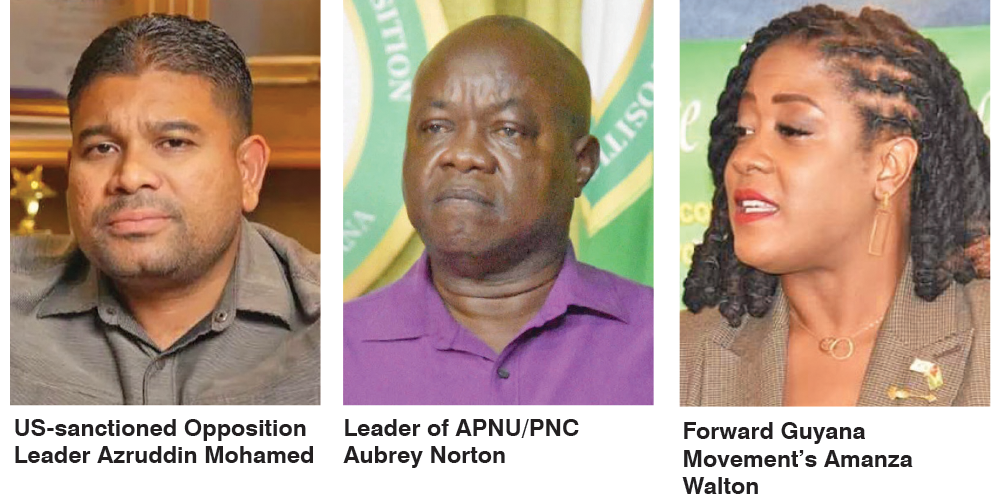
She argued that the absence of an agenda could not reasonably justify disengagement when issues of obvious national importance were to be discussed.
The MP also took aim at what she described as a pattern of disengagement involving WIN and APNU, pointing to recent talks concerning Opposition representation, the Guyana Elections Commission, the Local Government Commission and the Region 10 (Upper Demerara-Berbice) impasse.
Those talks, she noted, ended without final decisions on the substantive matters.
For McAllister, the episode reflected what she described as hesitation, procedural manoeuvring and political posturing when national interest required serious engagement.
She singled out the PNCR for criticism, arguing that the party’s long history in Guyana’s political system should bring with it a greater expectation of institutional maturity.
The PNCR, she noted, is one of Guyana’s oldest political parties and has both governed the country and occupied the Opposition benches.
McAllister said Opposition parliamentarians were elected to participate in the National Assembly and not merely to issue statements explaining their absence.
“They elected them to participate, scrutinise, challenge, negotiate and represent,” she wrote.
She was particularly critical of the Opposition’s absence during discussions involving Guyana’s sovereignty and territorial integrity.
McAllister pointed to the Venezuela controversy as an issue that transcends partisan politics, arguing that Guyana’s territorial integrity should not become part of domestic political gamesmanship.
She also referenced the 2025 National Assembly debate on Venezuela’s claim to Guyana’s Essequibo territory, when, according to her letter, the then Opposition walked out of the Assembly.
“A responsible Opposition should want more information, not less; more engagement, not strategic absence,” McAllister wrote.
She argued that opposition politics cannot simply consist of saying “no”, maintaining that a viable opposition must be prepared to absorb information, scrutinise competing positions, negotiate where necessary and present workable alternatives.
McAllister further warned that repeatedly avoiding engagement creates the opposite impression and makes it easier to criticise from outside than to defend arguments in direct discussion.
“An empty chair asks no questions”
“There is nothing courageous about remaining outside a meeting room while complaining about what may be happening inside it,” she wrote.
Her conclusion was blunt: “Show up. That is leadership.”
McAllister said Guyanese deserve an opposition that recognises opposition as a constitutional responsibility rather than a permanent posture of protest.
“An empty chair asks no questions. An empty chair advances no alternative. And an empty chair cannot represent the interests of the Guyanese people,” she wrote.
President Ali has said the Opposition’s failure to attend was disappointing and that he would continue extending invitations for engagement, expressing hope that Opposition members would eventually see the value in participating.
McAllister maintained that political leadership should be demonstrated through preparation, participation, questioning and the presentation of credible alternatives – not through boycotts and empty chairs.
President Ali, despite the Opposition’s failure to attend, said he remained undeterred, telling those present that he would continue working to bridge the relationship gap and would continue inviting parliamentary committees to engage. He said he hoped the Opposition would eventually see the value in participating in discussions on matters of national importance.
Discover more from Guyana Times
Subscribe to get the latest posts sent to your email.