

– engages Guyanese diaspora in St Kitts
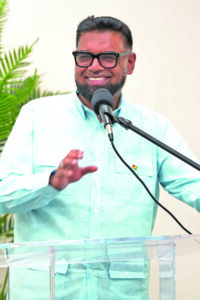
President Dr Irfaan Ali has renewed calls for the removal of what he describes as “artificial barriers” and bureaucracy surrounding trade with Trinidad and Tobago.
For years, the Guyanese private sector as well as the Guyana Government have bemoaned the restrictions that hinder free trade to some Caribbean countries, such as the Twin Island Republic.
Speaking with reporters on the side-lines of the 50th Caribbean Community (CARICOM) Heads of Government Meeting in St Kitts and Nevis earlier this week, President Ali said it is now time to address this matter in the interest of expanding trade between the two nations.
“A major issue [is] us getting our goods into Trinidad without the bureaucracy and without the type of delays that we face. And I believe that the time has come for those barriers – the artificial barriers – to be removed and the bureaucracy to be removed so that we can facilitate trade in a more efficient way, and we can facilitate the movement of goods in a more efficient way,” the Guyanese leader stated.
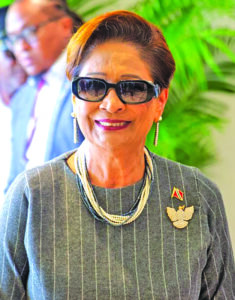
President Ali’s remarks come on the heels of him being expected to have bilateral talks with Trinidadian Prime Minister Kamla Persad-Bissessar in the near future. The two Caribbean leaders are expected to meet United States President Donald Trump in Miami next month.
While no date has been set for the Guyana-Trinidad bilateral meeting, the Guyanese Head of State indicated that trade, food security, regional integration and energy are among key topics that he will prioritise during those talks with PM Persad-Bissessar.
“A position has been painted that that bilateral meeting must only focus on energy… But I think that the bilateral must be far broader than energy,” he posited.
The Guyanese leader went on to remind that Trinidad has been one of Guyana’s strongest trading partners for decades. He said Trinidadian distributors have long maintained a solid presence in the local market, while contractors there played key roles in some of Guyana’s most transformative infrastructure projects.
He noted that companies such as Dipcon Engineering and Ceran Brothers were involved in major national undertakings long before Guyana’s petroleum sector emerged.
Energy talks
According to President Ali, since the onset of oil and gas production in Guyana, the Twin Island’s private sector has again benefitted substantially, participating freely in Guyana’s expanding energy ecosystem without restrictive barriers.
“I look forward to our bilateral being very progressive and future-driven [looking at] how we expand trade. And the fact is that Guyana has had an open relationship with CARICOM. The entire private sector in CARICOM is welcome on the same playing field as Guyanese to invest and to work in Guyana.”
“We have had many discussions here at CARICOM. We were able to talk a bit about how we see the energy sector evolving, the type of relationship that can be built and the connectivity that can be built… Of course, energy is an important component of those meetings – energy that leads to the energy security of the region,” he asserted.
Guyana’s commitment to the energy security of the Caribbean was reinforced by President Ali during his engagements with regional leaders on the side-lines of the CARICOM Meeting in St Kitts.
On Thursday, the Guyanese Head of State met with Jamaican Prime Minister Andrew Holness to discuss continued cooperation in energy, agriculture, investment, technology transfer, regional security and infrastructure development.
Similarly, President Ali had discussions on continuing the strong partnership on energy and food security as well as cooperation towards regional connectivity with his Surinamese counterpart, President Dr Jennifer Geerlings-Simons.
Diaspora engagement
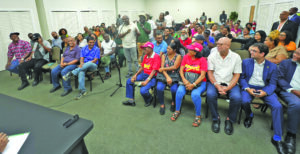
Meanwhile, President Ali on Friday met with the Guyanese diaspora in St Kitts, telling them about Guyana’s ongoing development trajectory as well as current collaborations between Guyana and St Kitts.
He also spoke of the many investment opportunities for persons who may want to return to Guyana to live or invest, encouraging them to seize these chances.
Moreover, several issues were also raised by members of the Guyanese community – many of which were addressed on the spot.
St Kitts and Nevis Prime Minister Dr Terrance Drew and Guyana’s Minister of Public Service, Government Efficiency and Implementation Zulfikar Ally were also at the meeting with the diaspora members.
Discover more from Guyana Times
Subscribe to get the latest posts sent to your email.