

– GWI Head says bottled water facility to reduce costs, create jobs
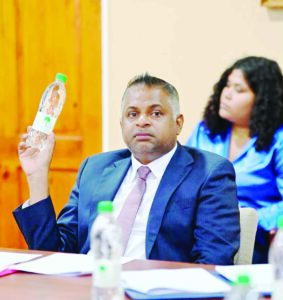
Public Utilities and Aviation Minister Deodat Indar on Friday engaged representatives from local Private Sector bodies and key stakeholders in Guyana’s bottled water industry over the Government’s plans to establish a $496.3 million state-owned water bottling plant. There have been mounting concerns, especially from industry stakeholders, that this project would directly impact Private Sector operators. Addressing these and other concerns raised by stakeholders, Minister Indar assured the Private Sector that the Government’s proposed initiative is not intended to compete with existing businesses.
“We are not producing water to compete with you,” Indar reaffirmed to the stakeholders during Friday’s engagement.
The meeting, held alongside Parliamentary Secretary Thandi McAllister, brought together Chairman of the Private Sector Commission (PSC) Captain Gerald Gouveia Jr; PSC Vice Chairwoman Kathy Smith, who also serves as President of the Georgetown Chamber of Commerce and Industry (GCCI); representatives of the Women’s Chamber of Commerce and Industry Guyana (WCCIG); the Guyana Manufacturing and Services Association (GMSA); local manufacturers, suppliers, and representatives of companies including Banks DIH, Demerara Distillers Limited (DDL), Aquafina, and other bottled water producers.
According to the Public Utilities and Aviation Ministry, this engagement reflects the People’s Progressive Party Civic (PPP/C) Government’s commitment to consulting with stakeholders and fostering partnerships that support investment, economic growth, and improved services for the people of Guyana.
Bottled water importation
Friday’s meeting came one day after President Dr Irfaan Ali declared that the proposed water bottling facility, which will be executed by Guyana Water Incorporated (GWI), is merely seeking to provide affordable water to citizens. “GWI has a responsibility to provide safe drinking water to the population and water that is affordable,” Ali stated. “GWI is not in competition with anyone… The local manufacturers should ask themselves why foreign water is here displacing them. Why do we have foreign water coming to Guyana and displacing local producers?” “There are some products that are social in nature. And when you look at the price of water in the region and internationally and water here, we have a duty and responsibility to the people. So it’s just arriving at that situation where there is balance-balance in need and balance in profitability,” the Guyanese leader told reporters on Thursday. In fact, similar sentiments were expressed by the Chief Executive Officer (CEO) of GWI, Shaik Baksh, who on Friday defended the Government’s decision to establish the state-owned bottled water plant, saying it will provide more affordable bottled water, create jobs and reduce the country’s foreign currency outflow. “ [The private operators] have allowed this drain of foreign exchange… We are importing bottled water in this country from as far afield, apart from Trinidad and Jamaica, from Canada and from the USA. Could you imagine that? A country with such abundant water resources importing bottled water here? Something is wrong with the system,” Baksh stated as he dismissed concerns raised by the GMSA earlier this week.

Arrival of bottled water plant
The Association, in a statement on Tuesday, called for a review of the project, arguing that the country’s goal of achieving 100 per cent locally produced bottled water can be realised through partnerships with existing local producers rather than direct state participation in the market. But according to the GWI Head, the plant has already been ordered and should arrive in Guyana within two months. A site has already been earmarked at Parfaite Harmonie, Region Three (Essequibo Islands-West Demerara), for the establishment of the water bottling facility.
“They have not been responding, I would say… to the water bottling business, trying to use the abundant resources here… So, we’re going to get involved here and bring down the price of bottled water… We will move in that direction and we will create more employment here in Guyana,” he asserted.
Meanwhile, Baksh also rejected concerns, mainly from the opposition, that this initiative will distract GWI from achieving its core objectives. In fact, at a press conference on Friday, the A Partnership for National Unity (APNU) argued that this initiative would divert state resources from fixing the national water supply system and infrastructure. Only Monday last, the National Assembly approved $496.3 million for the GWI-operated water bottling facility. The investment aims to reduce Guyana’s dependence on imported bottled water while strengthening national self-sufficiency and water security. However, the GMSA said on Tuesday that while it supports the Government’s objective of producing all bottled water locally, there are concerns about the impact this proposed state venture would have on private Guyanese businesses that already produce and distribute bottled water in the country. “Several GMSA members have invested capital, built distribution networks, and created jobs in this space over many years. Any initiative by the state should be structured to strengthen, not to compete with or undermine that existing private investment,” it contended. Moreover, the Association further referenced President Ali’s announcement back in February, during which he spoke of achieving 100 per cent locally produced bottled water through close collaboration between the Government and the Private Sector, including shared production infrastructure such as bottle manufacturing to reduce costs across the industry.
The GMSA said it supports that approach and urged GWI and the Public Utilities and Aviation Ministry to structure the project as a partnership that expands industry capacity and lowers production costs, rather than establishing what it described as a taxpayer-funded competitor to existing manufacturers – something it warned could discourage local producers from making future investments and create uncertainty for businesses and wider Private Sector growth.
Discover more from Guyana Times
Subscribe to get the latest posts sent to your email.