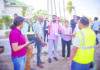


Zeeburg Secondary School has taken a major step towards strengthening digital and technical education with the commissioning of a new AutoCAD laboratory, giving students access to technology designed to enhance their skills in computer-aided design, engineering and other technical fields.

The commissioning ceremony was held on Wednesday, marking the completion of the first phase of an initiative aimed at modernising and improving digital skills in the delivery of industrial technology education in secondary schools.
This advancement serves a total cost of $85 million; six secondary schools nationwide were outfitted with air-conditioned spaces equipped with high-powered laptops, peripheral hardware and AutoCAD software.
Speaking at the ceremony, Deputy Chief Education Officer for Technical and Vocational Education and Training (TVET), Dr Ritesh Tularam, emphasised that technical training must evolve beyond basic manual skills.
Tularam highlighted the collaborative efforts that contributed to the establishment of the AutoCAD laboratory. He expressed appreciation to the head teacher and her staff, as well as officers from the region and the Central Ministry of Education’s TVET Unit, for working together to make the initiative possible.
He explained that AutoCAD enables students to generate innovative designs using various tools, commands and functions within the software. These designs can subsequently be developed into actual production work.
As an example, he pointed to the podium on which he was standing and explained that such an item could be designed using computer-aided design software.
Tularam also emphasised that the AutoCAD laboratory would provide students with vast opportunities to develop their creativity, technical skills and ability to transform ideas into practical designs. He noted that the facility would benefit both current students and those who attend the school in the future.
“I want for us to see the possibilities that lie and await you, to go and maximise them fully. I want for you to see that you can become what you want to become, because the facility is right here in your school. It’s not out of your school, and you stand to benefit significantly, so don’t let anybody else come in here and take priority of your facility.”
He pointed out that the intention of the Ministry of Education and the Region is to ensure that, now that Zeeburg has a digital hub, students from other schools also have an opportunity to benefit from the facility.
“Now that we have a digital hub at Zeeburg, how do we ensure that we work around the timetabling and give other people an opportunity on a timetable basis? Of course, that’s an administrative internal arrangement with the head teacher and discussions with other head teachers,” he said.
Tularam further emphasised the importance of preparing students with the skills and attitudes necessary for the world of work.
“So it means, therefore, that we have to nurture and groom cohorts of students who are prepared with the requisite skill sets, with the competencies, with the right work attitudes, so that when they exit their secondary school, they will transition into the world of work with those skills, so that they can make that meaningful contribution to national development.”
Digital competencies & problem-solving abilities
He also shed light on the transition students must make as they adapt to new forms of technology, particularly in relation to computer-aided design.
“Moving away from a traditional methodology to now CAD, Computer-Aided Design, is where you will acquire those skills and competencies in the areas of your choice, be it technical drawing, be it engineering, be it designing, be it architecture, be it construction, or be it manufacturing, because all those areas today require persons with those skill sets in CAD, particularly. And so collaboratively, from the region’s end, the regional administration, the Department of Education, and the Ministry of Education, this is what we are doing.”
He added, “In today’s rapidly changing world, technical education is no longer simply about learning how to operate tools and equipment. It is about developing the knowledge, creativity, digital competencies and problem-solving abilities needed to design solutions for the challenges of tomorrow.”
Dr Tularam noted that the laboratory enables students to “move from an idea in their imagination to a precise digital design that can be developed, tested, modified and eventually transformed into a physical product or structure.”
Additionally, the new facilities directly support students preparing for Caribbean Examinations Council (CXC) Industrial Technology assessments. Candidates in subjects such as Building and Mechanical Engineering Drawing can now create digital drawings, 3D spatial models and structural blueprints on workstations rather than traditional drafting boards.
Zeeburg Secondary joins North Ruimveldt Secondary, Abram Zuil Secondary, Bygeval Secondary, Hope Secondary and New Amsterdam Multilateral School as the six schools outfitted under the $85 million investment.
Discover more from Guyana Times
Subscribe to get the latest posts sent to your email.