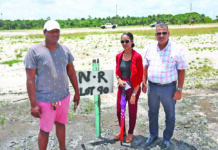
The Civil Defence Commission (CDC) is warning communities across Guyana to prepare for both flash flooding and forest fires as El Niño conditions continue, stressing that the ongoing dry spell does not eliminate the risk of heavy rainfall and flooding.

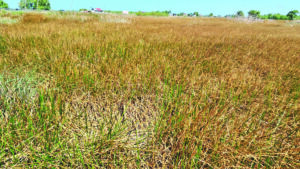
Deputy Director General of the CDC, Lieutenant-Colonel Mark Thomas, issued the warning during a sensitisation consultation in Region Five (Mahaica-Berbice), part of a nationwide programme aimed at helping regional authorities and communities prepare for the effects of the weather phenomenon.
Farmers’ groups, NDC members, regional councillors and residents turned out Thursday for a consultation hosted by the CDC in the region as part of a nationwide sensitisation drive during the El Niño period.
The exercise has already been held in Regions Three (Essequibo Islands-West Demerara) and Four (Demerara-Mahaica), with Region Six (East Berbice-Corentyne) being held today and Region Two (Pomeroon-Supenaam) set to follow next week, before the Commission moves into the hinterland regions.
Thomas said the CDC is taking a proactive approach, with consultations being held with regional officials, Neighbourhood Democratic Councils, village councils and other Government agencies across the country. “We want to have a proactive approach to disaster risk management,” he explained during an interview on the consultations.
He said the El Niño situation is expected to continue into the first quarter of next year, with October projected to be warmer than September, making preparation for water management particularly important.
For farmers, Thomas said planning should include systems to harvest and store water when rainfall occurs, with livestock and cash crops among those requiring attention.
But he cautioned that reduced rainfall does not mean communities can discount flooding. “Not because it’s a dry spell during this El Niño; you can also have flash floods because of rain. There will be rain.”
Thomas said heavy downpours can still occur and may result in flash flooding, particularly in low-lying communities. He urged regions to put systems in place now to respond if those events occur.
The CDC is also warning of an increased risk of forest fires during the dry period. Thomas said Guyana experienced numerous forest fires in 2024 and referred to a recent fire at Kukwani.
Thomas added the slash-and-burn land preparation remains common in some rural and hinterland communities, but farmers must take precautions before lighting fires. “The problem is, once you light a fire and the necessary systems are not put in place, the fire can get away.”
He further stated that Neighbourhood Democratic Councils (NCCs) and Regional Democratic Councils (RDCs) have been advised to take a more proactive role, including ensuring that appropriate procedures are followed and firebreaks are established before fires are lit.
The response also includes strengthening firefighting capacity in communities without regular fire-service coverage. The CDC has been providing basic firefighting training to volunteers and community members, including members of the Guyana Defence Force Reserve, while NDCs are being provided with protective equipment and other supplies.
At the national level, Thomas said the National Emergency Center is being supported by regional emergency systems that will allow problems to be reported so assistance can be coordinated.
The CDC is also preparing for a worst-case scenario, with Thomas noting that Guyana had to seek outside assistance after being overwhelmed during the 2024 floods. He said the country remains in contact with the Caribbean Disaster Agency, Brazil and the United Nations should international assistance become necessary.
The heat component of the El Niño conditions is another concern, particularly for people who spend long periods outdoors.
Thomas said young children, construction workers and employees of utilities such as Guyana Power and Light and the Guyana Water Authority need to be properly educated about maintaining hydration while working outside.
In Region Five, where the latest consultation was held, Chairman Ricardo Phillips said the exercise was particularly relevant given the region’s dependence on agriculture.
He said the Regional Democratic Council (RDC) is developing an action plan that includes increased public awareness through stakeholder engagements and community consultations.
Phillips said the campaign will address heat-related health concerns and water and energy conservation, while attention will also be given to elderly persons, shut-ins and persons with disabilities who may be more vulnerable to the effects of the heat.
“This consultation here today is very timely because many of the sector agencies that are here are presenting mitigative plans for how the region can mitigate the effects of the El Niño period… we have a variety of groups here, a wide range of stakeholders, we have farmers’ groups, members of all NDCs, regional councillors, and residents of Region 5,” the Regional Chairman explained.
Region Five is a low-lying coastal region built largely on rice, sugar, cash crops, and cattle, making it particularly exposed to shifts in rainfall and temperature.
Phillips said the RDC is now building out an action plan of its own, starting with a public awareness campaign that will roll out through community consultations across the region.
“We will be sharing health tips and how to mitigate the effects of this heat and of the weather, and also we’ll be sharing other water conservation and energy conservation measures across the region,” he noted.
Meanwhile, Thomas’s message to communities is that preparation now can reduce the difficulty of the months ahead. “If we stay proactive and we discuss and we put systems and plans in place, then this period should not be a difficult period for us.”
Discover more from Guyana Times
Subscribe to get the latest posts sent to your email.