


– says Guyana’s growth must not compromise worker safety, well-being
Director of the Guyana Technical Training College Incorporated (GTTCI), Professor Clement Sankat, has called for a culture change in order to see safety and health practices being adopted in workplaces across every sector in the country.
He made this point while delivering remarks at the Occupational Safety and Health (OSH) Symposium 2026 hosted on Tuesday by the Ministry of Labour and Manpower Planning as part of the activities to observe World Day for Safety and Health at Work under the theme “Good psychosocial working environments: a pathway to thriving workers and strong organisations”.
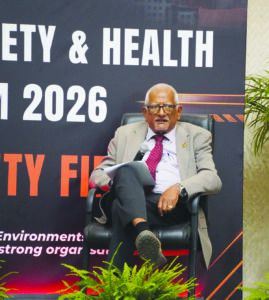
According to Professor Sankat, Guyana is undergoing an unprecedented transformation and growth in a new industrial environment as never seen before, from oil, gas and energy to mining and agriculture, building not just an economy but shaping a new culture of work and, ultimately, the future of Guyana.
However, he noted that this growth must not come at the expense of workers’ physical safety and mental well-being, emphasising the importance of creating the environment for people to truly work safely, with their health and well-being being a priority. To this end, Professor Sankat called for a shift beyond mere compliance across all levels, something he stressed is even more important as Guyana continues to grow in this new developmental pathway.
He contended that leaders must reward and celebrate safe and humane behaviours at the workplace, embed psychosocial risks into systems and start measuring culture, not just compliance.
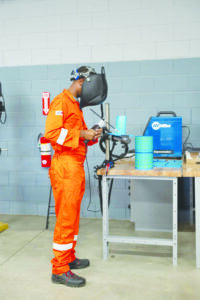
“We must reward and celebrate safe behaviour,” he highlighted, while urging supervisors to lead with respect and encourage their teams to speak up, and when they do, reward that courage. Similarly, he implored workers to “…take ownership of your safety; speak up, even when it is uncomfortable; be your brother’s or sister’s keeper; and avoid the shortcuts that seem tempting in the moment. Value the mentorship and training provided by your employer.”
Team effort from all
At the Government level, Professor Sankat is advocating for the strengthening of labour laws to include psychosocial risks and promoting national standards for total workplace well-being in this rapidly industrialising Guyana. “It will take a team effort from all of us to build a safer and happier working environment,” he declared. While the focus is often placed on physical hazards such as a missing guardrail or the lack of personal protective equipment (PPE), Professor Sankat drew attention to the “psychosocial” working environment.
This, he explained, is the interaction between how work is designed, managed, executed and experienced. It includes the invisible forces that dictate daily lives: workload, the way leaders and supervisors show or demonstrate support and empathy and whether workers feel valued, respected, or empowered.
According to Sankat, these factors are the true drivers of how decisions are made and how safe and amenable the working environment is physically, emotionally, and mentally. In fact, he highlighted that workers often make decisions under constraints like limited time, fatigue and intense pressure without taking safety into consideration.
“In high-risk areas like our offshore environment or remote mines, workers aren’t always performing a perfect risk analysis; they often use fast, reflexive thinking as opposed to more nuanced critical thinking. This is where accidents happen. I am also deeply concerned about the ‘normalisation of deviance’, where skipping a safety check or not wearing your Personal Protective Equipment (PPE) becomes the new normal simply because ‘nothing went wrong last time’. Regretfully, we see this occurring in many workplaces. This is a trap that remains invisible until tragedy strikes,” the GTTCI Director stated.
Learning from tragedies
Pointing to sobering incidents in Guyana such as collapses at mining pits during heavy rains, which are failures of planning and supervision rather than just acts of nature; the four lives lost in a vessel’s engine room in Georgetown due to toxic fumes in a confined space; or the reoccurring tragedies in the agricultural sector whereby tractors roll over in muddy rice fields – all of which he declared are preventable.
“These are not just technical failures; they are shaped by fatigue, pressure, and cultures where unsafe practices have become normalised and where the training for operating in such difficult off-road conditions may not have been provided to our humble farmers. Safety cannot exist without capability, and yes, there’s a cost to building safe systems, but the cost of failure is far greater; lives can be lost, families can be devastated, reputations can be permanently damaged, and the competitiveness of institutions and entire industries can be seriously weakened,” he posited.
At the GTTCI, located at Port Mourant, Region Six, Professor Sankat said they are building and operating on a simple principle: “Safety is not just a set of rules; it is a culture and a shared responsibility.” He said they are driven by the college’s partner, ExxonMobil’s, guiding principle: “Nobody gets hurt.” This, he contended, is not just a slogan but a mindset that is now being embedded in all the students at the GTTCI.
The Director went on to quote management guru Peter Drucker, who said, “Culture eats strategy for breakfast.” According to Professor Sankat, “You can have the best policies in the world, but if your culture doesn’t support safe behaviour when no one is watching, those systems will fail. My goal is a Guyana where every worker returns home safe to their families – physically, mentally and emotionally – and where they are happy to return to work the next day. Let us build a nation where growth does not come at the expense of people – but because of our people.”
Discover more from Guyana Times
Subscribe to get the latest posts sent to your email.