– to seek Govt approval for gas development in early 2026
United States oil major ExxonMobil is already eyeing its ninth project offshore Guyana and will be seeking the Government’s approval next year to develop the gas resources at the Haimara discovery in the prolific Stabroek Block.
“Back in February, we began to talk about project number nine, or what could potentially be project number nine, which will be anchored on the Haimara discovery in the very southeast part of the Stabroek Block,” President of ExxonMobil Guyana Limited (EMGL), Alistair Routledge, told reporters at a press conference on Thursday.
Expressing confidence in the Haimara gas development field, Routledge noted, “A lot of excellent technical work has been going on. We’re gaining confidence that this project can meet the sort of investment hurdles that we would expect the Government would expect us to achieve, and so we’re maturing that.”
In fact, the Exxon Country Manager says that in order to achieve an earlier timeline for start-up, they are looking to have a Field Development Plan (FDP) ready around this time next year. In preparation for that, the oil major will likely submit an application in the coming weeks for environmental authorisation to Guyana’s Environmental Protection Agency (EPA) for the Haimara area project.
ExxonMobil has already received the Government’s approval to develop six projects – Liza Phase One and Two, Payara, Yellowtail, Uaru (2026), and Whiptail (2027) – in the Stabroek Block offshore Guyana, all of which are primarily oil projects.
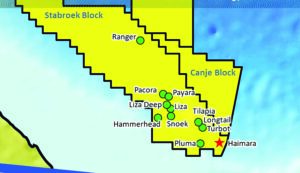 However, Exxon’s seventh and eighth projects, Hammerhead and Longtail, respectively, are major gas developments. In fact, the southeast section of the Stabroek Block is considered a gas area and will be the anchor for several gas projects to be developed, including Haimara and Longtail.
In the Stabroek Block, which ExxonMobil operates along with its co-venturers – Hess and CNOOC – some 17 trillion cubic feet of gas has already been found, with the Haimara well along with Pluma being proven gas fields.
Routledge explained during Thursday’s press conference at the company’s Ogle, East Coast Demerara, headquarters that both Haimara and Pluma would be utilised for the ninth offshore development.
“Although I talked about Haimara as the anchor, we do foresee Pluma being part of that development. So, the remaining gas discoveries that are not included in the Longtail development that we submitted would be associated with a Haimara-anchor development. So, having a floating production facility in the vicinity of Haimara but tying back these other resources in order to maximise recovery,” he noted.
Routledge explained that Haimara is favoured over the Pluma discovery since the latter is drier and contains less gas condensate.
“[Pluma] still does have gas condensate in the reservoir; it still would produce condensate, but it’s drier. We haven’t done as significant testing of that reservoir as we have with some of the others, so I don’t have dynamic data…but on a relative basis based on the static data we’ve collected from the reservoir, it looks like it’s less condensate than some of the others. That’s why we would favour developing other reservoirs before we would then tie back Pluma in order to maximise recovery of the condensate,” he noted.
Meanwhile, the Guyana Government last year approved the Hammerhead project, which is likely to deliver around 80 to 90 million cubic feet (mmcf) per day of gas from Hammerhead at peak production. Initially set for a 2029 start-up, Hammerhead is now projected to come onstream one year earlier instead, feeding gas into the Gas-to-Energy pipeline.
“It will not re-inject gas into the Hammerhead reservoir… Because it’s a heavier crude in Hammerhead, there is not the same benefit to injecting the gas. So, that will provide two benefits. One is more security of supply for gas onshore to power generation, but it also will allow us to continue to optimise where we inject gas to maximise the recovery of liquids from the fields in the Stabroek Block,” Routledge stated.
Then in 2030, Exxon is looking to bring the Longtail project online. Already, the company has submitted its Environmental and Social Impact Assessment (EIA) to the EPA, and the 60-day public consultation process will get underway next month.
Additionally, the Field Development Plan for Longtail has been finalised and is expected to be submitted to the Ministry of Natural Resources in the coming days.
“So, at that point, we will have both the environmental permitting process coming close toward the end of its process and the Field Development Plan and application for the production licence advancing with the Ministry of Natural Resources and GGMC (Guyana Geology and Mines Commission),” the ExxonMobil Guyana head said.
The Guyana Government has been pushing ExxonMobil to develop the country’s rich gas resources offshore, touting the establishment of a second gas project in Region Six (East Berbice-Corentyne) to support large-scale industrial growth with power plants, a data centre, and an alumina plant, among other heavy industries – an initiative that will be separate from the highly anticipated Gas-to-Energy (GtE) project at Wales, West Bank Demerara.
However, Routledge told reporters on Thursday that the pipeline infrastructure to connect to the Berbice gas project would be much larger and could cost double the US$1 billion for the 250-kilometre, 12-inch pipelines that connect the GtE Project to the Liza field in the Stabroek Block.
But he noted that Exxon is keen on making this investment since there is growing interest from international companies in Guyana’s energy potential.
“Several letters of interest have been submitted to the Government and us indicating interest in projects such as data centres, converting bauxite to alumina, and more power generation. So, we can see real interest in building a domestic gas market… They’ll be looking to us to have surety of supply of gas, and we’ll be looking to them to make sure that they’re going to be ready to take the gas from us. So that’s what we’re working toward,” Routledge indicated.
Discover more from Guyana Times
Subscribe to get the latest posts sent to your email.