

…8438 students, 1664 teachers to benefit
Nineteen educational institutions across Region Six (East Berbice-Corentyne) are now benefiting from solar-powered water purification systems under the National Water Purification and Sustainability Initiative FLOW, as the programme continues its rollout across Guyana.
The Region Six phase, commissioned at the New Amsterdam Secondary School, covers 17 secondary schools and two Technical and Vocational Education and Training (TVET) institutions, benefiting 8438 students and 1664 teachers.
The institutions serve young people and families from approximately 219 communities across East Berbice-Corentyne.
FLOW is being implemented through the collaborative efforts of Recover Guyana, the Greater Guyana Initiative (GGI) and the Education Department and is designed to address access to clean and safe drinking water in schools while reducing single-use plastics, promoting environmental sustainability and exposing students to science and technology.
The initiative has a national target of 155 sites, 141 public secondary schools, 10 TVET institutions and four special needs schools across 11 educational districts.
Region Six is the second regional rollout, following the commissioning of systems at 16 schools in Region Three. With the completion of the 19 Region Six sites, FLOW has reached 35 of its targeted 155 sites nationally, representing approximately 23 per cent of the overall target.
Speaking on behalf of the Greater Guyana Initiative at the Region Six commissioning, ExxonMobil Guyana President Alistair Routledge placed FLOW within the wider objective of ensuring that the benefits from Guyana’s natural resources are translated into sustainable development for communities.
He explained that the Greater Guyana Initiative represents a GY$20 billion commitment made in 2021 towards projects aimed at investing in the country, building capacity in other sectors of the economy and contributing to a sustainable future.
“To invest in the country, to invest in a sustainable future, to build capacity in other parts of the economy so that what is being realised from the resources of the country will translate into sustainable, diverse development for the country in the future. Because, as we know, natural resources are finite,” Routledge said.
He noted that while natural resources are a gift, what is most important is how the country and society use them, adding that investment in infrastructure and people is essential.
Routledge said the partners under the Greater Guyana Initiative were pleased to be able to “make our contribution to that.”
He said FLOW was particularly important because its benefits extend beyond providing drinking water and into education and technology.
“Because FLOW brings technology into schools. It’s not just about the delivery of fresh potable water. It’s about giving the school and the students something to own, to feel responsible for,” he said.
Routledge added that students have an opportunity to understand the technologies involved in providing the water while taking responsibility for maintaining the systems and ensuring that they continue operating effectively.
Education Minister Sonia Parag also placed significant emphasis on the partnership behind FLOW and the importance of translating available resources into tangible benefits for people and communities.
She told students that having resources was not in itself enough, but that what is done with those resources for the development of the country, communities and people is what matters.
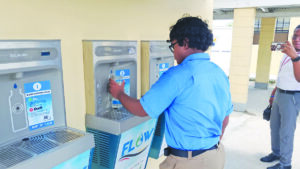
Parag said FLOW demonstrates what can be achieved through such a partnership, noting that what may appear to be the simple act of obtaining filtered water from a dispenser can have significant implications for students.
The Minister also highlighted the environmental significance of FLOW, pointing to the number of plastic bottles that could be removed from use as students and teachers utilise the purification systems.
Across the 19 Region Six institutions, FLOW is projected to generate approximately $103.74 million in savings over a three-year period through reduced expenditure associated with accessing drinking water.
The initiative also has the potential to prevent approximately 1.92 million single-use plastic bottles from being used each year in Region Six, or more than 5.76 million bottles over three years.
At an estimated $120 per bottle, project officials have placed the potential savings to direct beneficiaries at approximately $691.34 million over three years.
The water supplied through the FLOW systems undergoes a multi-stage purification process, beginning with collection and storage before passing through gravel, green sand and activated carbon filtration to remove contaminants, iron, sediments, odours and unwanted chemicals.
It then undergoes progressively finer particle filtration before passing through reverse osmosis, which removes dissolved salts, bacteria, viruses, heavy metals and other contaminants. The purified water is stored before undergoing ultraviolet sterilisation and is then made available to students and teachers through touchless cooling dispensers.
Parag, meanwhile, told students that receiving the infrastructure also places a responsibility on them to protect it and ensure that it remains available for those who come after them.
She urged them not to deface or destroy the systems and said maintaining school infrastructure should not be regarded solely as the responsibility of cleaners, ancillary staff or school administrators.
The Region Six rollout has also provided employment opportunities within communities, engaging workers in welding, plumbing, painting, electrical work, solar installation, carpentry and general labour.
Discover more from Guyana Times
Subscribe to get the latest posts sent to your email.