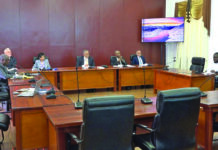


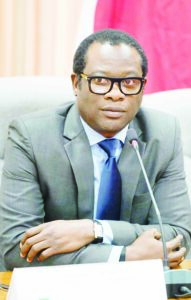
The Guyanese Government has been invited by its Surinamese counterpart to discuss the controversial fees imposed by authorities in the Dutch-speaking nation on Guyanese operators using the Corentyne River.
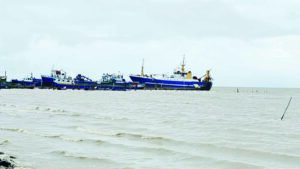
Last month, President Dr Irfaan Ali disclosed that he had issued a diplomatic note to the Government of Suriname to formally protest the institution of the charges on Guyanese timber and quarry operators traversing the Corentyne River, which borders the two countries; however, the Dutch-speaking nation has sovereignty over the critical waterway.
In a statement on Friday, the Ministry of Foreign Affairs, International Trade, and Cooperation in Paramaribo said it has responded to Guyana in an April 20 Nota Verbale, explaining the legal and administrative basis for the application of maritime charges and further inviting Guyana to engage on the matter.
“The Cooperative Republic of Guyana has been invited to technical discussions…,” the missive detailed.
Contacted on Friday, Foreign Affairs and International Cooperation Minister Hugh Todd told the Guyana Times that no date has been fixed for this meeting. However, he noted that talks are ongoing between the two countries with the aim of finding a mutually acceptable solution to the situation.
“So, we will be having dialogue with Suriname at the level of the Foreign Ministries to find a reasonable solution to the fees and charges being imposed by Suriname,” Minister Todd told this newspaper on Friday evening.

Exemptions
Meanwhile, in Friday’s statement, the Surinamese Foreign Ministry explained that these maritime charges are based on existing laws and regulations of Suriname and do not represent a recent policy change. It was explained that Suriname had previously granted specific and limited exemptions to the Guyana Sugar Corporation (GuySuCo) to freely utilise the Corentyne River – something that was not intended as a general exemption for all vessels using the waterways.
Moreover, the Foreign Ministry in Paramaribo further emphasised that all vessels, including Surinamese and foreign vessels, operating within Surinamese jurisdiction remain subject to the applicable laws and regulations. This, the missive added, upholds the principle of equal application of maritime rules.
Nevertheless, the Surinamese Government has expressed, in the statement, its appreciation for the long-term cooperation with Guyana and reaffirms its commitment to a constructive and cooperative relationship. Hence, the invite was extended to discuss the maritime charges.
“The Cooperative Republic of Guyana has been invited to technical discussions for the evaluation of the relevant arrangement for GuySuCo and further discussions in connection with the safe navigation and trade on the Corentyne River,” the missive noted.
Suriname’s statement on Friday came in response to a media report in Guyana, which states that the Guyanese vessels were being allowed to freely use the Corentyne River.
But according to the Surinamese Ministry, the article does not accurately reflect the policy and practice in the use of the Corentyne River, adding that the statements regarding the discontinuation or adjustment of maritime charges are contradictory to current policy and regulations.
Economic impact
Already, communities along the Upper Corentyne region of Guyana are beginning to feel the weight of uncertainty as a result of the introduction of this new maritime fee, with those along river-dependent villages like Orealla bracing for a direct hit on their livelihoods. In fact, economic activity in Orealla is heavily tied to sand mining, loam extraction, and timber production – industries that depend almost entirely on river access.
Moreover, the local Private Sector has been up in arms about the fallout that these new charges would bring to economic activity in Guyana, as well as trade relations with Suriname.
Only earlier this month, President Ali told reporters in Georgetown that he raised the issue with Suriname’s Foreign Affairs Minister, Melvin Bouva, when he travelled to Paramaribo on April 7 for the funeral of former Surinamese President Chandrikapersad Santokhi.
“[The visit] was for a specific purpose; to pay tribute to President Santokhi, to honour the work and partnership that we had. But yes, of course, I raised the matter with the Minister of Foreign Affairs,” the Guyanese leader indicated.
According to the Head of State, his Government has placed tremendous emphasis on this issue, and it remains a priority matter for the Ministry of Foreign Affairs and International Cooperation in Georgetown. “So, every day, we are engaged with it,” the President had stated.
In his March 26 protest note to Paramaribo, President Ali had indicated that Guyana expects Suriname to reconsider and ultimately desist from such actions that may be perceived as arbitrary or detrimental to the shared objective of deepening cooperation between the two countries.
While expressing hope that this matter would be “dealt with as friends”, the Guyanese Head of State had underscored the importance of reciprocity, reminding that Surinamese businesses have been enjoying a level of freedom and equity of access, like any local businesses, here.
In fact, during his remarks at President Santokhi’s funeral service in Paramaribo, President Ali subtly addressed the issue, noting that the former Surinamese President viewed the shared waterway as a passage of unity between the two countries, not as a border for discord.
“He believed that the fortunes of our two lands were braided together. He often spoke of the river not as a line between us but as a vein connecting two hearts, a passage of unity, not a border for discord,” President Ali expressed.
Discover more from Guyana Times
Subscribe to get the latest posts sent to your email.