


– lauds recent engagement between Presidents Ali, Geerlings-Simons
The Suriname-Guyana Chamber of Commerce (SGCC) has lauded the recent bilateral engagement with President Dr Irfaan Ali and his Surinamese counterpart, Jennifer Geerlings-Simons, stating that their renewed commitment to cooperation and economic integration will not only stabilise cross-border business activities but also open up new opportunities.
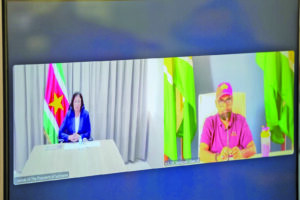
In a statement on Thursday, the SGCC pointed out that these commitments by the two neighbouring Heads of State “reflect the growing recognition that Suriname and Guyana are uniquely positioned to build a stronger and more connected economic corridor through sustained cooperation, improved connectivity, and greater private sector engagement.”
As a bilateral business support organisation operating across both markets, SGCC believes that continued dialogue and practical cooperation between the two South American nations are essential to creating a more predictable, connected, and opportunity-driven environment for businesses operating within the corridor.
On May 15, President Ali and President Geerlings-Simons met virtually to address a number of issues, including movement along the Corentyne River and challenges facing the fishing sector, as well as opportunities in the area of oil and gas. The engagement was described as a positive and encouraging signal for the future of bilateral cooperation, trade, private sector engagement, and regional integration between the two neighbouring countries.
Following the meeting, President Ali emphasised the importance of deepening bilateral ties, noting the countries’ “shared commitment to deepening our partnership and friendship to ensure further economic cooperation, expansion of trade, and integration of our economies.”
On the other hand, the Surinamese leader noted that discussions focused on “the further strengthening of socio-economic cooperation between Suriname and Guyana”, including collaboration in oil and gas, fisheries, and navigation on the Corentyne/Corantijn River. President Geerlings-Simons further stated that both countries “will also actively involve the private sector in further cooperation processes”.
In Thursday’s missive, the SGCC said for its members and the wider private sector, stronger bilateral engagement can help unlock greater cross-border trade, investment facilitation, joint ventures, logistics and supply chain opportunities, improved market access, and deeper regional value chain integration across key sectors driving growth in both economies.
“The Chamber particularly welcomes the recognition of the private sector as an active stakeholder in future cooperation efforts and remains committed to supporting initiatives that strengthen business-to-business engagement, cross-border partnerships, and regional integration between Guyana and Suriname,” the statement detailed.
Last week’s high-level meeting comes on the heels of economic tensions between the two nations after Surinamese authorities imposed new fees on Guyanese vessels traversing the Corentyne River, which borders the two countries – a move that is affecting local timber and quarry operators.
While the statement from Guyana’s Office of the President did not mention any dialogue on this issue between the two Heads of State, Suriname’s President Jennifer Geerlings-Simons, via a Facebook post, indicated that the matter was discussed.
In March, President Ali issued a diplomatic note to the Government of Suriname, protesting the imposition of the maritime fee, indicating that Guyana expects its South American neighbour to reconsider and ultimately desist from such actions that may be perceived as arbitrary or detrimental to the shared objective of deepening cooperation between the two countries.
Meanwhile, the two neighbouring leaders discussed challenges within the fishing industry, though no further details were provided.
Under Suriname’s existing legal framework, licenses to fish in the Corentyne River are generally issued only to Surinamese nationals or companies, leaving Guyanese fishermen unable to obtain licenses directly.
This has forced many to rely on costly arrangements with intermediaries, significantly increasing operational expenses and cutting into already thin profit margins. Although previous bilateral engagements had resulted in assurances that a special allocation of licences would be granted to Guyanese fishermen, those licences were never delivered.
Additionally, during the May 15 meeting, the two South American leaders discussed the impact of climate change and current challenges posed by heavy rainfall, including flooding.
Both Guyana and Suriname are dealing with flooding following intense rainfall in recent weeks. In fact, only on Thursday, it was reported that Guyana has loaned two high-capacity water pumps to support ongoing efforts to address widespread flooding caused by persistent rainfall in the Dutch-speaking nation.
Presidents Ali and Geerlings-Simons also furthered discussions on the establishment of a bridge across the Corentyne River, linking the two countries. The high-span Corentyne River bridge will run approximately 3.1 kilometres, connecting Moleson Creek in Guyana to South Drain in Suriname, with a landing on Long Island in the Corentyne River, where a commercial hub and tourist destination will be established.
Already, Guyana and Suriname have settled on the Chinese construction company, China Road and Bridge Corporation (CRBC), as the preferred contractor to build the new bridge. However, it is unclear whether the contract has been signed.
According to the statement from President Geerlings-Simons, Guyana and Suriname also discussed opportunities in the oil and gas sector. Earlier this year, President Ali told the Energy Conference and Supply Chain Expo in Georgetown that the two countries could jointly develop their natural gas resources.
The Guyanese leader had previously touted several projects that are being considered for this gas monetisation plan, including the export of energy to northern Brazil, a shore base facility, an additional power plant, and a potential joint aluminium plant facility using bauxite from both Guyana and Suriname.
Meanwhile, a statement from the Office of the President in Georgetown indicates that the two countries committed to working within a three-month framework to finalize many of the matters discussed.
Discover more from Guyana Times
Subscribe to get the latest posts sent to your email.