


…reaffirms support for Guyana’s sovereignty, territorial integrity
As the International Court of Justice (ICJ) deliberates on its decision regarding the border controversy between Guyana and Venezuela, the Caribbean Community (Caricom) has reaffirmed that this judicial process is the proper means of resolving decades-long controversy between the two South American neighbours.
This position by the regional bloc was reiterated during the 29th Meeting of the Council for Foreign and Community Relations (COFCOR) of the Caribbean Community that was held in Paramaribo, Suriname, from May 20 to 21. Suriname’s Minister of Foreign Affairs, International Business and Cooperation, Melvin Bouva, chaired the meeting, and Guyana was represented by its Ambassador to Caricom, George Talbot.
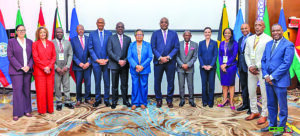 In a joint communiqué on Wednesday, it was noted that during the meeting, the Foreign Ministers received an update on the recently concluded oral hearings by Guyana and Venezuela before the World Court.
From May 4 to 11, both countries were given two opportunities to make oral arguments on the merits of their respective cases at the Peace Palace in The Hague, Netherlands.
The Caricom Ministers expressed satisfaction with the participation of both Guyana and Venezuela in the proceedings and underscored the importance of the parties’ respect for international law; the 1966 Geneva Agreement, especially its Article IV (2) that empowered the Secretary General of the United Nations to choose the ICJ as the means of settlement of the controversy; the Charter of the United Nations; and the final and binding character of the Court’s eventual judgement on the merits.
“Ministers reiterated their full support for the judicial process as the proper means of resolving the controversy between Guyana and Venezuela peacefully, finally and in accordance with the Geneva Agreement and international law, and they reaffirmed Caricom’s firm and unwavering support for the maintenance and preservation of the sovereignty and territorial integrity of Guyana,” Wednesday’s missive detailed.
This statement from the Foreign Ministers comes nearly two weeks after the regional bloc reaffirmed its unwavering support for Guyana’s territorial integrity and the judicial process.
At the opening ceremony of the Centre for International and Border Studies Conference in Georgetown earlier this month, Caricom’s Assistant Secretary-General Elizabeth Solomon declared, “Sovereignty is not a static achievement but a continuous work of diplomacy, intellectual rigour and national resilience. Within this context, I reiterate the unwavering position of the community regarding the Guyana–Venezuela border controversy. Caricom remains firm in its support for the judicial process before the International Court of Justice and continues to advocate for a peaceful, legal resolution that respects Guyana’s territorial integrity and maintains our region as a zone of peace.”
The Spanish-speaking nation is laying claims to more than two-thirds of Guyana’s landmass and a portion of the country’s Exclusive Economic Zone (EEZ), where over 11 billion barrels of oil equivalent (BOE) have been found and production as well as other exploration activities are ongoing.
Back in 2018, and based on the recommendation of then UN Secretary-General António Guterres following years of failed diplomacy between the two countries, Guyana had approached the ICJ, seeking a final and binding settlement of the 1899 Arbitral Award, which establishes the boundaries with Venezuela.
Only last Friday, President Dr Irfaan Ali said that the ICJ’s pending ruling will give finality to the border controversy with Venezuela, and Guyana will wait with patience and dignity for that decision – something which he is confident will be in this country’s favour.
“Guyana has pledged repeatedly, including at these oral hearings, that it will abide by the court’s judgement, whatever it may be. Guyana is confident, in fact, that after the oral hearings, we are even more confident than ever that the Court will uphold the legal validity of the 1899 Arbitral Award and the finality and permanence of the international boundary between Guyana and Venezuela,” Ali told a press conference at the Office of the President last week.
He went on to underscore that disputes between states must be resolved peacefully and never through military force, as he called on Caracas to change its defiant stance and choose peace. During the recent oral arguments, Venezuela’s acting President Delcy Rodríguez, declared that the Spanish-speaking nation would reject any ruling by the rule, insisting that the court has no jurisdiction to hear the matter.
But according to President Ali, “We will await the court’s final judgement on the merits with patience, dignity, and optimism.” We’ll continue to address Venezuela in a spirit of peace, cooperation, and friendship and as sovereign equals.”
“It is our fervent hope that Venezuela’s expression of disrespect for the court and for international law reflects the emotions that often accompany litigation of this kind. We hope that after passions recede and responsible Government officials reflect, they will conclude, as we have done, that both states are best served by an end to this long-standing conflict and that the only way to secure a just and lasting peace and an enduring friendship is by respect for and compliance with the court’s final judgement, whatever it may be, as required by the United Nations Charter,” the Guyanese leader stated last Friday.
Discover more from Guyana Times
Subscribe to get the latest posts sent to your email.