


The Caribbean Examinations Council (CXC) has reported a slight improvement in overall performance at the Caribbean Secondary Education Certificate (CSEC) level, with 72.18 per cent of subject entries receiving acceptable grades in the May-June 2026 examinations, while Mathematics recorded a four-percentage-point increase to 42 per cent.
The results were officially released on Tuesday during a regional ceremony hosted in Anguilla, where CXC officials also announced the formal introduction of a new modular certification system aimed at recognising what students have mastered even when they have not yet successfully completed an entire subject.
CXC Director of Operations Dr Nicole Manning, presenting an analysis of the results, welcomed the improvement in Mathematics, a subject which has historically posed significant challenges for candidates across the Caribbean.
“For math, the regional percentage being 42 per cent, this is a four per cent increase over the previous year. And this is a good story,” Manning said.
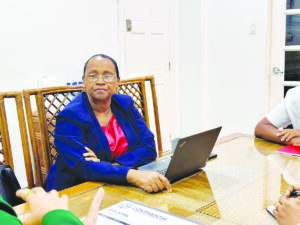
“I don’t want anybody to be crying because any improvement in math is a good improvement. Improvement is improvement.”
The Mathematics performance, however, remained well below several of the other major CSEC subjects.
Information Technology was among the strongest-performing subjects highlighted, with 83 per cent of candidates receiving acceptable grades, while Principles of Business recorded 81 per cent and English A recorded 80 per cent.
Electronic Document Preparation and Management (EDPM) recorded 79 per cent and Human and Social Biology 78 per cent.
Among subjects performing at or below the overall regional CSEC rate were Principles of Accounts at 72 per cent, Physics at 69 per cent, and Chemistry at 68 per cent.
CXC also pointed to challenges in Social Studies, with Manning saying the subject had “taken a hit this year”. Performance across individual territories ranged widely, from 44 per cent to 100 per cent.
At the Caribbean Advanced Proficiency Examination (CAPE) level, meanwhile, CXC reported that 93.52 per cent of candidates overall received acceptable grades.
Strong performances were reported in several subjects, including Information Technology, Environmental Science and Physics.
Information Technology recorded acceptable-grade rates of 95 per cent and 99 per cent for Units One and Two, respectively, while Environmental Science recorded 97 per cent for Unit One and 96 per cent for Unit Two. Physics also recorded regional performances of 97 and 98 per cent.
Communication Studies recorded a 93 per cent acceptable-grade rate.
New certification pathway
One of the most significant developments accompanying the release of the 2026 results was the official launch of the Caribbean Targeted Education Certificate (CTEC), following a pilot programme in Mathematics which CXC said produced encouraging results.
CXC Registrar and Chief Executive Officer Dr Wayne Wesley said the initiative represents a fundamental change in how the council recognises learning, particularly for students who demonstrate competence in portions of a subject but do not attain an acceptable grade in the complete examination.
For years, Wesley said, only about one-third of candidates have typically achieved acceptable grades in Mathematics.
Under the traditional system, he explained, students could spend five years studying the subject but receive no formal recognition if their overall examination performance fell below the required standard.
“Not because they learnt nothing, but because our instrument of assessment was an all-or-nothing event. One subject, one sitting, one verdict,” Wesley said.
CTEC seeks to change that by dividing the existing syllabus into focused modules which can be individually assessed and certified.
CXC stressed that the programme does not lower the academic standard.
CTEC uses the same subject content, syllabus and assessment standards as CSEC but allows candidates to demonstrate competence progressively. Each successfully completed module becomes a credential which can be banked and ultimately accumulated towards the complete qualification.
“A module is not a whole subject. The full qualification still requires completion of every module at the full standard,” Wesley stressed.
“But that is precisely what these results demonstrate. When learning is assessed in focused, achievable stages, our students do more than cope. They excel.”
88% succeed in pilot
More than 2500 candidates participated in the Mathematics Module One pilot across 15 Caribbean territories and 42 centres.
Of the 2535 candidates who wrote the Module One examination during the May-June sitting, 88 per cent achieved acceptable grades.
According to Wesley, only one candidate across the pilot received the lowest grade.
He said the performance was particularly significant when compared with the long-standing difficulties candidates have experienced in the full Mathematics examination.
CXC also examined the performance of students who sat the regular CSEC Mathematics examination because the competencies tested under CTEC Module One are already embedded in that examination.
Wesley subsequently announced that 69,567 candidates had earned the Module One credential.
Of particular significance, he said, were 41,367 candidates whose learning could now be formally recognised under the new system.
“These are 41,000 students we would not have recognised otherwise,” Wesley said.
“What we have done here with CTEC is to ensure that no learning goes to waste.”
CXC officials explained that candidates who successfully complete individual modules will be able to progress to the remaining modules. Candidates in the 2026 pilot will be allowed to complete Modules Two and Three free of cost and will have up to four years to complete the process.
Once all three Mathematics modules are successfully completed, the candidate can attain the full qualification.
Employment value
CXC also intends for the individual credentials to have practical value outside the classroom.
During a question-and-answer session following the results presentation, Wesley said the modules were structured around identifiable competencies which could help employers determine what skills a prospective employee possesses.
He pointed to consumer arithmetic in Mathematics Module One, including areas such as pricing, discounts, simple interest and compound interest, as competencies that could be useful in entry-level employment.
Module Two, he explained, incorporates statistical competencies which could have applications in areas involving population data, census work and statistical analysis.
CXC has consequently been engaging employers across the Caribbean to explain what the individual credentials represent.
Officials also made clear that CTEC is not intended to replace CSEC.
Instead, it provides a modular pathway within the same qualification framework, allowing students to obtain micro-credentials as they progress.
Additional subjects are expected to be modularised during 2027 and 2028, while CXC officials indicated that the approach is also being developed for CAPE.
32,403 CSEC candidates absent
Despite the improved overall performance, CXC expressed serious concern about the number of registered candidates who failed to appear for examinations.
Manning disclosed that 32,403 CSEC candidates were absent, while another 3534 candidates were absent at CAPE.
“For CSEC, it’s even more worrying,” she said, describing more than 32,000 candidates failing to turn up for examinations as an issue that education systems throughout the region needed to address.
CXC surveys, she said, have found that some candidates deliberately stay away because they believe they are inadequately prepared.
“This is not a reason to be absent. Just try,” Manning urged.
A candidate who misses a required examination component may have no opportunity to receive a grade.
CXC raised similar concerns about the non-submission of School-Based Assessments (SBAs).
Manning distinguished between cases where candidates completed their SBAs but centres failed to submit them to CXC and cases where candidates themselves failed to complete the required work.
She said non-submission by candidates was increasing and warned that failure to complete an SBA, third paper or other compulsory component could result in a candidate being ungraded.
Exam irregularities increase
CXC also recorded an increase in examination irregularities during the 2026 sitting.
There were 128 reported irregularities, compared with 80 previously.
The use of unauthorised devices represented the largest category, followed by collusion among candidates and the use of unauthorised material.
For the first time, CXC also recorded the misuse of artificial intelligence as an examination irregularity.
Manning said the council had already developed standards and guidelines governing the use of artificial intelligence in assessments and continued to encourage schools and education authorities to promote responsible use of the technology.
Candidates found responsible for examination misconduct can have their grades cancelled or be disqualified.
At the same time, CXC provided compassionate consideration to 359 candidates who encountered circumstances, including medical or other serious personal situations, which could otherwise have disadvantaged them.
The Council also continued to provide special assessment arrangements for candidates requiring additional assistance, including extra time or other accommodations.
Gender gap persists
CXC’s figures also highlighted a continuing gender disparity as students progress through the regional education system.
At CSEC, females accounted for 59 per cent of candidates, compared with 41 per cent males.
The disparity widened at CAPE, where females represented 62 per cent of candidates and males 38 per cent.
At the Caribbean Certificate of Secondary Level Competence (CCSLC), however, males represented 52 per cent and females 48 per cent.
Manning noted that participation is much closer to equal at the primary level and said the widening disparity as students move through secondary and post-secondary education required closer examination by regional education authorities.
Meanwhile, CXC reported continued growth in some of its other qualifications, including the Caribbean Vocational Qualification (CVQ).
Some 4977 candidates registered across 37 occupational areas for CVQs in 2026, up from 3719 candidates across 36 occupational areas the previous year.
CXC said the expansion of its qualifications, increased use of electronic assessment and introduction of modular certification are intended to provide Caribbean learners with more flexible routes through education and into employment without compromising established academic standards.
Wesley said CTEC represented a shift away from an assessment system in which students who had demonstrated significant learning could nevertheless leave without any certification of what they had achieved.
“At CXC, we hold to the position that competence is competence, no matter how long it takes to achieve, and no matter the route by which it comes,” he said.
Discover more from Guyana Times
Subscribe to get the latest posts sent to your email.