

…as Pres Ali pledges end to public hospital medicine shortages
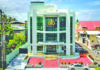
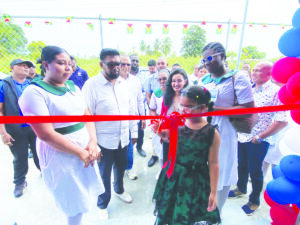
Residents across Region Two (Pomeroon-Supenaam) are set to benefit from improved access to essential medicines following the official commissioning of a new $230 million Regional Medical Distribution Centre at Onderneeming on Saturday. President Dr Irfaan Ali, who commissioned the modern facility, said the investment is part of the Government’s strategy to modernise Guyana’s healthcare system through digital innovation and decentralised services. President Ali explained that the distribution hub will improve the storage and delivery of medicines, ensuring health facilities throughout the region maintain adequate pharmaceutical supplies. He noted that communities in remote areas, including the Pomeroon, will receive medications more efficiently through enhanced logistics and inventory management systems. The facility is equipped with advanced digital technology that enables real-time monitoring of medicine stocks, helping health officials improve accountability, minimise shortages and streamline distribution.
“For too long, our healthcare system, particularly in regions outside the capital, has been plagued by logistical challenges. This facility changes that in a dynamic way. It allows us to stock sufficient quantities of medicines to meet the specific needs of this region,” President Ali said, adding, “And when I say the specific needs of this region, I mean all of Region Two, in all the health centres, health clinics, and health outposts all across…and even a section of Region One.” He said that the centre is a culmination of years of planning and a key aspect of strategy to ensure that health clinics and hospitals have more timely access to the medicines they need to save lives. Ali said Guyana’s public healthcare system is undergoing a major transformation aimed at ensuring patients no longer have to purchase essential medication from private pharmacies because of shortages at public health facilities. Speaking about the Government’s investment in strengthening the country’s pharmaceutical supply chain, the President reflected on the challenges that plagued the health sector during the 1980s, when public hospitals frequently lacked essential medication.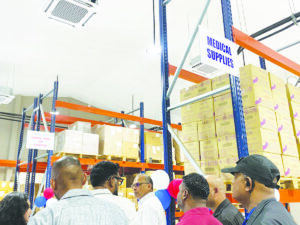
“There was a period in Guyana’s history in the 1980s when our public health system faced severe constraints,” President Ali said. “Old timers will recall a time when visiting a public hospital meant facing a stark reality.” He recalled that while basic medication such as paracetamol might have been available, many other essential drugs were often out of stock, forcing patients to seek medication privately. According to President Ali, the Government is now ensuring that all approved medication is available within the public healthcare system through a scientifically managed procurement process. He explained that a scientific board is responsible for reviewing and approving all medicines to be used in public health facilities. “We are putting all of the medication in the system,” he said. “We have a scientific board that is clearing all the medication that Guyana will use in our public health care system.” He stressed that doctors working within the public healthcare system will only be permitted to prescribe medication from the approved list, as those are the drugs the Government is investing in to provide free of cost to patients.
“Those days are over.”
President Ali declared that the era of patients being forced to purchase medication privately because of shortages at public facilities must come to an end. “Those days are over. We refuse to accept a situation where a patient at a public health facility has to go to a private pharmacy to procure medication simply because the medicine is not available within the public health facility in their area,” he said. He described the establishment of the medical distribution centre as a significant step towards decentralising the country’s healthcare supply chain. Rather than storing large quantities of medication in a single central facility, regional drug bonds will ensure medicines are located closer to the communities they serve. “We do not want a situation in which billions of dollars of drugs are lying in our main bond while outlying regions and communities are short of these drugs,” he said. “We do not want a situation in which drugs expire in the bond whilst clinics and hospitals are in need of those very drugs.”
Directly accountable
He warned that Regional Health Officers (RHOs) and regional leadership will now be held directly accountable for managing the new facilities. “They have no excuse, because they have their own facility now that must be managed,” President Ali said. “I’m putting all those in the system on notice that you will be held accountable.” Alongside the physical infrastructure, the Government is also digitising the country’s healthcare system through a modern inventory management platform capable of tracking every box and bottle of medication across the public health network. “We are partnering with a global expert to establish an AI (artificial intelligence)-powered system that will provide us with real-time data to guide our decision-making,” President Ali announced. He said the digitised system will improve forecasting, reduce waste, prevent medicines from expiring in storage and enable health officials to respond more quickly to emerging disease trends.
Using dengue as an example, the president explained that instead of relying on manual reports from health facilities, officials will be able to identify potential outbreaks by analysing medicine consumption patterns in real time. President Ali added that the data-driven system will generate location-specific forecasts, automatically identify slow-moving pharmaceutical stock before it expires and dynamically adjust ordering quantities based on actual demand rather than historical trends. He also announced plans to incorporate drone technology into the healthcare network, allowing medicines and medical supplies to be delivered quickly to riverine and other difficult-to-access communities. “So you will see in the months ahead of us that from this facility we may launch drones that will take emergency medical supplies and vaccines and also directly to the Pomeranian and other communities. Why? Because some of these facilities are not equipped to stock very sensitive supplies, maybe even antivenom. And the time to administer that is what separates survival from death. With the integration of drone technology, we will be able to deliver that at a faster pace.” Additionally, Minister of Health Dr Frank Anthony described the new centre as a significant boost to Region Two’s healthcare supply chain. He explained that the facility has the capacity to store nearly all medications required by the region and revealed that future upgrades will include specialised cold storage for vaccines and other temperature-sensitive pharmaceuticals.
Medical training centre
Dr Anthony also highlighted the expansion of healthcare services in Region Two, noting that the region now has more than 80 doctors. He further announced plans for a new medical training centre and said the Health Ministry, in partnership with the University of Guyana (UG), has launched an 18-month pre-medical programme to prepare more students for careers in medicine. Teaching facilities are also expected to be established at the Lima Regional Hospital to support clinical training.
“There is no excuse. We want more doctors coming from Region Two to serve the people of Region Two,” the Minister stated.
Discover more from Guyana Times
Subscribe to get the latest posts sent to your email.