


Agriculture Minister Zulfikar Mustapha has urged farmers to change their mindset and embrace modern practices, stressing that traditional approaches are no longer sufficient, even as the Government continues to subsidise rising fertiliser costs to cushion the impact on the sector.
Fertiliser prices have seen a significant and sharp increase in April 2026, driven by global supply constraints and conflict in the Middle East. Data from the Fertiliser Price Index shows that the commodity is up roughly 42 per cent compared to a year ago.
Around one-third of the global seaborne fertiliser trade passes through the Strait of Hormuz, according to the United Nations.
The waterway, a critical shipping route that runs along Iran’s southern border, has been severely disrupted since the start of the war, with traffic effectively coming to a halt and several ships being hit by projectiles in or near the waterway.
“Many of you who are rice farmers and cash crop farmers would want to know what some of our plans are, especially rice farmers, because we know we are seeing a crisis in the world. Only last crop, or earlier this year, we bought fertiliser for as low as $6000 a bag. Fertiliser has now gone up to about $12,000. We want to know the future – what will happen to you in the coming crop,” the Minister stated.
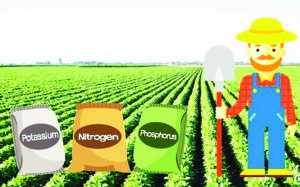 Amid these challenges, Mustapha urged farmers to move away from traditional methods, stressing that outdated practices are no longer effective. He highlighted that the Government has introduced modern approaches and alternative fertiliser options to help farmers adapt and sustain productivity.
He added, “We want to know what will happen to the future of the rice industry and how we will move to address these concerns. As I am speaking here, we have not made any decision yet on what will come, but very shortly we are already starting discussions on those issues. I am hoping that we can have similar measures put into place, like we had before, in terms of fertiliser for farmers. But [our farmers] have to change their mindset. We have to change the way we do things. We can’t do the same things we did 10 or 15 years ago.”
The Agriculture Minister stated that the Government launched nano-fertiliser initiatives less than a year ago at the Burma Rice Research Station, Mahaicony, and explained that the fertiliser is designed to work alongside traditional fertilisers such as urea, allowing farmers to reduce the amount of urea used while supplementing it with nano-fertilisers.
According to the Minister, trial results have shown positive outcomes, with yields reaching approximately 6.6 tonnes per hectare when both nano-fertilisers and traditional fertilisers are used together.
Slow to adopt new technology
However, he expressed concern that farmers have been slow to adopt the new technology and are not fully taking advantage of the initiative.
The Minister further noted that the Government, through the Guyana Rice Development Board, is subsidising nano-fertiliser to encourage adoption. He added that the product is being supplied through partnerships with two companies from India and one from Canada.
He urged farmers to make use of the support being provided and to adopt the new agricultural measures introduced to improve productivity.
In fact, in 2024, Indian Prime Minister Narendra Modi, during his three-day state visit to Guyana, proposed at the second CARICOM-India Summit that his country share its technological advances with the Caribbean region, including nanotechnology and other modern practices, in order to boost climate-smart agriculture.
However, despite these provisions, farmers are still not widely adopting the initiatives.
“But our farmers are not taking up these initiatives and measures. We had two suppliers from India and one from Canada, and we have purchased it and are now subsidising it to farmers. You must take up the measures that we have put into place. We want you to progress. We want you to have more disposable income, and we will continue to bring opportunities. But we have to change our mindset,” Mustapha stated.
Last year, the Minister revealed that nano-fertilisers deliver nutrients with far greater precision and efficiency.
Because it is composed of only eight persons’ nitrogen, it places a significantly lower nitrogen load on the soil, reducing emissions and the sector’s overall carbon footprint. Nano-fertilisers supply approximately 80 per cent of the nutrients needed by crops, compared to 35 per cent achieved with conventional fertilisers. When applied directly to leaves, it allows for rapid absorption, higher efficiency, and comparable or even improved yields compared to traditional nitrogen fertilisers.
Discover more from Guyana Times
Subscribe to get the latest posts sent to your email.