


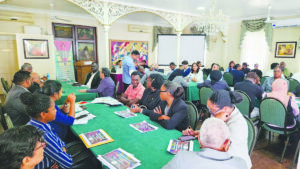
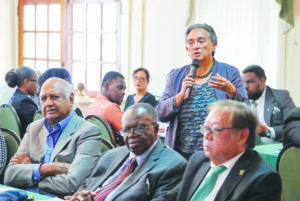
Another round of stakeholder consultations on Monday brought together several prominent legal minds, who shared their views on the consequential effects of social media on children. The Attorney General’s (AG) Chambers and the Legal Affairs Ministry hosted the session at the Cara Lodge Hotel, Quamina Street, Georgetown. Weighing in on the discussion, CARICOM Secretariat General Counsel, Lisa Shoman, praised Guyana for providing the leadership on this front and in starting such conversations, while making her own submissions. “I am now going to evangelise to the rest of the Caribbean, that you are the leaders on this, and that you will be working with CARICOM member states,” the general counsel is quoted as saying in a Department of Public Information (DPI) report. Shoman urged Guyana to ensure that young people are actively involved in shaping policies, emphasising that the Caribbean Regional Youth Council and other youth bodies should be key stakeholders in these conversations. According to Shoman, protecting children online must be balanced with preparing them for a rapidly evolving future.
Emphasising the need for a balanced approach to regulating children’s use of social media, Chairperson of the Constitution Reform Commission, Justice Carl Singh, cited Australia’s efforts to restrict access for younger users, while acknowledging the challenges of monitoring and enforcement. Justice Singh underscored that social media does indeed have advantages and disadvantages. He further explained that there are platforms beneficial to children, particularly for educational purposes, while there are others that can cause harm by exposure to inappropriate content.
Aggressive education and awareness
In his recommendation, Justice Singh called for an aggressive education and awareness programme for parents. This, he believes, is critical, since much is expected from parents concerning parental control. According to the DPI report, similarly, Chief Justice (ag) Navindra Singh proposed that the minimum age for social media be set to 18 years old. The chief justice argued that research has shown that between the ages of 12 and 17 is considered a critical stage of emotional development, and young people are more sensitive to stress, peer pressure and reward-seeking behaviour.
As a result, they are more likely to engage in questionable activities, which social media platforms often encourage. Justice Singh suggested that access to social media be carefully regulated, with parental consent and age-specific limitations, to better protect children from harmful online influences while still allowing them to benefit from essential digital tools. AG and Minister of Legal Affairs, Mohabir Anil Nandlall, SC, said the world has entered a fully digital era, creating unprecedented challenges for Government and legal systems seeking to regulate activities in cyberspace. He noted that while laws have historically been designed to govern human behaviour, regulating the vast and ever-evolving online space remains a global challenge, with countries across the Caribbean and beyond grappling with similar issues. The AG emphasised that successful regulation cannot be imposed by the state alone, but must involve parents, teachers, guardians and communities. He said the ongoing consultations are intended to ensure citizens have ownership and a say in the legislature. “We do not want to impose anything, we want you to tell us what you think…because it is your children’s welfare…it is your children’s future, and we know that you would not want anything bad for your children,” Minister Nandlall iterated. He also underscored the importance of the perseverance of a child’s physical and social development, warning that excessive screen time can come at a cost of outdoor activities and basic human interaction.
Discover more from Guyana Times
Subscribe to get the latest posts sent to your email.