


– as energy, infrastructure & healthcare drive ties
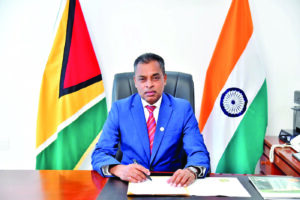
As Guyana and India celebrate 60 years of formal diplomatic relations, Guyana’s High Commissioner to India, Dharamkumar Seeraj, says the bilateral partnership is entering a new phase driven by energy cooperation, infrastructure development, healthcare, digital transformation, and investment.
Speaking in an interview with StratNews Global, Seeraj reflected on the historical foundations of the relationship while outlining new opportunities for Indian companies in Guyana’s rapidly expanding economy.
He noted that while the countries established diplomatic relations in 1966, their shared history dates back to the arrival of Indian indentured labourers in Guyana following the abolition of slavery.
“2026 marks 60 years since the establishment of formal diplomatic relations between Guyana and India, but our history goes way beyond that because the first person of Indian origin to arrive on the shores of Guyana did so 189 years ago, when they landed on the shores of the Berbice River on the 5th of May, 1838,” Seeraj said.
“We have come a long way; from the time of bringing people from India to work on the sugar plantations in Guyana under the indentureship programme, we are now an independent nation, and we are still bringing some people from India to Guyana, and they have been working there in several sectors: infrastructure, energy, health, and education, and we are quite happy about that.”
Oil-producing nation
Seeraj said Guyana’s emergence as one of the world’s newest oil producers has opened a significant new chapter in relations with India. During the past year, India has imported around four million barrels of Guyanese crude, and Seeraj expressed hope that Indian participation in Guyana’s upstream energy sector would expand.
“We would like Indian companies to get involved in the oil and gas sector of Guyana. “We are auctioning off oil blocks, and we hope that Indian companies will bid for these blocks because we want as diverse a range of players in the oil and gas sector as possible,” he said.
“If Indian companies, and even if the Government of India, bid for these blocks, and it’s a competitive process, we would very much welcome their participation in exploration, drilling, and ultimately the production of oil and gas.”
He said Guyana’s light sweet crude provides an attractive option for India’s growing energy demand. “India needs a significant amount of energy, of oil and gas, and we will be very happy to be a part of the energy mix for India,” he said.
Discussing the impact of instability in West Asia, Seeraj pointed out that the ongoing disruptions around the Strait of Hormuz reinforced the importance of diversifying energy supplies. He acknowledged that while higher oil prices benefited Guyana as a crude exporter, the country also faced increased costs because it imports refined petroleum products.
Seeraj also took the opportunity to highlight the growing presence of Indian companies across Guyana’s infrastructure sector, noting that cooperation has evolved considerably since an Indian firm built Guyana’s National Stadium for the International Cricket Council (ICC) World Cup. He said Indian firms are now involved in road construction, electricity transmission, renewable energy, and airport infrastructure.
“Currently, the number of companies and the volume of work being done in diversified infrastructure development projects has increased. We have moved from cricket stadiums and sports infrastructure to transportation infrastructure, to energy infrastructure, and health infrastructure,” he noted.
Healthcare
He also pointed to increasing Indian participation in education and healthcare. “We also have the human resources factor, with Indian experts in the areas of medicine, civil engineering, mechanical engineering, electrical engineering, and renewable sectors, who have been assisting Guyana with our infrastructure development,” he said.
Seeraj said that Prime Minister Narendra Modi’s visit to Guyana in December 2024 only served to accelerate bilateral cooperation. Among the most significant developments, he highlighted the world-record long-distance robotic telesurgery performed between Guyana and India in May 2026.
“Guyana and India established a global record on the 26th of May, 2026, for the longest distance telesurgery ever,” he said.
According to Seeraj, healthcare remains one of the strongest pillars of bilateral cooperation. He noted that Guyana sources the overwhelming majority of its pharmaceuticals from India.
“Our pharmaceuticals, I would say about 75 to 80 per cent of all our pharmaceuticals that we import come from India. So, it’s an area that is very competitive for us because of the price and also because of the quality,” he said.
He noted that Guyana aims to become a regional healthcare hub, inspired in part by India’s own success in medical tourism.
“One of President Irfaan Ali’s visions is to establish Guyana as a health hub in the Caribbean. We want to provide health tourism for the Caribbean and Latin America and even North America, similar to what India is doing,” he said.
He also highlighted a recently signed memorandum of understanding between Guyana’s Ministry of Health and India’s National Cancer Institute in Nagpur to support cancer treatment, medical training, and research collaboration.
Bauxite
Looking towards the future, Seeraj said Guyana sees substantial opportunities for Indian investment in bauxite mining and mineral processing.
“The one importer who is bringing bauxite to India needs 12,000 tonnes per month for his aluminium plant alone, and he’s only able to import between 3000 and 4000 tonnes of bauxite per month. So, there is huge scope for Indian companies to get involved in the mining of bauxite in Guyana because we have a supply deficit,” he said.
He also encouraged Indian investment in value-added industries such as diamond cutting, jewellery manufacturing, and gold processing.
Seeraj also praised India’s digital payments ecosystem and said Guyana is working towards implementing its own nationwide digital payment platform.
“I would like Guyana to be where India is currently, with a Unified Payment Interface. Guyana desperately needs a unified payment platform. We are in an advanced phase of rolling out a digital payment platform that all of our vendors and all of our consumers will be able to use to effect payments for all transactions,” he said.
Seeraj also spoke about the two nations’ defence cooperation, which he noted expanded through India’s US$100 million line of credit, which Guyana is using to modernise its defence capabilities.
“We have drawn down about 40 or 45 per cent of it already. I expect that we will be utilising all of it in areas that our Guyana Defence Force will deem as priority areas,” he said.
Discover more from Guyana Times
Subscribe to get the latest posts sent to your email.