 The Education Ministry has received more than 1000 recommendations as part of its nationwide consultation process aimed at developing a comprehensive anti-bullying and anti-violence policy for schools across Guyana.
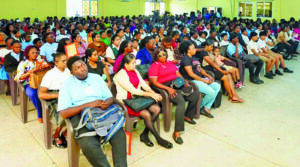
The disclosure was made during the final consultation held on Tuesday at the Mahaicony Technical and Vocational Training Centre in Region Five (Mahaica-Berbice), where stakeholders put forward a range of proposals to address bullying and violence within the education system.
Among the key recommendations, the Ministry said on Wednesday, were the establishment of anti-bullying clubs in schools, the development of peer advocates, the expansion and improvement of counselling services, and the implementation of stricter consequences for repeat offenders. Some participants suggested measures such as community service and the withholding of school cash grants for students involved in chronic misconduct.
Parents attending the consultation also proposed community-led after-school programmes designed to encourage teamwork, positive social interactions and sportsmanship among young people.
Education Minister Sonia Parag said all recommendations gathered throughout the consultation process will be compiled and reviewed by a multi-agency task force comprising representatives from the Ministries of Education, Home Affairs, and Human Services and Social Security.
According to the Minister, the most practical and impactful recommendations will be incorporated into a policy framework that establishes clear and standardised consequences for bullying and violent behaviour involving both students and teachers.
Parag noted that the proposed policy will address all forms of bullying and violence, including physical, verbal and social forms of abuse.
“What we’re seeing is not simply an act of bullying, but it’s also translating into violence, and it’s making our spaces that should be safe unsafe for our children,” she said.
The Minister stressed that bullying can have significant psychological effects on victims, even when it does not involve physical violence. She pointed to social exclusion and verbal attacks as forms of abuse that can negatively affect a child’s mental well-being.
Parag also highlighted the challenges posed by the digital age, noting that children are increasingly influenced by content and trends encountered online.
“Years ago, a child would be influenced by what happens in their homes, schools and neighbourhoods, but now, they are also influenced by social media and what happens online and the trends that dominate that space,” she said.
In addition to developing the new policy, the Ministry of Education is preparing to strengthen support services in schools through enhanced training for guidance counsellors beginning in September.
The training programme will place a greater emphasis on psychology and mental health, equipping counsellors to provide improved support for students dealing with issues arising from bullying, violence and other challenges.
The Minister also revealed that efforts are underway to improve supervision within schools and ensure that incidents are reported promptly to the Ministry. She expressed optimism that initiatives such as the Presidential Prison Avoidance Programme would contribute to fostering positive behaviour among young people.
Parag underscored the importance of a collaborative approach in addressing bullying and violence, emphasising that responsibility extends beyond schools alone.
While reminding educators that they serve as guardians during the school day, she also stressed that parents play a fundamental role in shaping their children’s behaviour before they enter the classroom.
The Minister urged parents to examine disciplinary practices within the home, arguing that children often adopt behavioural patterns observed from adults around them. She also raised concerns about children having unrestricted access to digital devices and online content without adequate supervision.
At the same time, Parag cautioned against the use of physical punishment, stating that discipline and abuse are not the same and that violence is not necessary to correct behaviour.
Regional Education Officer Selestine La Rose welcomed the strong participation at the consultation, describing it as evidence of the commitment among stakeholders to creating safer learning environments throughout the country.
The consultation concluded with an interactive session during which teachers, students and residents from across Region Five shared concerns and recommendations.
Parag said she hopes that once the anti-bullying and anti-violence policy is fully implemented, efforts can begin toward the development of supporting legislation.
Discover more from Guyana Times
Subscribe to get the latest posts sent to your email.