

…as Guyana prepares to host CDM14 in December
Prime Minister (PM) Brigadier (Ret’d) Mark Phillips has underscored the importance of regional collaboration in strengthening resilience at a time when the Caribbean is confronting a rapidly changing environment and increasingly complexed risk landscape. He made these remarks on Tuesday at a partnership breakfast and launch of the 14th Caribbean Conference on Comprehensive Disaster Management (CDM14), which will be held in Guyana from December 7 to 12. Bringing together the region’s best minds and strongest partners, the upcoming conference will be held under the theme, “CDM: Road to Resilience; Checkpoint 2026, Resilient Sectors, Sustainable Communities, Safer States.
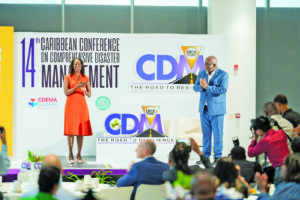
Addressing the gathering at the Partnership Breakfast and Launch event at the Pegasus Suites and Corporate Centre in Georgetown, PM Phillips explained that the idea of a “checkpoint” is deliberate as it prompts the region to pause and take measure of where its stands regarding the readiness of various institutions and the soundness of financing that would support them when the next shock arrives. “It is a useful checkpoint that helps us record our progress and name the gaps that remain with a commitment to closing them on a clear timeline. The theme set for December points to the outcome we are working toward, ensuring our sectors and communities can absorb a shock and keep functioning so we can keep our people safe,” he asserted. According to the PM, while the conference is set for December, the work on positioning resilience as a development and economic priority must start today. He noted that while in the past, disaster management was only activated after an event occurred, he emphasised that resilience now sits at the centre of how a country is run and touches various aspects of its economy, infrastructure, security and long-term development. With the windows in which decisions must be taken are narrowing, and the cost of acting late rises with every passing season. PM Phillips, who has oversight of the local disaster management sector, underscored the importance of having the systems and infrastructure in place to withstand destructions caused by disasters.
Emergency response facilities
Drawing the conversation home, he pointed out that for Guyana, a low-lying state with majority of its population on the coastline, resilience and development are intertwined and cannot be secured without the other. To this end, he added that Civil Defence Commission (CDC) has been working on enhancing its capabilities in several areas with support from the national budget for a broad range of disaster risk management programmes. This year, the CDC will move to implement the Oil Pollution Act and advance new disaster risk management legislation. The National Oil Spill Continuity Plan will also be updated and the Multi-hazard Early Warning Systems will be expanded through geographic information systems (GIS), satellite data and information and communications technology (ICT).
“A Gas-to-Energy (GTE) Emergency Response Contingency Plan is in development and new emergency response facilities at Lethem and Mahdia, as well as the multi-purpose bonds in Georgetown, will be brought into full operation. Investment in the CDC’s people runs through everything, because systems are only as strong as those who operate them,” the PM noted. These and other measures, according to Phillips, gives Guyana a more complete legal and operational footing for the risks that accompany an expanding economy, while also laying the foundation for the December conference, which he stressed requires regional participation. “It is pertinent to note that no country secures resilience on its own, and no single budget can finance it. This is where partnership becomes essential, and it is why this morning’s programme places financing at its centre. Capital for resilience does its greatest work when it is well prepared in advance of disaster. Regional risk pooling and prearranged finance allow a country to respond and recover quickly, sparing its people the long delays that follow when resources have to be assembled from scratch,” he added. On this note, PM Phillips lauded the presence of the Caribbean Development Bank (CDB) and the Caribbean Catastrophe Risk Insurance Facility — Segregated Portfolio Company (CCRIF SPC), stressing that partnership, including with the private sector, also extends to shared standards, joint exercises, and knowledge exchange among nations.
Emerging technologies
Also emphasising the importance of approaching resilience from a strategic Government development and economic imperative was Executive Director the Caribbean Disaster Emergency Management Agency (CDEMA), Elizabeth Riley.
“It must shape how we plan, invest, and govern. This is especially important as development financing becomes more constrained and official development assistance declines. Maximising available resources, strengthening disaster-risk financing and embedding resilience into investment decisions will be critical to safeguard development gains.” Against this backdrop, the CDEMA Head stressed that the upcoming CDM14 will provide wide-raging areas for examination including the adoption of technology in building out the region’s resilience. “It is an opportunity to examine progress, identify remaining gaps and align around practical actions that accelerate recovery outcomes. It will also explore how emerging technologies including artificial intelligence (AI) can strengthen decision-making, risks analysis and preparedness while ensuring that planning remains grounded in strategic foresight and long-term thinking,” the CDEMA Head posited.
Similarly, Director General of CDC Guyana, Colonel (Ret’d) Nazrul Hussain, also highlighted the importance of innovation as well as youth participation in building out regional resilience. “We invite you to deepen your commitment through CDM14, to fund innovation, co-develop climate smart infrastructure and be active architects of a more resilience Caribbean economy. We also affirm the indispensable role of our youth. The generation that will inherit the climate future must also help to shape the climate response. CDM14 will provide meaningful platforms to elevate youth leadership, to amplify innovative thinking, and to ensure the voices of tomorrow are present in the decisions being made today,” Hussain stated.
Discover more from Guyana Times
Subscribe to get the latest posts sent to your email.