

…ideas must move beyond pilot projects – Pres Ali
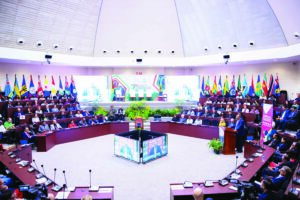
President Dr Irfaan Ali on Wednesday called on regional leaders to tackle barriers to health innovation. Addressing the opening of the 70th Caribbean Public Health Agency (CARPHA) Annual Health Research Conference at the Arthur Chung Conference Centre (ACCC), President Ali said the region is rich in innovative health ideas but held back by weak regulation, financing gaps, workforce shortages and low trust in institutions.
The Guyanese leader highlighted that never before has humanity possessed so many tools to improve health outcomes, yet “health systems across the world are struggling to turn innovation into impact”.
“We have artificial intelligence capable of reading scans in seconds. We have digital platforms that connect patients to clinics across continents. We have precision public health systems that can map disease in real time. We have new financing models that promise to stretch scarce resources further than ever before,” he outlined.
“The problem, I want to suggest, is no longer a lack of ideas. It is a shortage of systems that can observe, govern, finance, and scale those ideas fairly,” he added.
According to President Ali, health innovation is no longer defined by invention alone but by institutional capability.
“It is a question of whether countries have the regulatory strength to evaluate new technologies safely, the workforce capacity to use them efficiently, the digital infrastructure to support them, the financing systems to sustain them, and the social trust to ensure they are accepted by the public,” he posited.
“Innovation today succeeds or fails not in laboratories, but in Health Ministries, procurement offices, rural clinics, and community settings,” he further noted.
One challenge, he highlighted, is the region’s inability to allow its societies to be pilot sites.
He noted that while “we live in a region where our entire population size can be a pilot”, countries do not have the ecosystem, the infrastructure, the legislation, or the regulations to facilitate such.
“So, how are we going to be pioneers? How are we going to be ahead of the game? How are we going to be leaders if we don’t examine the ecosystem and design the model as to how this region will become a pilot for new technology, research and development and be part of the global system of advanced medicine and technology? So that is the first mission, maybe, of this conference, to examine the gaps and come up with a document that can be shared among leaders in the region as to how we position this region that is a pilot size, really, to be part of this model. That will give us first access, and that will give us scale very quickly,” he challenged the regional leaders.
Another difficulty, he highlighted, is the inability to move from pilot projects to population-wide systems.
“There is no shortage of successful demonstrations. Telemedicine pilots that improve access in remote communities, mobile health applications that improve adherence, AI tools that enhance diagnostic accuracy, and community-based diagnostic innovations that bring care closer to patients. Yet many of these tools remain trapped in that pilot stage. They do not become routine services. The reasons are not technical failure but systemic weakness, fragile financing structures, outdated procurement systems, limited governance capacity, and weak operational infrastructure,” President Ali contended.
In fact, he pointed out that in the Health Ministries across the region, “you will see stacks of studies on every problem”, but yet, authorities continue to study the same problem “again and again”.
“Because we do not have a clear strategy of implementation, moving from a pilot to a scalable project. And this is where a lot of the problem resides,” the President lamented.
“We have great initiatives that went through a phase of testing, and after the testing, that’s it. Back to routine,” he added, noting that regional leaders must be able to address this issue.
“Otherwise, we will not be able to achieve true transformation.”
The President also highlighted the challenge of human capital constraints, noting that innovation does not scale itself.
“People scale it. Yet many health systems face chronic workforce shortages, uneven distribution of health professionals, skill mismatches, and high attrition rates. The ability to adopt and sustain innovation depends heavily on training, mentorship, institutional support, and workforce redesign,” he noted, reminding that “without investing in people, technological advancement remains underutilised.”
The three-day conference, themed “Innovations in Health”, marks 70 years since CARPHA’s flagship research gathering was held in 1956. It is the longest health research conference in the English-speaking Caribbean.
Also speaking at the event, Health Minister Dr Frank Anthony said it is fitting that the conference is being held at a time when Guyana is undergoing a period of transformation, where investments in health systems, digital innovation and human capital are shaping a stronger and more responsive future for its peoples.
According to Dr Anthony, CARPHA has played a pivotal role in shaping the research culture of the region.
“From its origin to its current mandate, CARPHA has evolved into the centre of excellence, providing surveillance, laboratory services, policy guidance and, more importantly, a platform for scientific exchange. This conference, year after year, has become one of the most important spaces for sharing, challenging and strengthening Caribbean science. And that matters, because if we do not generate our own data, others would define our realities for us. If we do not publish our findings, our stories remain untold,” he posited.
In this regard, the Health Minister contended that research that is not published is research that is not fully realised.
“Publication is not merely an academic exercise; it is an act of influence. It ensures that our findings inform policy, guide clinical practice and contribute to global knowledge. It places Caribbean science on the world stage, and it allows our voices and our evidence to shape the international discourse,” Dr Anthony noted.
He added, “We must therefore strengthen a culture in which research does not end in the laboratory or at the conference podium but continues in peer-reviewed journals, policy briefs and implementation frameworks. We must mentor young researchers, not only to investigate, but also to write, publish and lead. The ultimate goal of research is not publication alone. It must have an impact. It must lead to better outcomes, better health outcomes. It must lead to stronger health systems. It must result in longer, healthier lives for the people of the Caribbean.”
Beyond publication, Minister Anthony underscored the importance of innovation. Innovation is not only about high technology.
“It is about solving problems in practical, scalable and impactful ways. And at this conference, we have amassed many examples, and you will see them in the exhibition booths. Innovation is a community health worker using telemedicine to improve the care of patients in remote regions. It is the integration of digital health tools so that we can improve the efficiency of care. In the Caribbean, innovation must be rooted in our realities. It must address our geography, our resource constraints and our unique epidemiological profile. That is why research and innovation must go hand in hand,” he emphasised.
Meanwhile, Secretary General of the Caribbean Community, Dr Carla Barnett, reflected on how member states are already applying innovation in their public health sectors, such as Guyana, with its telemedicine programme. However, she emphasised the need for more to be done to ensure ordinary citizens get on board with health innovations.
“To be fully equipped for the new era, our professionals need new instruments in their toolkit. We need more researchers who understand public policy, data analytics and ethical governance and who are ready to make the paradigm shift required to accelerate our collective actions. We must ensure an inclusive approach that involves our people in their communities. If our people do not trust innovation, they will not adopt it. Our research must stay relevant, speaking to the needs of the mothers in a rural or remote village as clearly as it does to a scientist in a laboratory,” she noted.
The executive director of CARPHA, Dr Lisa Indar, posited that innovation is not just about technology but about people.
“It is about the researchers who push boundaries, the policymakers who translate evidence into action, the healthcare workers who bring innovation to life, and the communities who trust us to deliver better health outcomes. Together in this room, we represent the region’s leading minds in health research and public health practice. We are not just participants in this conference; we are the architects of the Caribbean’s health future,” Indar said.
Discover more from Guyana Times
Subscribe to get the latest posts sent to your email.