

…Guyana receives Green Destinations Country Baseline Assessment Award
As regional leaders and stakeholders gathered in Georgetown to examine the opportunities and challenges confronting the future of Caribbean tourism, emphasis has been placed on ensuring that the people, communities and businesses that shape the region reap the benefits of the industry.
Guyana is hosting the Caribbean Tourism Organisation’s (CTO) State of the Tourism Industry Conference (SOTIC) 2026 this week. The five-day conference, which runs from October 5 to 9 under the theme “Tourism Futures: Smart, Sustainable and Inclusive”, has brought together 336 delegates from across the Caribbean and beyond.
Reflecting on the theme, outgoing Chairman of CTO Ian Gooding-Edghill called for technology to be leveraged to enhance the competitiveness of the region’s tourism industry and for the assets that make the Caribbean unique to be protected.
Gooding-Edghill – who currently serves as the Minister of Tourism and International Transport in Barbados – went on to underscore, however, that an inclusive tourism future must ensure that the benefits of the industry continue to reach the people.
“Tourism should create opportunities for entrepreneurs and small businesses. It should provide meaningful careers for our young people. It should elevate our culture, creativity and heritage. And it should ensure that the communities that make our destinations special have a voice and a stake in tourism’s success. Because ultimately, our strongest measure of our progress is not simply how many visitors arrive on our shores; it is how tourism improves the lives of the people who call the Caribbean home,” the CTO Chair posited during the SOTIC 2026 opening ceremony.
Similar sentiments were echoed by Guyana’s Tourism, Industry and Commerce Minister Susan Rodrigues in her remarks. She too believes that being “smart, sustainable, and inclusive” are interconnected and must shape the next generation of Caribbean tourism.
“The future of tourism cannot simply be about getting more people to more places. It has to be about being smarter in how we plan, use technology, and understand our visitors. More sustainable in how we develop destinations and protect our environment, and more inclusive in ensuring that the economic benefits of tourism reach the people and communities who are the foundation of the visitor experience,” Rodrigues stated.
In fact, the Minister noted that the future of tourism cannot be discussed without talking about communities and micro, small and medium-sized enterprises. She stressed that there must be an ecosystem that ensures benefits are redounded to communities and its small businesses.
“A visitor travelling into the Rupununi, staying at a community lodge, purchasing a locally made craft, eating food sourced from local producers, or engaging a local guide should create value that remains within that community. The tourism ecosystem must therefore be designed so that the growth of one part of the industry creates opportunities for another,” she noted.
The Minister pointed out that while the Government is responsible for building infrastructure, policy, and standards, the real strength of tourism comes when communities, entrepreneurs, investors, and larger businesses are connected to that ecosystem.
According to Minister Rodrigues, Guyana is already moving in this direction by ensuring that communities and small businesses in the local tourism sector have easy access to financing. To this end, she noted that the newly launched Guyana Development Bank is relevant to the tourism conversation, as it gives tourism businesses and SMEs access to zero-interest collateral-free loans of up to GY$3 million to start or grow their businesses.
“Tourism is constantly championed by people with ideas, products, and experiences who need access to capital to take them to the next level. The Guyana Development Bank is our response to that challenge and provides support that can help turn viable ideas into sustainable businesses. If we are serious about inclusive tourism, then we must ensure that entrepreneurs have a genuine opportunity to participate in the industry,” Rodrigues declared.
The Minister also went onto reiterate Guyana’s commitment to sustainable tourism, noting that it is not just a marketing strategy but a key factor in how the country develops and measures the quality of its destination.
Over the years, Guyana’s eco-tourism product has received increasing international recognition through major publications such as Bloomberg, Time Magazine, and the New York Times, as well as multiple sustainable tourism accolades that validate the work of local tourism businesses, communities, and conservation partners.
In fact, Rodrigues pointed out that collaborations with partners such as Green Destinations and the Good Travel Seal Program help to strengthen the sustainability standards across Guyana’s tourism sector.
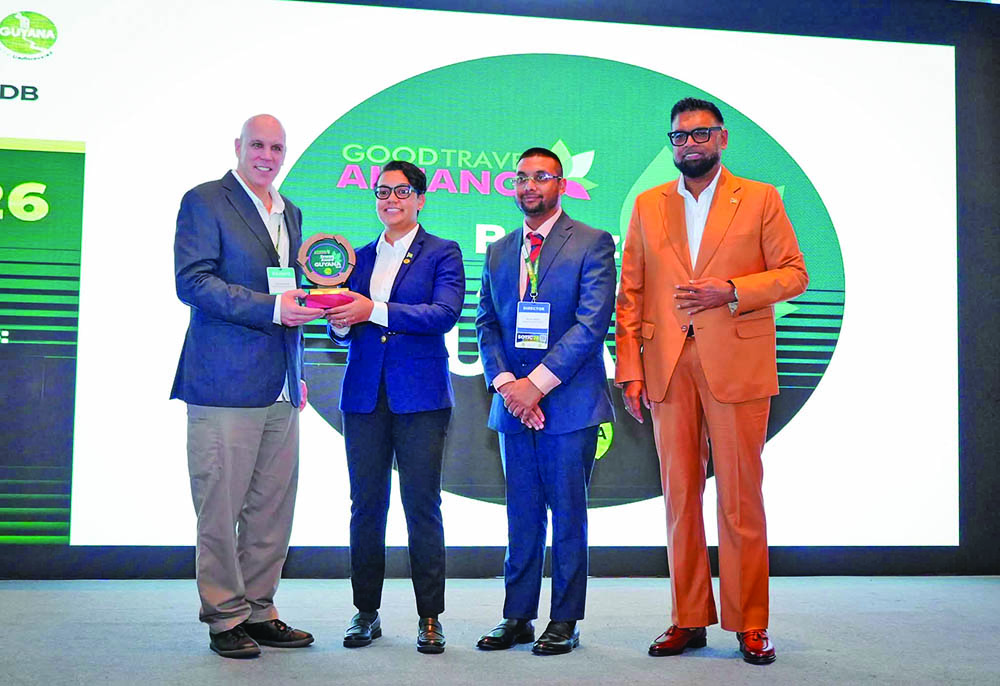
This was demonstrated when the Guyana Tourism Authority (GTA) was presented with the Green Destinations Country Baseline Assessment Award in recognition of its compliance with the applicable criteria of the Green Destinations Standards.
The award follows a country baseline assessment conducted by the Good Travel Institute of Green Destinations International.
Director of the Good Travel Institute, D’Arcy Dornan, presented the award to Minister Rodrigues alongside President Dr Irfaan Ali and GTA Director, Kamrul Baksh, during the SOTIC opening ceremony on Wednesday at the Atlantic Suites by Hyatt in Georgetown.
Wednesday’s opening ceremony was marked by a symbolic coconut-breaking ceremony that saw the participation of tourism officials across the region, CTO officials, funding partners and other stakeholders.
Discover more from Guyana Times
Subscribe to get the latest posts sent to your email.