


Commuters, including schoolchildren and workers attempting to return home on Wednesday, were left stranded along sections of the West Coast Berbice (WCB) corridor after minibus operators withdrew their service in protest over transportation fares they say have remained largely unchanged for more than three decades.
The strike action came days after Public Works Minister, Juan Edghill warned that the Government has not approved any increase in public transportation fares and that operators forcing commuters to pay higher rates could face penalties. President Dr Irfaan Ali on Tuesday last urged transport operators and other Private Sector stakeholders benefiting from Government fuel subsidies to “be fair to the public”, arguing that many have not passed on the savings to consumers despite billions of dollars in tax relief and subsidies aimed at cushioning the impact of rising global fuel prices.
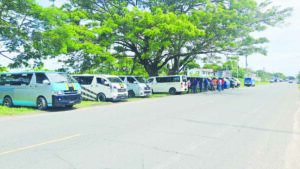
However, operators along the Route 50 corridor said that enforcement warnings prompted many drivers to remove fare notices from their minibuses and park their vehicles in protest. Drivers operating the Rosignol to Onverwagt and Bush Lot routes had been seeking an increase from the current $100 fare to $200, while operators travelling the shorter Rosignol to Belladrum and Shieldstown route were seeking to move fares from $160 to $300.
However, the proposed increases sparked objections from commuters, some of whom argued that the hikes were too steep and would place additional pressure on persons already struggling with the rising cost of living. Operators, however, argued that the existing fare structure is no longer financially viable given the distances being travelled and the rising cost of operations.
The Rosignol to Belladrum journey covers approximately 32 kilometres (km), while the Rosignol to Onverwagt and Bush Lot routes stretch close to 50 km. Sixty-five-year-old minibus operator Inderlall Deolall, who said he has been in the transportation business for nearly four decades, recalled that fares were last adjusted in the early 1990s.
“In 1993 it was $100, and it never raise back,” Deolall said. He explained that fuel prices, tyres, spare parts and general maintenance costs have increased significantly over the years.
“The gas gone up. The cost of living gone up. Everything gone up,” he said, adding that “before, tyre was $4000. Now it is $11,000 and $12,000.” Another operator, Wilton Reece, said the current fare structure places tremendous strain on drivers trying to earn a living. “$100 from Rosignol all the way to Bush Lot become very, very stressful,” he said. Reece explained that beyond fuel prices, operators also face maintenance expenses and rising household costs. “Maintenance is very, very costly,” he stated while noting that drivers also have children to send to school and families to maintain. “Everybody getting a little raise. We remain the same for many years,” he added. Meanwhile, Seepersaud Raymond, who said he has spent more than 35 years in the transportation sector, noted that operators initially increased fares but later backed down amid complaints and fears following warnings.
He argued that operators using foreign-used vehicles are constantly faced with costly repairs and maintenance. Raymond also pointed to fluctuating fuel prices.
Maxed out direct fuel subsidies
Last week, President Ali called on the Private Sector to share the burden of rising fuel prices, as the Government has maxed out direct fuel subsidies, and assured that exploring plans for ports and a refinery here continue as key to this country’s long-term energy stability amid global disruptions. “We were able to take excise tax to zero. What that did is that it gives us now no room to adjust the excise tax. And now that the price has increased at the national market, we are asking those, all the stakeholders who would have benefited from the zero per cent excise tax, to be nationalistic in their approach,” Ali had said in an address on his Facebook platform.
Although Guyana is a significant crude oil producer, he reminded us that it lacks refining capacity. As a result, all refined products are imported at world market prices. To cushion citizens, the Government removed excise taxes on fuel imports, a measure that has cost the treasury more than $100 billion Guyanese dollars annually. The Government has also directly subsidised diesel and gasoline since March of this year, further reducing profit margins to stabilise the market.
With private-sector transportation, especially by minibus operators, increasing by over 100 per cent recently, the Government’s balancing act between fiscal responsibility and consumer protection, Ali reasoned, underscored the urgent need for shared sacrifice in a volatile global energy market, given the operators benefited significantly from fuel subsidies.
“In practical terms, when we took off the zero per cent, when we took excise tax to zero per cent, that translated to approximately $500 savings for citizens on every gallon of diesel or gasoline purchase. It was a $500 saving, providing substantial relief to households, businesses, and the wider economy. For minibuses operating in Georgetown and consuming an average of, let us say, more than 12 gallons of fuel per day, which is 50 litres, the policy delivers savings of about $6000 per day, directly improving, of course, profitability and helping to keep fares affordable,” he said.
“Now that we have this challenge and we have fully utilised that tool, this tool that was available to us, I think the minibus operators, the taxi and speedboat operators, and of course, truckers, and all stakeholders within this framework now have to play their role. Because this is something that is affecting us at the national level,” he added.
No approval given
The Government has reaffirmed that no fare increases have been approved for any form of public transportation, including minibuses, taxis, hire cars, speedboats and airport services. Public Works Minister Juan Edghill on Tuesday last restated that existing fares remain in effect and warned that passengers must not be subjected to any unauthorised price hikes. Government officials emphasised that transport operators have no authority to impose increased fares and that passengers who are forced to pay higher rates or face harassment are encouraged to report such incidents to the Public Utilities Commission for investigation and action.
Discover more from Guyana Times
Subscribe to get the latest posts sent to your email.