

…as Deputy Solicitor General urges continuous training, expanded use of plea bargaining
Some 71 participants, including 40 Police prosecutors, will benefit from a two-day joint training programme being conducted under the Partnership of the Caribbean and European Union (PACE) on Justice Project, which commenced on Thursday at the Guyana Police Force Officers’ Mess, Eve Leary.
Facilitated by former Director of Public Prosecutions of Jamaica and King’s Counsel Paula Llewellyn, along with European Union expert Anselmo Morales Torres, the training brings together prosecutors, Police investigators and other justice sector stakeholders as part of efforts to strengthen criminal investigations, prosecutions and the broader administration of justice in Guyana.
Among those delivering remarks at the opening ceremony were the crime chief of the Guyana Police Force, Wendell Blanhum; director of public prosecutions (DPP), Shalimar Ali-Hack; Chargé d’Affaires of the European Union Delegation to Guyana, Spiros Polycandriotis-Van Duynhoven; and officer-in-charge of the United Nations Development Programme (UNDP) Guyana, Dhiraj Singh.
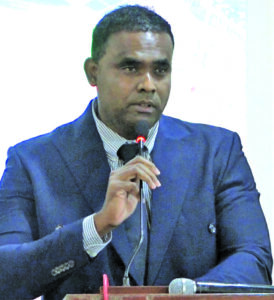
Deputy Solicitor General Shoshanna Lall delivered the feature address on behalf of Attorney General and Legal Affairs Minister Anil Nandlall.
Addressing participants, Lall underscored the importance of continuous training for criminal justice stakeholders and highlighted ongoing reforms being supported through the PACE Justice Project.
“One of the three interventions on this PACE justice project is to empower stakeholders, including the judiciary, our prosecutors, our Police, our lawyers, all of the actors in the criminal justice landscape, through training and capacity building,” she said.

Lall noted that the training would focus heavily on technology and its growing role in investigations and prosecutions.
“We have these two very experienced facilitators who will guide us through training as to the use of the technology that is relevant to prosecuting, investigating, and the necessary training that is also necessary,” she stated.
The Deputy Solicitor General said the Government has invested heavily in improving justice sector infrastructure and human resources but stressed that such investments must be complemented by training.
“We can speak about the many new courts that the Government has built over the last couple of years, including in our very, very rural areas; the appointment of new Magistrates and Judges; and new legislation and rules, but all of that will count for nothing if we do not equip our justice actors with the proper training,” Lall said.
She also pointed to emerging areas requiring specialised expertise, including anti-money laundering and countering the financing of terrorism (AML/CFT), social media regulation and artificial intelligence legislation.
Discussing criminal justice reforms, Lall urged greater utilisation of recently enacted legislation, including plea bargaining provisions.
“The AG himself has worked on bringing those laws on board and has expressed some amount of concern that the cases are not being subjected to the plea-bargaining regime as it should,” she said.
Lall noted how plea bargaining and restorative justice measures were intended to help address court backlogs and provide alternatives to traditional adversarial proceedings.
Sessions of the training programme are expected to focus on strengthening investigative and prosecutorial practices, enhancing the use of technology and improving coordination among criminal justice stakeholders.
The programme forms part of broader regional efforts under the PACE Justice initiative to improve efficiency, accountability and effectiveness across Caribbean justice systems.
Enhanced investigations and prosecutions
During her remarks, the DPP, Ali-Hack, praised the collaborative approach adopted by the European Union and UNDP under the PACE Justice Programme, noting that the initiative has addressed legislation, procedures, training and technology within the justice sector.
“When they met with me, I asked for the judiciary and the prosecution to be trained alike. Because if the judiciary and the prosecution, which includes the investigators, are not operating from the same perspective or singing from the same hymn book and the same hymn and the same stanza at the same time, we will not make progress in the courts with the cases,” Ali-Hack said.
She noted that technological support received through the programme has already enhanced investigations and prosecutions.
“We have been using technology; as you rightly said, we have gotten lots of equipment, and we have been benefiting from it. We have been using it.
It has improved both the investigations and the prosecution,” she stated.
Ali-Hack highlighted significant progress in reducing criminal case backlogs in the High Court.
“Between 2020 and 2024, we had about 300 cases listed for assizes. From 2025, those have come down to like 100 and something. And this is a remarkable improvement, and it is a part of the results of all the justice improvements that we have been involved in,” she said.
The DPP explained that efforts are focused not only on reducing existing backlogs but also on preventing new ones from developing.
“So that’s my approach with maintaining a standard and status quo so that courses will have timely trials, and that has been happening,” she added.
Encouraging active participation throughout the training, Ali-Hack told attendees: ‘There’s no stupid question. You have the experts here… Ask the questions.”
Integrate technology into policing & criminal probes
Delivering the feature address, Crime Chief and Deputy Commissioner of Police (Law Enforcement), Wendell Blanhum, said the objectives of the PACE Justice Programme align closely with the Guyana Police Force’s modernisation agenda and strategic goals.
“The role and relevance of Pace Justice, the partnership of the Caribbean and European Union on the Justice Regional Program, aims to strengthen institutional capabilities, cooperation, and collaboration among our key stakeholders, such as the Guyana Police Force, the Chambers of the Director of Public Prosecution, the Attorney General’s Chambers, and the Judiciary,” Blanhum said.
He explained that the programme supports the force’s ongoing efforts to integrate technology into policing and criminal investigations.
“As part of our ongoing reform initiative, the Guyana Police Force continues to incorporate technology into our daily operations across areas such as intelligence, investigation, and prosecution,” he said.
Blanhum also addressed public criticism often directed at the criminal justice system when cases are dismissed, noting that many setbacks result from challenges such as reluctant or untraceable witnesses. The crime chief highlighted the successful collaboration between investigators and prosecutors in several high-profile matters, including the recently concluded Henry Boys case.
“This success would not have been possible without the tremendous seamless support given by the DPP to the Police throughout the investigation and prosecution phases, ultimately presenting a case that left a 12-member jury convinced beyond a reasonable doubt,” Blanhum stated.
He urged participants to maximise the opportunity.
“To the members of the Guyana Police Force who have been carefully selected for this specialised training, I implore you to take full advantage of this golden opportunity,” he said.
Discover more from Guyana Times
Subscribe to get the latest posts sent to your email.