


“Tam-tam… boom-boom…” That is the sound of the historical Tassa drum, beating like a heartbeat across Guyana’s cultural landscape for more than half a century.
Rising from a family-run workshop at Richard’s Town, Lusignan, East Coast Demerara (ECD), the tradition has helped shape the nation’s rhythmic identity since the 1960s.
From Raghu’s Tassa Tadja and Craft, thousands of handcrafted drums have been produced and generations of players trained, carrying the sound of tradition far beyond local yards and into communities across Guyana and the diaspora.
The Guyana Times caught up with 42-year-old Akhilanand Raghunandan, the leader of the tassa drum group, who explained the deep history and rise of the band.
He said that since the 1960s, the group has been in operation, using both tassa and taja drums as its primary instruments. He noted that while many other bands identify as tassa drummers, most only use tassa drums alone.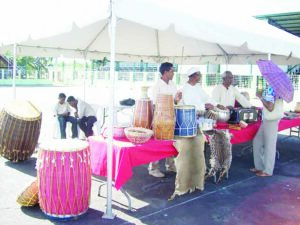
He described the instruments as large, likening them to the size of rum barrels.
He further explained that, in addition to crafting new drums, the group also repairs instruments made primarily from goat skin and deer skin.
Over the years, he said, they have trained between 2000 and 3000 people in tassa drumming, many of whom continue to perform today, with some going on to become well-known musicians.
“We are probably the only group that still plays main themes and repairs drums. The Tassa drum is the big one. At one point in time, it represented almost everything around Guyana. It was usually associated with Muslim gatherings, and it was once very active in Guyana. It was even banned at one point by pandits, but in places like Trinidad it still thrives… Over time the drum evolved into something that represented all races – Indian, African, Chinese, and others. When that drum sounded years ago in Guyana, it brought everyone together.”
According to him, over the years the group has produced thousands of drum sets for clients and cultural groups across Guyana, as well as for export to North America and other regions.
He noted that during his days of studying at university he recalled that the drums were taken there and introduced within academic and cultural spaces. He also relayed that there was one early instance of Guyanese drums being introduced in Cuba through scholarship-linked cultural exchange.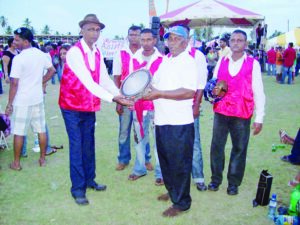
Following this, he said, other countries began adopting similar practices, with drum-making and cultural exchange extending to parts of Africa, including Gambia, Ghana, Egypt, and Morocco. He explained that Guyanese drums were shared with groups in these regions, helping to elevate their cultural visibility internationally. He added that this period of expansion and exchange took place between 2004 and 2009, marking a significant phase in the tradition’s international reach.
In fact, he and his father are currently setting their sights upon teaching the history of Tassa drums and the contributions his family has made in the realms of Tassa making – in their very own book.
“My father is now in his late years. He has been playing drums for over 60 years, and he was awarded a Lifetime Achievement Award for his contributions to the world of drumming. I myself have been playing for the last 40 years, and I have worked alongside him throughout. We have played drums in all parts of Guyana and outside of Guyana as well. He is well known in cultural circles as Teacher Raghu, and when he goes to the ministry, everyone knows who he is.”
He noted that despite periods of decline in recognition, the tradition survived through families who continued to preserve the craft. He said his own family’s involvement spans generations, with knowledge passed down from India through his grandfather’s lineage.
According to him, large community gatherings in earlier decades often featured extensive drumming ensembles, sometimes involving dozens of players across ethnic lines. He described these events as moments of social cohesion during otherwise divided periods in Guyana’s history.
“In those days you had segregation in Guyana and so on,” he said, noting that tassa drumming events often brought African, Indian, and other communities together in shared cultural expression.
He also reflected on his pride in the group’s work, particularly its efforts to preserve traditional techniques while adapting to modern materials. He said the organisations have trained many young people, often from difficult circumstances, using music as a form of structure, discipline, and opportunity.
Among its recent developments, he highlighted efforts to help form a national Tassa association alongside other senior groups in Guyana. He described the initiative as still in its early stages but significant in bringing together long-standing practitioners to formalise the craft.
Looking ahead, he expressed concern about the future survival of the tradition, noting that much of its history remains undocumented and preserved mainly through oral memory.
“What I want to see is a format in which this type of drum can be preserved in something more than just oral tradition,” he said, adding that there is currently little written or archived material on the instrument.
He further suggested that the tassa drum may have developed uniquely in Guyana, shaped by the constraints of indentureship-era life, where communities adapted available materials to create instruments that became culturally distinct over time.
He added that while interest in tassa drumming is growing among younger generations, there remains a need for structured publication, research, and cultural investment to safeguard what he described as a significant but under-documented part of Guyana’s heritage.
Discover more from Guyana Times
Subscribe to get the latest posts sent to your email.