


– 450 farmers benefit from initiative

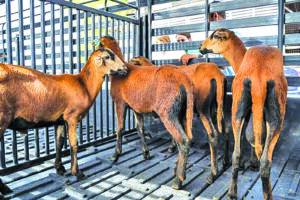
Guyana’s Black Belly sheep herd has expanded by 500 per cent since 2020, growing from an initial 1000 animals imported from Barbados to more than 5000 to date, according to the Guyana Livestock Development Authority (GLDA).
Chief Executive Officer (CEO) of the Guyana Livestock Development Authority (GLDA), Dwight Walrond, during a pre-recorded interview released by the government, described the Black Belly Sheep Project as a transformative programme.
He said that the growth reflects ongoing efforts to improve genetics, boost productivity, and strengthen the country’s livestock sector. The project, launched by the Government of Guyana in collaboration with the Government of Barbados in 2022, forms part of a broader regional effort to reduce reliance on imported meat products and develop a sustainable sheep production industry within the Caribbean.
Aimed at reducing CARICOM’s food import bill by 25 per cent by 2030, the multi-million-dollar programme partners with Barbados to build a sustainable regional sheep and mutton industry.
During his presentation, Dr Waldron posited that the undertaking in 2022 has been transformative for Guyana’s livestock sector by providing farmers with access to improved sheep genetics after years of limited genetic investment.
According to him, the initiative has enhanced farmers’ productivity and income potential while delivering positive returns for beneficiaries. He added that the project also supports the government’s policy of increasing women’s participation in agriculture, highlighting Region Five as an example where many women have benefited from the programme.
He added that for 2025, two of the most outstanding farmers in the country are female breeders, and they are currently reaping the benefits and making substantial income.
“There are two females who are now full-time farmers because of this project. When you look at the technical coefficients emanating from this programme – the birth weight, the weight gained per day, and so on – of the lambs from this project, it is actually amazing to see what the farmers are doing.”
“They are taking advantage of small spaces of land with improved forage; they are allowing the Black-belly sheep to express its true genetic potential. It is an initiative that we partnered with Barbados on, and we brought in 1000 Black belly sheep… As the CEO of the Guyana Livestock Development Authority, I want to assure Guyana that those genetic materials are in good hands. They are in a good place. We received 1000, and we are now in excess of 5000 in terms of increase from what we would have received from Barbados. We could be approximately approaching 7000 by now.”
Meanwhile, Dr Walrond has revealed that more than 450 Guyanese farmers have benefited from the government’s Black Belly Sheep Project since its launch in 2022, describing the initiative as a transformative programme.
“In terms of those who have benefited directly, we had in excess of 450 beneficiaries. These are farmers, not ‘wannabe’ farmers. These are farmers who are involved in the rearing of Black Belly sheep. And what we found is that we are now at the third generation with some of these farms. We are now injecting fresh genetics into those farms to ensure that the Barbados Black Belly is good for its prolific nature. You will have a lot of twins, triplets, and so on.”
Although the Barbados Black Belly is known for producing twins and triplets, Walrond posited that the crossbreeding programme aims at creating a meatier animal to strengthen the country’s sheep industry and support the development of a premium product.
“We are now injecting fresh genetics into those farms to ensure that because the Barbados Black Belly is good for its prolific nature, you will have a lot of twins, triplets, and so on. But in terms of meatiness, you would not have that like the other meat breeds, like the Dorper. We have introduced those genetics. So, we are now injecting some of those meat breeds into the Barbados Black Belly to give us a better product. And you will hear ministers speaking about that brand. Well, we are moving very rapidly towards that.”
Discover more from Guyana Times
Subscribe to get the latest posts sent to your email.