


…bauxite sector also progressing, as BOSAI to create 1000 jobs between 2024 and 2025
The A Partnership for National Unity/Alliance For Change’s (APNU/AFC) mismanagement of critical sectors such as forestry, was put on blast by President Dr Irfaan Ali who on Sunday recounted how his party was able to reverse the damage done by the former Government to the sector.
In a video broadcast on Sunday, the Head of State highlighted that since the People’s Progressive Party/Civic (PPP/C) Government returned to office in 2020, small and medium-scale foresters have been able to occupy over five million hectares of land.

“Through the various policies and programmes, the sector has seen a cumulative increase in production by more than $15.6 billion since 2020. Today, there are over 550 small foresters, who occupy more than 2.5 million hectares of land. And 22 medium-scale foresters who occupy 2.7 million hectares of land. So, if you check it, more than 5 million hectares of land is occupied by the small and medium scale foresters,” Ali pointed out.
Things were not as rosy as they are now, as the President recounted in extensive detail that under the former Government, almost all the small foresters were wiped out and almost 15,000 jobs in the sector were lost.
“Ituni, Kwakwani, these residents can tell you with a clear conscience, what took place in their community in the period 2015 to 2020, in the Berbice River, all over. When forestry was decimated. However, the people of Region 10 suffered even further losses. Linden, you had more than 500 jobs lost directly. In Bauxite.”
“You had 500 families that were sent to the breadline. You had one company pulling out investment, and another company curtailing investment. Because there was no clarity of vision. The destruction that took place between 2015 and 2020, created a drag on the economy in Linden and Region 10.”
President Ali recounted that due to APNU/AFC’s mismanagement of the forestry sector, Baishanlin International and Barama Company Limited were both forced to exit the sector. With the then Government offering no incentives to investors while imposing onerous fees on small and medium-sized loggers, the sector stagnated.
Total production dropped from 500,000 cubic metres (m³) in 2015 to under 400,000 m³ by 2020, while export of forestry products dropped from US$53 million in 2014 to US$34 million in 2019… an over 35 per cent decrease. Also dropping was the employment rate in the sector, dropping from 22,000 in 2015 to 14,000 in 2020.
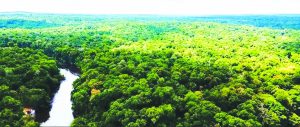
Perhaps the most sordid example of the APNU/AFC’s mismanagement of forestry is the state it left the Guyana Forestry Commission (GFC). The entity, which once had a surplus of $211 million in 2014, could neither pay its employees their salaries nor bonuses under APNU/AFC and has difficulties paying its light, water and telephone bills, as well as paying National Insurance Scheme (NIS) and the Guyana Revenue Authority (GRA).
Bauxite
The Bauxite sector was also mismanaged under the former APNU/AFC Government, with production dropping by more than 40 per cent and employment being reduced by half between 2015 and 2020. Again, this primarily affected persons in Region 10.
“Since the PPP/C assumed office, a number of steps were taken by our Government to reduce costs, broaden product range and increase production. For us, we had to build back this sector. we had to get back those 50 per cent of jobs that were lost,” the President said.
Among the measures, the Government employed was issuing additional reserves in Kara Kara, investing in a 19-Megawatt (MW) solar farm that would reduce energy costs and supply both operational and community needs and issuing additional reserves to the BOSAI mineral group, which have allowed for increased investments and an increase in production to 400,000 tonnes.
As a matter of fact, President Ali during a visit to Linden on Sunday interacted with residents and spoke about projections for the Bauxite sector. So far, Bauxite export is expected to increase to US$163.2 million in 2024, while BOSAI is seeking to hire hundreds more after a successful year.
“This year, we have had important expansions in the Bauxite sector, from BOSAI. We had about 500 new persons employed. Their commitment is that another 500 persons will be employed during the course of this year.”
“And we’re also working and holding them to their plan of expanding and once the cost of energy becomes efficient, we can look at the value added. And value creation of this sector,” the Head of State related during the visit. (G-3)
Discover more from Guyana Times
Subscribe to get the latest posts sent to your email.