


Purified drinking water along Guyana’s coastline stands at 80% – Min Indar

-says in 2 years treated water nationwide will reach 100%

While more than 95 per cent of Guyanese now have access to potable water, only 80 per cent of that water is treated, primarily along the coastline, according to Public Utilities Minister Deodat Indar.
Indar made this revelation during the Guyana Dialogue Podcast on Thursday evening, where he appeared as the special guest. Additionally, he stated that the Government continues to construct water treatment plants across the country to ensure citizens receive clean, safe, and purified drinking water.
“So, the potable drinking water we have is about 95 per cent, but purified, treated water on the coastline is about 80 per cent. And in the next two years, we expect to bring that to 100 per cent,” the Minister said.
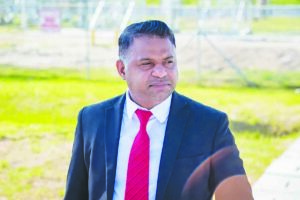
Public Utilities and Aviation Minister Deodat Indar

He highlighted that for the last five years, the Government has constructed seven new water treatment plants while also refurbishing and rehabilitating several existing facilities.
He noted that new plants were built along the East Coast, Caledonia on the East Bank of Two, while others were erected at Parika, East Bank Essequibo (EBE), and Wales, West Bank Demerara (WBD), all in an effort to improve access to treated water across the country.
Despite this, the Minister stated that the Government is looking to expand water treatment infrastructure along the coastline to meet the growing demand for potable water.
He explained that in Bartica, authorities sourced water from a stream located at Four Mile for the first time and implemented a surface water treatment system through a constructed plant.
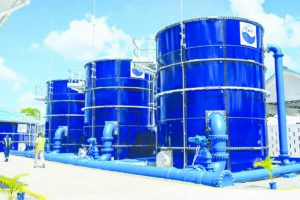
The water treatment plant at Caledonia, East Bank Demerara

“So, on the coastline, we have a number of water treatment plants. In Bartica, for the first time, we took the stream that was running at the back there at Four Mile and treated the surface water. We put in a treatment plant there built by Toshiba Water Systems. The water is treated, and it reaches and exceeds the World Health Organization (WHO) standards.”
“We are doing more of those kinds of treatment plants in Stewartville in Region Three, and we’re going to do one on the East Coast at La Bonne Intention (LBI), because those areas have massive population density growth due to new housing schemes and allocations. You need more production of water,” he said.
He stated that the strategic placement of water treatment facilities is necessary across the coastline, particularly in areas experiencing increased housing development and expanding housing schemes, in order to boost water production and ensure that the water is properly treated.
According to him, the Government has been working on the plan over the past five years. “The Guyana Government has budgeted some $22 billion this year in GWI’s capital budget to look at all aspects of providing water. And that’s on the coastline. On the hinterland side, we are close to 100 per cent,” he said.
He disclosed that approximately two months ago, he visited Region Nine, where he commissioned water system networks in four different villages as part of efforts to improve access to potable water in hinterland communities.
According to the Minister, many residents in those communities previously depended on nearby creeks as their main source of water. However, he noted that wells are now being installed to provide safer and more reliable access to water.
He further noted that the geographical layout of many hinterland communities presents significant challenges for water distribution, as homes are often scattered far apart, with some located miles away from central villages.
“But we continue to work on it ferociously. We have a good team at GWI, with some good managers there. The hinterland director is a very aggressive young man, and so is the team there; I met with them as well. They’re an aggressive bunch, so they know what they’re doing to get water to all the communities,” he said.
Meanwhile, Indar highlighted that water wastage and leakages continue to pose major challenges for GWI, similar to the issues faced by the Guyana Power and Light Company with electricity losses.
“But the same thing that troubles GPL with wastage, the same thing troubles GWI with leakages and wastage too. Because the loss factor on water produced is much higher; it’s close to 60 per cent. So, it’s something that we have to make sure we address by not leaving taps or pipes running,” he urged.


Discover more from Guyana Times

Subscribe to get the latest posts sent to your email.