

…says does not recognise ICJ’s authority despite participating in case
Professor Makane Mbengue told the Court that the arbitral process in Paris was nothing more than “the weaponisation of the nascent machinery of international arbitration”. He argued that the award was “the poisoned fruit of a poisoned tree”, imposed under imperial coercion.
“Whether dispossession is achieved by direct Governmental decree, as in Chagos, or through a tribunal corrupted by imperial influence, the result is the same – territory is wrested from a state through the exercise of colonial power, dressed in legal clothing to lend it an air of legitimacy it does not deserve,” Mbengue said.
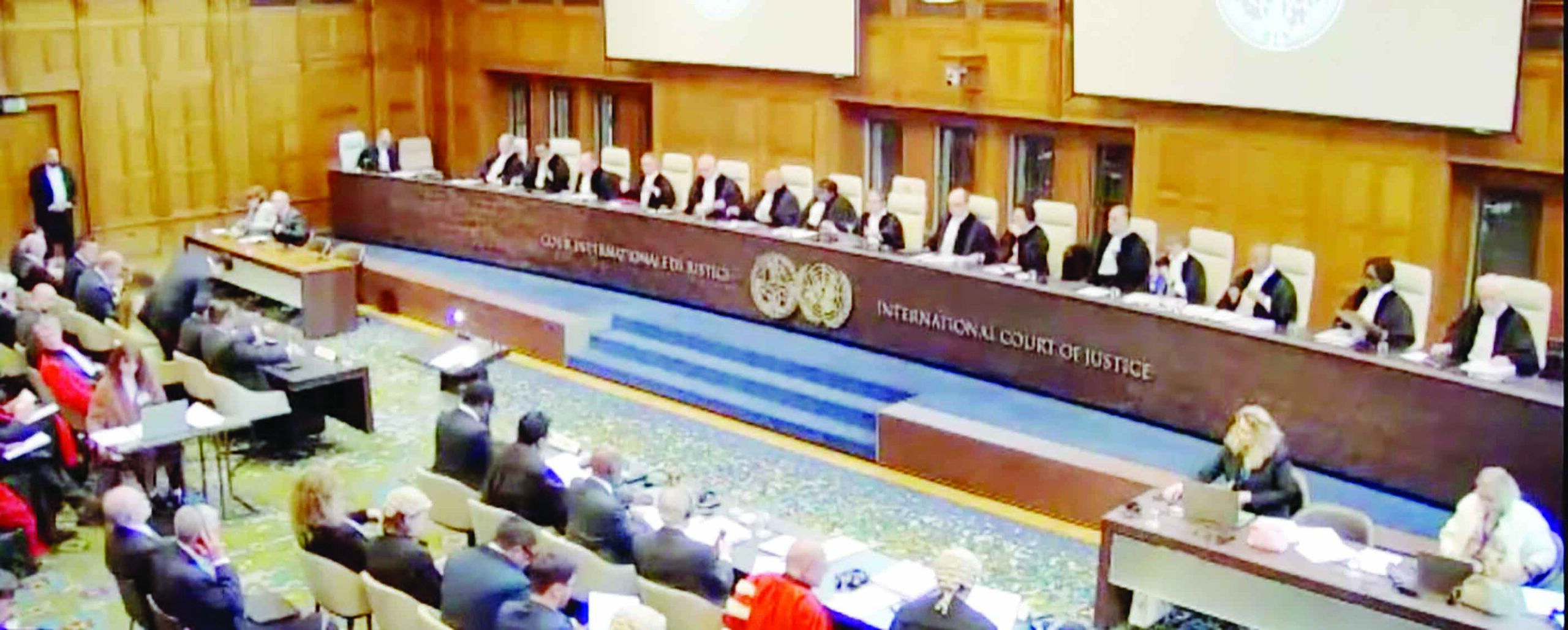
Continuing to claim Guyana’s Essequibo region, Venezuela on Wednesday again emphasised to the International Court of Justice (ICJ) that the court has no authority to decide on the 1899 Arbitral Award that established the boundary between the two countries, as it was formed through ‘gunboat diplomacy’ and is a fraudulent colonial imposition concocted by the United States and Britain.
Venezuela maintained that Essequibo was owned by the Spaniards and that it took to relooking at the agreement shortly before Guyana became independent because it felt the time was right and asked the court to recognize the 1966 Geneva Agreement as the true framework for resolving the controversy.
“Venezuela has never consented to submit this dispute to the jurisdiction of any court or arbitral tribunal. This has been unequivocally reaffirmed domestically. In the consultative referendum held on 3 December 2023, the Venezuelan people clearly expressed their rejection of submitting this dispute to the Court’s jurisdiction. This confirms it. It reflects a consistent course of action in terms of sovereign will,” Agent of Venezuela Samuel Moncada said on Wednesday morning in Caracas’ opening oral arguments.
Moncada, who is also the Permanent Representative of Venezuela to the United Nations, told the highest UN judicial body that his country repeats that it “does not accept the jurisdiction of the International Court of Justice, which was erroneously imposed in the 2020 judgement, and respectfully rejects its jurisdiction to hear and decide this dispute.”
He argued that the decolonisation process that took place after World War II created an appropriate international framework in which both independent republics that had been stripped of their territories by empires and colonised nations could initiate claims for compensation or restitution for damages suffered at the hands of the great powers.
“The United Nations and its Decolonisation Committee provided a platform through which many countries could negotiate with the colonial powers within the framework of international law and without the threat of force, with the aim of restoring their historical territorial rights,” he said.
“…In 1962, our Foreign Minister, Marcos Falcón Briceño, raised Venezuela’s claim to the Essequibo region of Guyana for the first time, specifically before the United Nations Decolonisation Committee. This led to negotiations resulting in the 1966 Geneva Agreement, which remained in effect between Venezuela and Guyana until energy interests prompted a change in the Guyanese Government’s position in 2015. The Geneva Agreement is therefore a quintessential instrument of decolonisation. As Guyana gained independence, Venezuela began to lay the groundwork for the return of its territory that had been colonised by the British Empire.”
Exhaustive proceedings & accepted by Venezuela
When Guyana made an oral presentation on Monday, its representatives underscored that the 1899 Arbitral Award, which established the boundary between then-British Guiana and Venezuela, was the product of exhaustive proceedings and accepted by Venezuela for decades.
“For six decades, Venezuela fully respected and complied with that Award and that Agreement. Throughout that period, it never protested or challenged the award,” Foreign Affairs Minister Hugh Todd had pointed out.
“It is Guyana’s submission that the 1899 Award is, without question, legally valid and binding on the parties,” he also stated.
Guyana’s agent and former Foreign Affairs Minister Carl Greenidge had on Monday taken the judges through a concise history of the territory as he made reference to maps posted and other historical documents.
Guyana’s position is that the Dutch were the first Europeans to establish themselves in what is now Guyana, founding the colony of Essequibo in the early 1600s, before the British later inherited and administered the colony.
Greenidge detailed there was no Spanish or Venezuelan administration in the territory now claimed by Venezuela.
Greenidge reminded the Court that Guyana’s post-Columbian history began with the arrival of the Dutch in 1598. By 1616, the Dutch had established the colony of Essequibo, built Fort Kykoveral along the Mazaruni River, and begun administering lands stretching westward toward the Orinoco. In 1621, the Dutch West India Company assumed control of the colony, and by 1744, the administrative seat had shifted to Fort Zeelandia. These developments, Greenidge argued, demonstrate that Essequibo was firmly under Dutch control long before Venezuela emerged as a state.
He also argued that Venezuela itself pushed for arbitration in the 19th century after failed negotiations with Britain, eventually leading to the 1897 Treaty of Washington and the 1899 Award.
He said Venezuela, in its exasperation with the British, sought support from the United States and asked it to use its influence to push Britain toward arbitration over all the land lying between Essequibo and the Orinoco rivers. He added that, according to the historical record before the Court, it was Venezuela that insisted on arbitration and brought the United States into the process to help secure Britain’s agreement after failing to obtain it on its own.
Greenidge further noted that, with US support, Venezuela achieved the arbitration arrangement through the 1897 Treaty of Washington and at the time “celebrated” it as a major diplomatic success, expressing strong appreciation for the United States’ role. He said Venezuela maintained this position for decades without challenging or questioning the treaty but now argues the opposite before the Court, claiming it was unlawful and invalid.
Attacked legitimacy of 1899 Arbitral Award
Throughout Venezuela’s arguments on Wednesday, its representatives attacked the legitimacy of the 1899 Arbitral Award, portraying it as a colonial instrument dressed up as law.
Professor Makane Mbengue told the Court that the arbitral process in Paris was nothing more than “the weaponisation of the nascent machinery of international arbitration”. He argued that the award was “the poisoned fruit of a poisoned tree”, imposed under imperial coercion.
“Whether dispossession is achieved by direct Governmental decree, as in Chagos, or through a tribunal corrupted by imperial influence, the result is the same – territory is wrested from a state through the exercise of colonial power, dressed in legal clothing to lend it an air of legitimacy it does not deserve,” Mbengue said.
Turning to the Geneva Agreement, Venezuela’s counsel emphasised that the 1966 treaty was designed to move beyond the arbitral award and establish a process of negotiation between sovereign equals.
“The Geneva Agreement was the two States’ answer to this history. Where the 1899 Award imposed a boundary dictated by imperial compromise, the Agreement substituted a framework built; that, Mr President, is the real issue in this case,” he said.
He claimed that that “colonial injustice” prevailed to form the 1899 Arbitral Award, and insisting that the Geneva Agreement requires negotiation, not litigation, to resolve the controversy, Professor Andreas Zimmermann underscored that Guyana had failed to engage with the substance of the agreement.
Caracas’ counsel repeatedly claimed that Guyana’s reliance on the arbitral award ignores the treaty’s broader mandate for a mutually acceptable settlement.
Zimmermann pointed to the drafting history, noting that both Venezuela and the United Kingdom had considered options such as joint administration of the disputed territory. He stressed that the agreement’s title – “to resolve the controversy over the frontier” – was deliberately broader than a mere dispute over the arbitral award.
Professor Antonio Remiro Brotóns closed Venezuela’s morning session by situating the Geneva Agreement in its historical context. He reminded the Court that the treaty was signed just months before Guyana’s independence, with the aim of preserving good neighbourly relations and avoiding a winner-takes-all outcome.
Professor Azaria pointed to Venezuela’s fear as the reason it challenged the award decades later, saying there “is not only overwhelming evidence of Venezuela’s fear as to Great Britain’s attitude towards her during this period” alongside only then getting “overwhelming evidence that Venezuela’s fear was well founded and that she only was able to obtain evidence that the award was invalid in the second half of the twentieth century.”
“It is these overall factual circumstances of the case brought by Guyana, Mr President, that simply do not allow the interpretation that Venezuela ever renounced its right to invoke the invalidity of the 1899 Award. Venezuela was in a position to challenge the award when she obtained evidence of its invalidity. That time coincided with the period of decolonisation, which enabled Venezuela to challenge the award through peaceful means and negotiations,” she said.
Professor of Public International Law Christian Tams Mallet-Prevost’s memorandum, a document Venezuela has relied on to suggest wrongdoing in the 1899 arbitration.
He said that while Guyana says “this is all a fantasy of a biased old man, written up decades later and ‘uncorroborated . . . in any other documents’”, it is “plainly incorrect”.
“As for Mallet-Prevost’s position, the memorandum confirms points he made in a private letter written in late October 1899, around three weeks after the award was rendered. In that letter, identified by Venezuelan researchers after the publication of the memorandum, Mallet-Prevost made the same core point; he said, ‘The decision was forced upon our arbitrators,’” Professor Tams posited.
Discredited document
International Law Professor Philippe Sands, for Guyana, had discredited the document’s reliability, saying the original has never been produced, its contents were published only after Mallet-Prevost’s death, and its allegations were uncorroborated. Guyana’s case is that the memorandum is not evidence capable of undoing a binding award.
He described Venezuela’s central evidence memorandum as “a giant red herring”, riddled with inaccuracies, and “it is long on fantasy and short on facts. This is the stuff of a novel. It is not the stuff of a pleading before this Court.”
Professor Sands noted that the memorandum, allegedly written decades after the arbitration, contains demonstrably false claims, including a supposed dinner conversation with Lord Russell before he was even appointed to the tribunal.
“Not a shred, nothing at all. Mr Mallet-Prevost’s claim of a secret Anglo-Russian deal is a concocted fantasy,” Sands argued.
“In the years since 1962 Venezuela has used it repeatedly to generate heat and smoke, but no light and no illumination… While the allegation of a secret Anglo-Russian deal is outlandish, it is also instructive, for it starkly demonstrates the unreliability of the claims made in the memorandum, which by way of speculation and nothing by way of substance. It’s long on fantasy and short on facts; it lay dormant for 13 years after its publication,” he said.
Discover more from Guyana Times
Subscribe to get the latest posts sent to your email.