

…bringing safe drinking water to 9000 students
Following collaborative efforts by Recover Guyana, the Greater Guyana Initiative (GGI), the Education Ministry and ExxonMobil Guyana, Project FLOW has advanced with the commissioning of 15 school water systems in Region Three. The National Water Purification and Sustainability Initiative, implemented through this partnership, successfully commissioned and handed over 15 water purification systems across secondary schools in Region Three (Essequibo Islands-West Demerara).
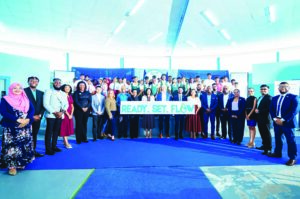
Over 9000 beneficiaries, including students and teachers, will now have access to safe and reliable purified drinking water across schools in the region.
FLOW, the signature project of the Greater Guyana Initiative, represents a major national investment in education and environmental sustainability. It is focused on expanding access to clean drinking water, promoting reusable bottle use, and reducing environmental impact across school communities. Launched as a four-year national programme, the initiative aims to improve access to purified drinking water for more than 58,000 students across 141 public secondary schools, 10 Technical and Vocational Education and Training (TVET) institutions, and four special needs schools by 2030, contributing directly to global sustainability priorities.
All systems were formally handed over to participating schools between May 6 and May 8, 2026, with headteachers and students expressing appreciation for the intervention and noting improvements in student wellbeing, hygiene standards, cost savings, and the overall learning environment.
Within Region Three, 14 secondary schools and one TVET institution have already begun benefiting from the initiative.
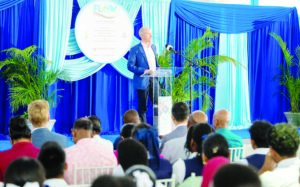
Speaking at the commissioning ceremony, the Chief Executive Officer (CEO) of Recover Guyana, Dr Dave Lalltoo, highlighted the environmental impact of the initiative.
He highlighted that the environmental impact of FLOW within Region Three alone is both measurable and transformational. According to him, based on consumption estimates, the initiative is projected to eliminate approximately 1,903,800 plastic water bottles annually across the region.
He stated that over a three-year period, this represents an estimated 5,711,400 plastic bottles prevented from entering the environment.
This projection is based on the combined direct beneficiary population, each consuming the equivalent of one bottle of water per school day across an average of 200 school days annually. Imagine we’ve created this for 365 days.
“That’s millions of plastic bottles diverted from drains, trenches, landfills, waterways, communities, schools, and ultimately, our oceans. That is a major reduction in environmental pollution, plastic waste accumulation, and long-term ecological harm.”
Meanwhile, he added that the initiative will enhance the well-being of children, ultimately improving their outlook toward STEM education.
10-year, US$100m ExxonMobil Guyana
President of ExxonMobil Guyana, Alistair Routledge, explained that the project is supported through the Greater Guyana Initiative, a 10-year, US$100 million commitment by ExxonMobil Guyana, Hess, and CNOOC to invest in Guyana’s development. Through this initiative, the partners aim to support projects that improve lives, strengthen communities, and create long-term value.
He further emphasised the importance of partnerships and the benefits that can be achieved through commitment to the Greater Guyana Initiative.
“The Greater Guyana Initiative, as has already been mentioned, is a 10-year, $20 billion Guyanese dollar commitment by the Starbroek Block co-venturers, Hess, CNOOC, and ExxonMobil Guyana. What it underscores is the importance of partnership, sustainability, and how these principles are underpinning the transformation of Guyana. Access to clean drinking water may seem like a simple thing, but as we’ve heard from some of the examples, it makes a huge difference. It helps students stay healthy, keeps them focused in the classroom, and supports their ability to perform at their very best in school and beyond.”
Fantastic and impactful project
Meanwhile, Education Minister Sonia Parag lauded the project, pointing out, “We believe in development through partnership, whether in education, agriculture, or healthcare. To witness the FLOW system first-hand and see how students are benefiting from it was truly amazing. This partnership is not only about development and shared benefits, but also about innovation and sustainability, all of which improve the quality of education. It aligns directly with the Government of Guyana’s vision to strengthen education and infrastructure while creating cleaner, safer environments and communities.”
The Education Minister further expressed strong support for the initiative, describing it as a fantastic and impactful project that the Ministry could not refuse to support.
“I believe this is such a fantastic and amazing initiative. When I looked at it and had that discussion, it was something I could not say no to, even if it was the first time it was happening. Students, I want you to know that the partnerships we are establishing are for your benefit.”
She added, “I am fully on board on behalf of the Government and His Excellency. This is Region Three, and it is the President’s region as well. Although all regions are his regions, he has a special connection to Region Three. You can look forward to more schools being facilitated and more students benefiting from this project.”
Beyond improved access to clean water, the initiative is expected to deliver significant socio-economic and environmental value at both school and community levels, including projected savings of $87 million within the region over a three-year period.
Additionally, Project FLOW advances a strong environmental sustainability agenda through integrated smart monitoring systems installed at each site. These systems track the number of plastic bottles saved daily, with data automatically uploaded to Recover Guyana’s digital platform, ensuring real-time accountability and measurement of environmental impact across schools.
Through this mechanism, the initiative is projected to reduce the use of approximately 25 million plastic bottles by the end of the project, significantly reducing plastic pollution while promoting environmental stewardship and responsible consumption among students and communities.
The initiative continues to deliver strong outcomes in STEM education and capacity building, which remains a central pillar of FLOW. As part of the project, structured capacity-building sessions are conducted with environmental clubs from each participating school, providing students with hands-on environmental and STEM learning opportunities.
To date, more than 500 students have participated in sessions focused on reverse osmosis filtration, UV water disinfection, and automated sensor-based monitoring systems integrated within the FLOW units. Nationally, more than 1500 students and educators are expected to benefit under the STEM education component, supporting the Government of Guyana’s agenda to strengthen science, technology, and innovation.
Discover more from Guyana Times
Subscribe to get the latest posts sent to your email.