

The Foreign Affairs and International Cooperation Ministry has expressed its full confidence as the International Court of Justice (ICJ) is set to hear oral arguments in the Guyana-Venezuela Border Controversy Case next week. The week-long hearings, which are devoted to the merits of the case, will run from Monday, May 4, to Monday, May 11, 2026, at the Peace Palace in The Hague, Netherlands – the seat of the World Court. When the hearing commences on Monday, Guyana’s legal team will deliver the first round of oral arguments from 10:00h to 13:00h and continue from 15:00h until 18:00h. Venezuela will then present its first round of oral arguments on Wednesday, May 6, during the same timeframe. Guyana will again lead the second round of oral arguments on Friday, May 8, beginning at 15:00h until 18:00h. Similarly, Venezuela will present its second round of oral arguments on May 11, within the same three-hour period.
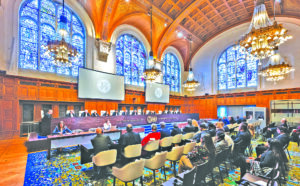
The hearings will be streamed live and on demand (VOD), in English and French, on the Court’s website, in the section of the Journal of the United Nations (UN) dedicated to the ICJ and on UN Web TV.
“Guyana approaches these hearings with full confidence in the strength of its case, which is supported by the historical record and the applicable legal principles relating to the binding nature of arbitral awards, the sanctity of treaties, respect for the rule of law and the stability of boundaries,” the Foreign Ministry said in a statement on Friday. On March 29, 2018, Guyana filed an application instituting proceedings against Venezuela concerning the legal validity and binding effect of the 1899 Arbitral Award regarding the boundary between the then Colony of British Guiana and the United States of Venezuela.
Guyana brought the case to the ICJ to confirm the validity of the internationally recognised boundary, which was determined by the Award and by a 1905 boundary agreement with Venezuela that adhered strictly to the unanimous decision rendered by the Arbitral Tribunal. The ICJ has already affirmed its jurisdiction to hear this case twice, in judgements issued on December 18, 2020, and April 6, 2023.
The Court has also had to issue two orders, both indicating provisional measures, which Guyana had requested, to prevent Venezuela from interfering with Guyana’s lawful control and administration of the territory that is the subject of the controversy while the judicial proceedings are still pending. The written phase of the case concluded last year after Guyana filed two written pleadings on the merits of the case and Venezuela also filed two, the last being in August 2025. Over the next week, both sides will present oral arguments on the merits of their respective cases before the ICJ’s deliberations and issuance of its final judgement, which will be binding on both countries under international law.
Guyana has declared its steadfast commitment to the peaceful resolution of this border controversy with Venezuela in accordance with international law through the World Court. Earlier this year, Foreign Affairs and International Cooperation Minister Hugh Todd said that Guyana is confident in the case presented to the World Court and is expecting a favourable ruling likely sometime this year.
“You’ve seen the performance of the legal team over the last several years. And I think you are confident also in the team, as we are confident. I think we have a very strong team, and we are very focused. But of course, we have to remain cautious. But we are very confident that we will have a ruling in our favour,” Todd told reporters on January 22. Venezuela is claiming more than two-thirds of Guyana’s landmass – the entire Essequibo region – and a portion of Guyana’s Exclusive Economic Zone (EEZ), where over 11 billion barrels of oil equivalent (boe) have been found and production as well as other exploration activities are currently being undertaken offshore Guyana.
In furtherance of its spurious claims, the Spanish-speaking nation has been heightening its aggression over the years towards Guyana despite the case pending before the ICJ, which had even had to issue two sets of provisional measures to restrain Venezuela and ease rising tensions between the two South American neighbours. But while some experts believed that the January 3, 2026, capture and toppling of the Nicolás Maduro regime in Caracas by the United States (US) would see that aggression wane, there have been renewed provocations by acting Venezuelan President, Delcy Rodríguez.
Only earlier this week, President Dr Irfaan Ali was forced to write to CARICOM Chairman and Prime Minister (PM) of St Kitts and Nevis Dr Terrence Drew, formally objecting to Rodríguez’s public display of a map that falsely portrays Guyana’s Essequibo region as part of Venezuela during official engagements within CARICOM member states. Rodríguez, during a recent official visit to Barbados, wore a brooch with a map of Venezuela that includes Guyana’s Essequibo region. Rodríguez wore a similar brooch during her earlier state visit to Grenada. In the Tuesday, April 28, letter, the Guyanese leader noted that “CARICOM’s principled support for Guyana must be reflected not only in declarations but also in the context and conduct of official engagements.”
Discover more from Guyana Times
Subscribe to get the latest posts sent to your email.