– says investors yet to fully tap into economic potential
Guyana’s rapid transformation demands a reset in the bilateral economic relationship with Canada, especially with the diaspora, according to President Dr Irfaan Ali, who made an appeal for renewed investments and policy engagement with interested investors and the private sector.
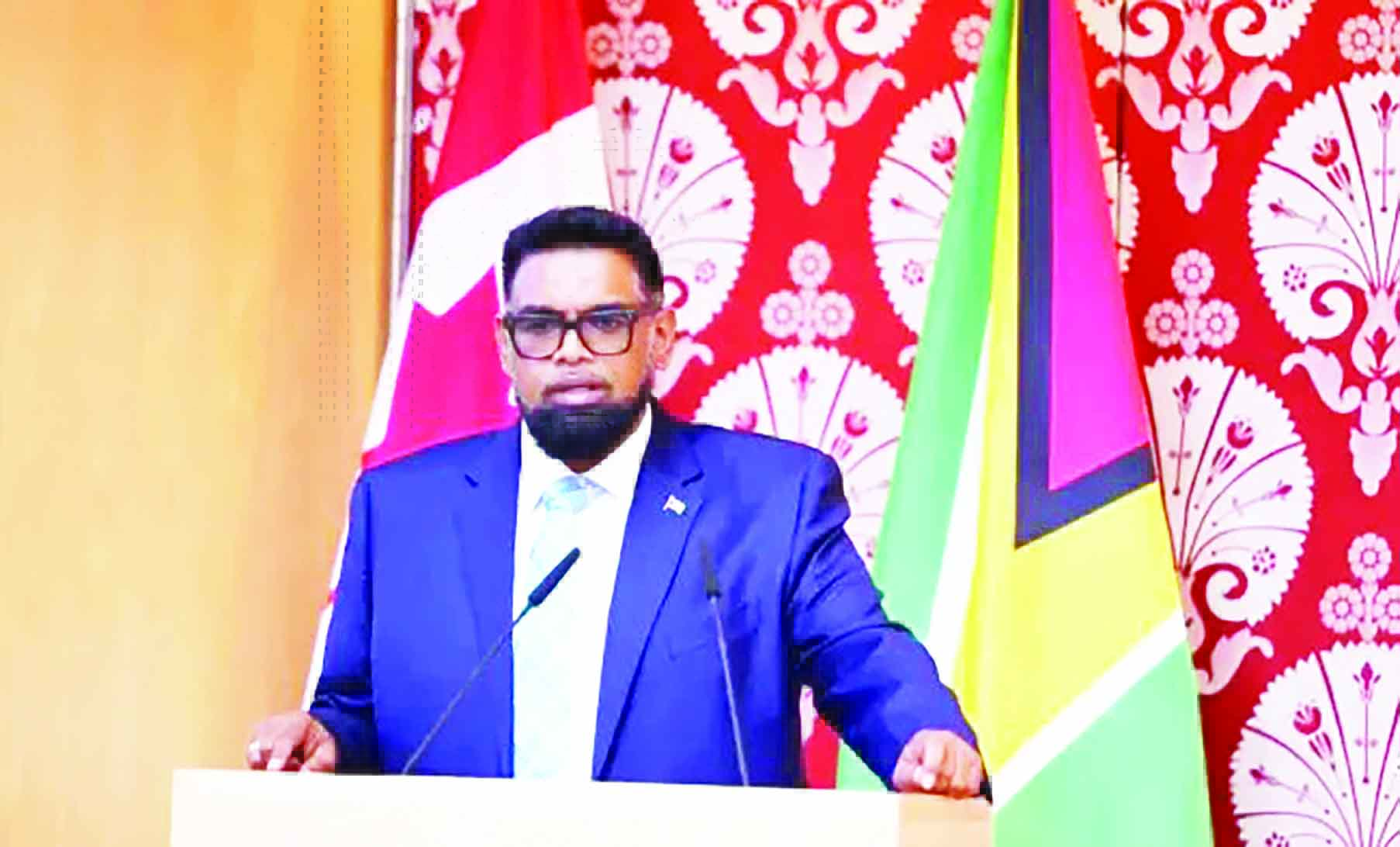
“Canada was our largest trading partner. I want to repeat that… and this forum allows us to reflect on that a bit and to see whether we have done enough to respond to the changing opportunities, respond to the changing economic conditions, or respond to the new economy of Canada, and those questions are for us to honestly answer if we are to reset and reposition the opportunities for the Canadian private sector in Guyana,” Ali told a Canadian Business Forum on Friday in Ontario.
He noted that, with all the opportunities in Guyana, alongside Canada sharing 60 years of bilateral partnership, Canadian firms have not maximised the investment prospects.
“Those opportunities are not only in mining. But for this to occur, there must be a reset at the policy level, and our Canadian High Commissioner in Guyana is working towards this reset because the economy is changing and the economy is diversifying, but when you look at the power of Canada in hydroelectricity, grid transformation, the development of smart grids and the development of transmission, you have enormous experience. You have tremendous liquidity waiting to be deployed,” he said.
Missed opportunities in energy infrastructure and pharmaceutical manufacturing, where Canadian firms have global expertise but remain absent from Guyana’s investment landscape, were also pointed out. “Take, for example, the second power plant. We have two American firms and two firms from across the world… yet you can’t find one Canadian firm,” Ali said. Guyana’s evolution from a little-known nation to a rising global player was reflected upon as Ali noted that this country has consistently “punched above its weight” through innovation and leadership.
Investment prospects
He contrasted Canada’s cautious approach with the more aggressive moves by other partners, including UK Export Finance (UKEF), the Export-Import Bank of the United States (US Exim Bank), and African Export-Import Bank (Afreximbank), all of which have significantly expanded allocations to Guyana.
Ali outlined a wide spectrum of opportunities for Canadian investors where, in the areas of energy and smart grids, Canada’s expertise in hydroelectricity and grid transformation could be pivotal, while in healthcare and education, partnerships can be forged as Guyana aims to build “the most modern healthcare and education systems in the world”, with export-orientated services.
Agriculture and agro-processing, which sees zero corporate tax and access to a $4 billion CARICOM market, offers unmatched incentives, the President reasoned while he pressed for tourism investments, especially eco-based. That is because the latter remains a priority, with fiscal incentives designed to attract large-scale investment.
“We have massive opportunities in tourism, world-class opportunities that can build out at scale and that can target your market with the best fiscal incentives in the world. I don’t think there’s anyone who can beat our fiscal incentives on health, education, agriculture, well, the whole food ecosystem, or tourism. These are low-hanging opportunities,” he said.
Urging Canada to join the Global Biodiversity Alliance, Ali warned that its absence undermines Canada’s climate leadership.
“Some of the most advanced economies and the best institutions in the world are joining that alliance. Canada has not joined as yet, but I believe that it is important for Canada to be part of the Global Biodiversity Alliance because, if Canada projects itself as a leader on environment, climate, and biodiversity, how can it not be part of the Global Biodiversity Alliance?”
“We have to be able to make the case because the Global Biodiversity Alliance unlocks opportunity for a sophisticated climate economy like Canada,” he added.
Manufacturing
On the manufacturing front, the Guyanese Head of State related that medium-sized Canadian enterprises could thrive with Guyana’s falling energy costs and expanding industrial base. But he stressed that Canadian private sector engagement hinges on Government policy. “The private sector follows the Government’s lead,” he said, noting that Canadian firms quickly align with Ottawa’s trade deals with China or Indonesia.
“If at the Government level we don’t create the lead… then it becomes difficult for the private sector to understand where those opportunities are.” The President also urged that forums like the Guyana-Canada Business Forum must go beyond speeches.
“I don’t want these forums to be captured as just a symposium or an information-sharing platform,” he said. “I believe that these forums must be structured to direct results.” During a wide-ranging question-and-answer session with the business leaders, investors, and diaspora members present, discussions ranged from rapid economic rise, its embrace of artificial intelligence (AI), and the Ali Administration’s push to ensure that development benefits ordinary citizens, a People’s Progressive Party/Civic (PPP/C) framework designed to build real capacity rather than superficial partnerships.
“We don’t want ownership or rental. We want actual involvement,” the President declared, underscoring the importance of local equity in energy and infrastructure ventures. He pointed to Trinidadian firms that once dominated Guyana’s oil services sector but have since partnered with or sold to Guyanese interests, proving that “the ownership structure is geared towards giving realism to the policy itself”.
No gender bias
Women in business were underscored with the President reminding that his Government does not tolerate gender biases in any area. He noted that opportunities are available for all and that in agro-processing here, some 35 per cent is set as the minimum for women-owned businesses.
“I want to say that I don’t discriminate between male and female. I believe that we do women a tremendous injustice when we try to believe that we have to carve out special spaces for them. You have to do it by incentive, but when you do that, we are not celebrating the power of women and what they have done in this world. And the power of women does not rely on handouts. I’ve seen women build businesses. I’ve seen women invest. I’ve seen women deploy their skills. Women do not need handouts. Women are the greatest builders,” he said.
Ali continued, “Today, we have the most women-owned contracting companies in all of the region. Today, we have more lending from the commercial bank to women-owned businesses than any time in the history of our country because women are leading; women are developing.” Today, 70 per cent or more of all the graduates from our universities are women. Women are not looking for handouts.”
Healthcare
Healthcare of the populace took prominence at the forum as concerns were raised about rising lifestyle diseases amid Guyana’s development boom, but in response, the President acknowledged the challenge, noting that “one of the most important pieces of information to fix this problem is data.” He revealed that Guyana, with Mount Sinai’s support, has completed health analyses of all nursery and primary school children to anticipate long-term trends.
The Government, he noted, is also rolling out containerised self-testing labs where citizens can check blood pressure and sugar levels, feeding into a national database for early intervention. The partnership this country has with Mount Sinai has completed health analyses of all nursery and primary school children, the President noted.
“So, we know in 20 years what type of problems we are looking at. We are now completing the secondary school, and the strategy will be built on data,” he explained. “We are integrating AI and digitisation with this whole process,” Ali said. “It’s intervention, education, management… but unfortunately, we still have a generation that needs urgent intervention.”
And with candour and commitment, he told the cardiologist that he sees a place for him helping Guyana, and this week he [Dr Rambihar] would be receiving an appointment as part of the public health initiative “that we have with public health education at the grassroots level”, the Guyanese leader related.
Discover more from Guyana Times
Subscribe to get the latest posts sent to your email.